Look a little closer
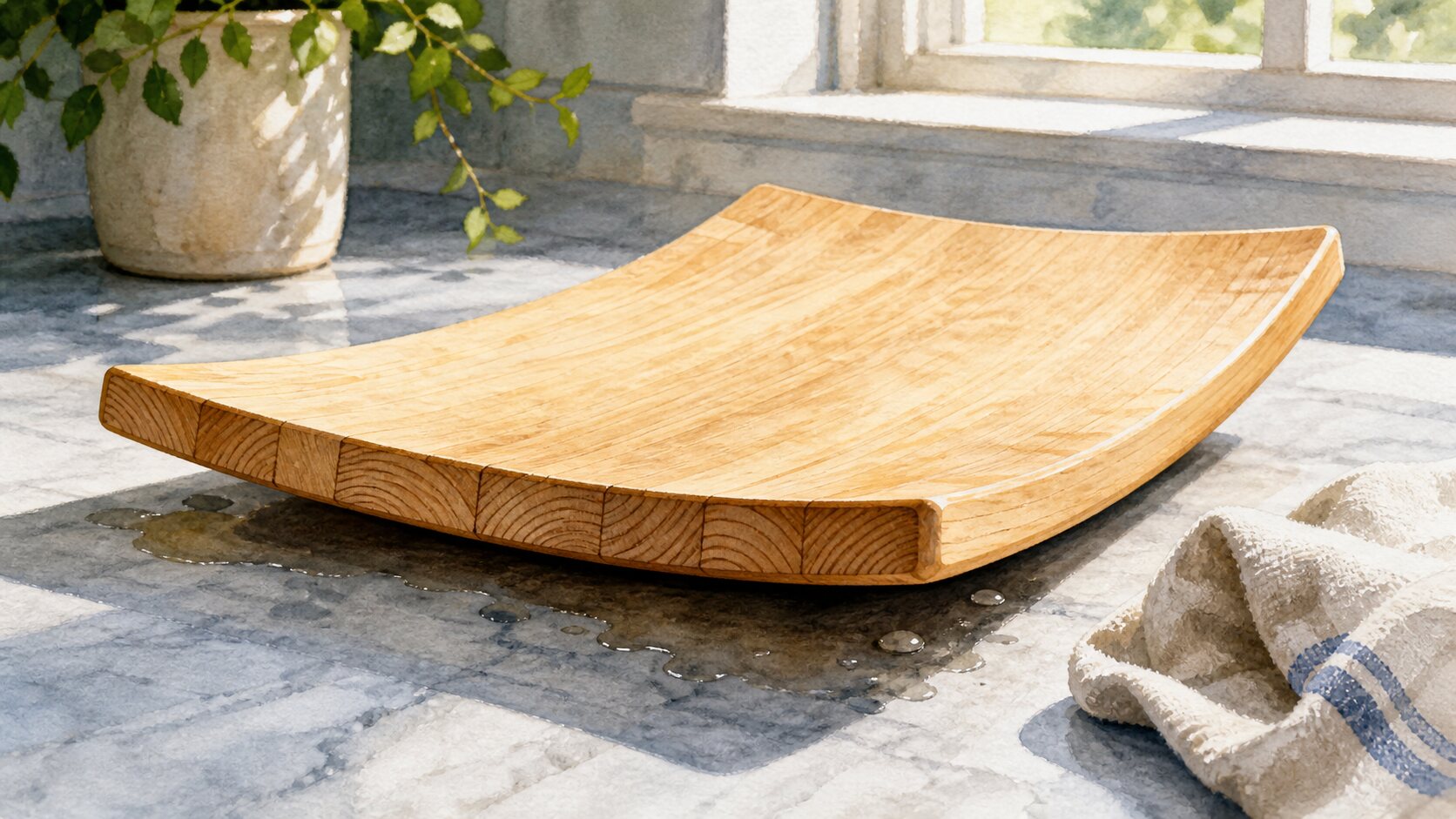
A wooden cutting board warps after washing when its two faces gain or lose moisture at different rates and therefore try to become different sizes. Wood cell walls swell as they take up water and shrink as they release it. If one layer changes dimension more than the other, a flat board cannot satisfy both lengths at once. The longer side moves toward the outside of a curve, lifting the center or edges.
Dry lumber is not isolated from water. Liquid can occupy open spaces inside its cellular structure, while water molecules also bond within cell walls rich in cellulose and hemicellulose. In a previously dried board, this bound water is what drives much of the dimensional swelling. It pushes the wall polymers farther apart; removal lets them draw closer again. A splash on the surface matters less than which face remains wet, how long it stays wet, and how deeply the moisture gradient penetrates.
Wood is anisotropic, meaning it does not move equally in every direction. Change along the trunk and fibers is usually small, while change across the grain is much larger. Tangential movement, around the circumference of the original tree, is generally greater than radial movement across its growth rings. The position and angle at which a board was sawn therefore matter. Curved growth-ring bands tend to change shape as moisture changes, contributing to cup-shaped distortion across a board's width.
Imagine leaving a board flat on a wet counter. Its underside can keep absorbing water while the upper face is exposed to air and begins drying. If the lower layer expands more, it becomes the longer outside surface of the bend and the side edges rise. Wetting mainly the upper face, or drying the underside rapidly over a heat source, can reverse the imbalance and the direction of curvature. There is no rule that every wet board must bend one way; the direction follows the moisture gradient and grain structure.
Timing matters because water does not spread instantly and uniformly from the surface to the center. Soon after wetting, the outer layer and core have different moisture contents. During drying, an exposed surface begins shrinking while a wetter interior resists it. The USDA Forest Products Laboratory describes differential moisture as a cause of raised grain, checking, warping, and cupping. Mild curvature may ease as moisture later equalizes, but repeated wet-dry cycles can compress cells, lock in stress, weaken glue lines, and leave part of the deformation behind.
Construction changes the outcome. A board cut from one wide plank strongly reflects that plank's growth-ring orientation and residual stress. An edge-grain board assembled from narrower strips can distribute movement, but mismatched grain, moisture content, or weak glue lines may still produce twist or separation. An end-grain board presents fiber ends at the cutting surface and behaves differently under a knife, yet it is neither waterproof nor immune to distortion. Extra thickness also slows moisture equalization, so a heavy board can retain a gradient longer.
Oil and other finishes slow water exchange and can reduce abrupt moisture differences, but they do not make wood completely waterproof. A heavy coating on only one face may even make the two faces respond at different rates. Care should follow the maker's directions and cover appropriate edges and end grain evenly. “Food oil” is not a sufficient specification: some oils become rancid or sticky, and the water resistance of the adhesive and finish varies among products. Use a finish identified by the manufacturer for that board and food-contact purpose.
Prevention is less about keeping a cutting board eternally dry than about avoiding a large, persistent difference between its faces. Wash it as its maker directs, do not soak it, wipe away standing water, and let air reach both sides while it dries. Leaving one face pressed against a wet sink or counter keeps feeding that side. Many wooden boards are not designed for the dishwasher's prolonged water exposure and heated drying; unless the board is explicitly labeled dishwasher-safe, hand washing and prompt, ventilated drying reduce the risk of warp and glue damage.
Forcing a severely warped board flat under a heavy load can add stress or damage joints. A small, recent movement sometimes diminishes as moisture equalizes slowly in a stable environment, but cracks, delamination, or persistent rocking make a cutting surface unsafe to control with a knife. Warping does not occur because wood vaguely “hates water.” It occurs because directional cell walls keep responding to water long after the tree is cut. Preserving flatness is therefore a problem of keeping both faces on similar wetting and drying schedules, not overpowering the curve after it forms.
EDITORIAL RESPONSIBILITY
FactosBrain Editorial Desk
The FactosBrain Editorial Desk researched and reviewed this article under our editorial policy. We assess error reports under our corrections policy.