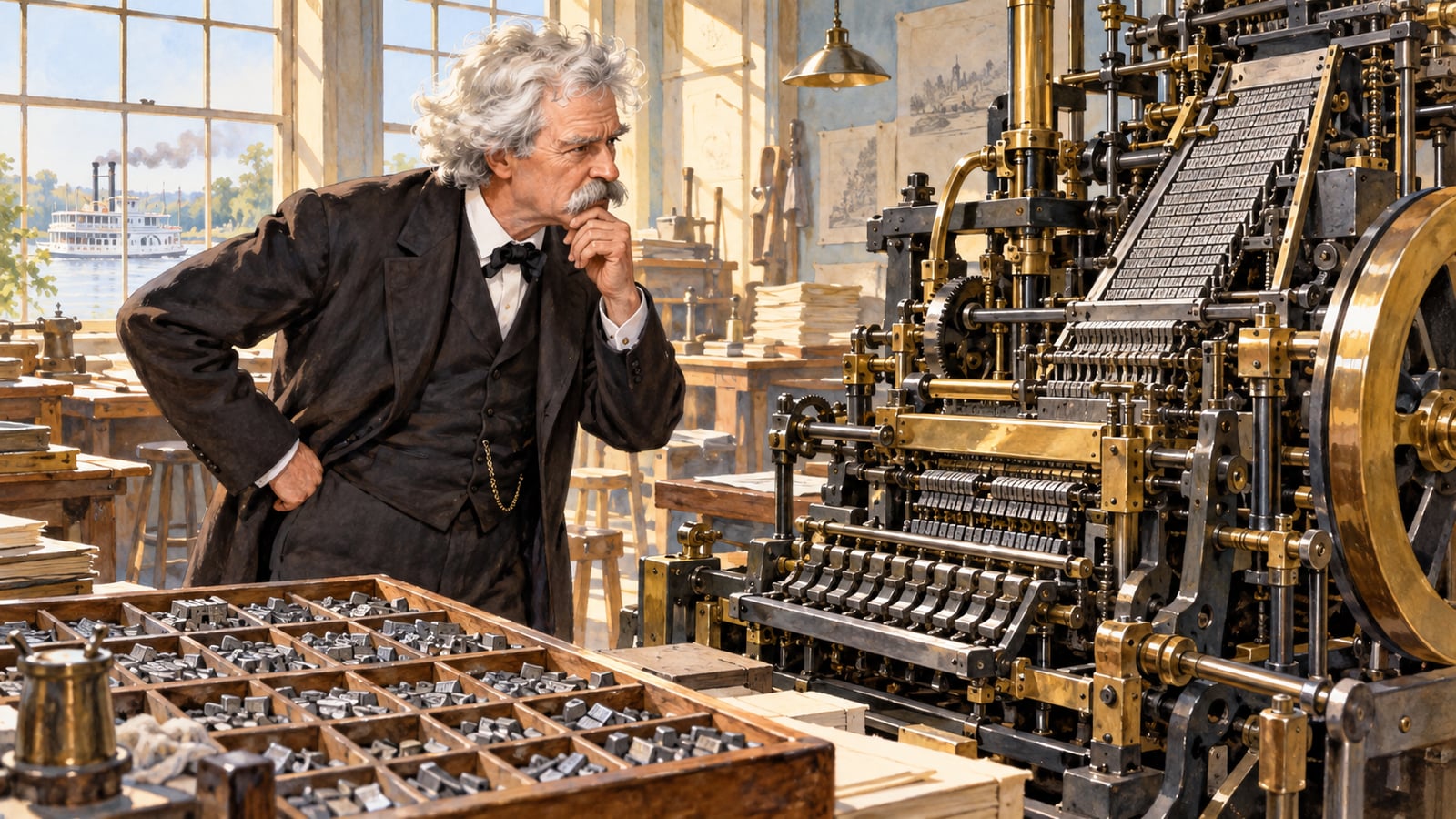
Mark Twain recorded the time: 12:20 p.m., January 5, 1889. He had watched a machine space and justify a line of movable type. Writing to his brother Orion, he treated the demonstration as a historic event. Other celebrated inventions seemed almost like toys beside this one.
The machine was James Paige's compositor. Preparing a page for printing meant assembling individual pieces of metal type, then adjusting the spaces so that the lines came out to the required width. Twain had worked as a printer. Automating this labor was a promise he could appreciate from experience.
Paige's ambitions extended beyond selecting letters. His machine was intended to compose lines, justify them and distribute used type for reuse. Twain committed substantial money to its development. As the work continued, he kept waiting for a finished invention that would justify the expense.
The January demonstration briefly appeared to go wrong. In Twain's account, the machine selected a thinner spacing piece than the observers expected. They suspected an obstruction or a binding part. Dismantling the apparatus was proposed before Paige offered another explanation: a speck of dirt on the type had increased its thickness, and the machine was compensating.
According to the letter, measurement of the completed line confirmed the adjustment. Twain portrayed the machine as knowing better than the people watching it. An apparent failure had become an advertisement for its precision. It is easy to see why that particular test strengthened an investor's hopes.
Twain thought a few more weeks would make it ready to reveal to the world. Instead, further problems emerged, including damage to the type. The machine underwent more work. Development and financing delays continued while the competing Linotype secured a place in printing businesses.
The Paige compositor was not simply an inert contraption. An engineer involved in its construction later described a strong performance during newspaper trials. But demonstrating one elaborate machine and supplying a practical commercial product were different achievements. Only two complete machines were built, and neither progressed beyond testing into widespread manufacture.
Twain's publishing business also ran into serious trouble. The typesetter was a major loss rather than the sole explanation for his financial collapse. In 1895 he embarked on a world lecture tour to help repay his debts. Income would have to come from telling stories to audiences rather than from a machine that assembled them for print.
One compositor survives in the Mark Twain House museum collection. The January letter preserves an earlier moment, when its future still seemed limitless. Twain finished his exuberant account with a smaller, practical request: Orion should send the letter back when he had read it.
EDITORIAL RESPONSIBILITY
FactosBrain Editorial Desk
The FactosBrain Editorial Desk researched and reviewed this article under our editorial policy. We assess error reports under our corrections policy.