Look a little closer
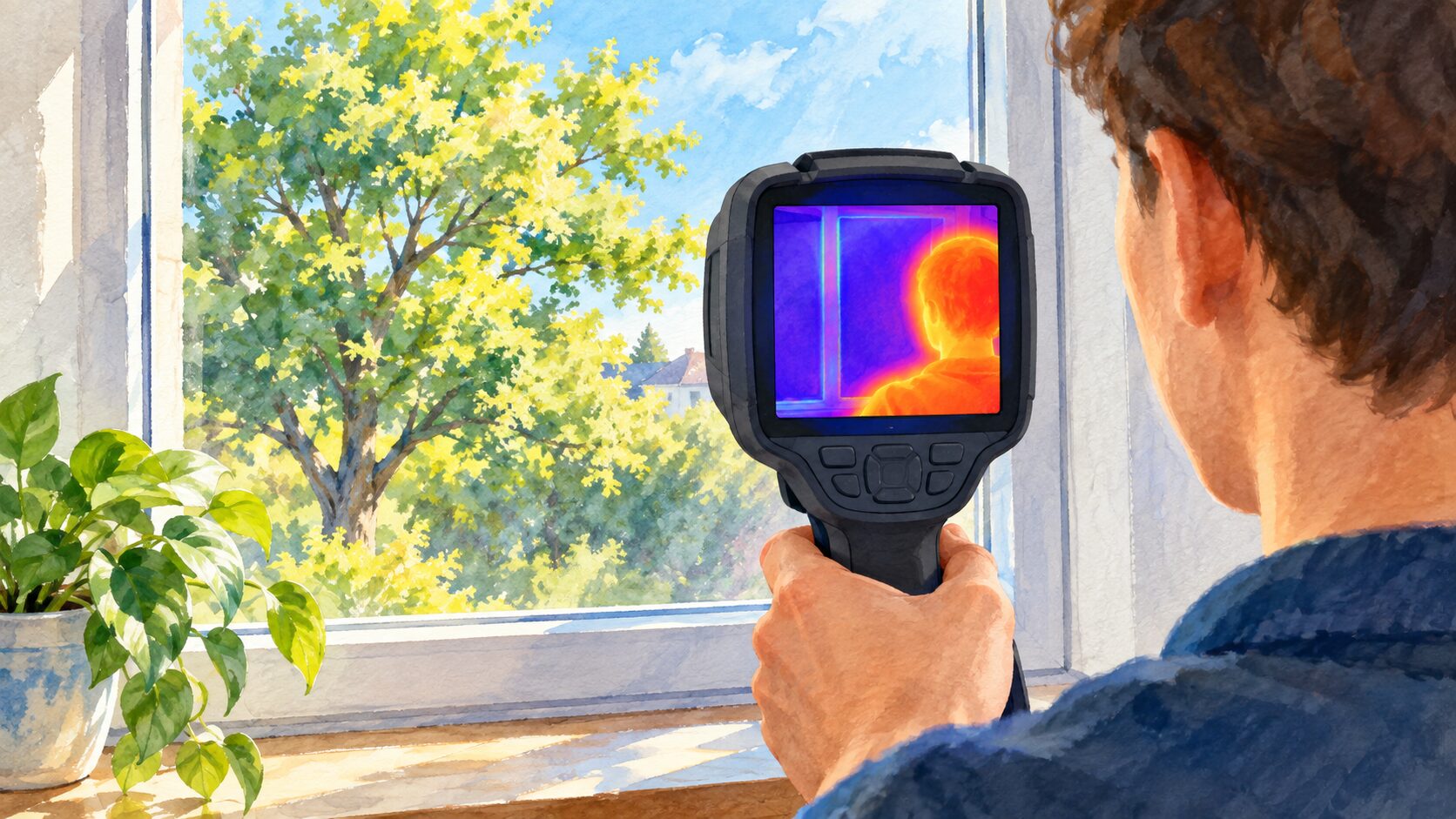
A person may be plainly visible through an ordinary window, yet disappear when the same window is viewed with a common thermal camera. The explanation is that window glass transmits visible light but blocks much of the long-wave infrared radiation that such cameras detect. Instead of directly imaging the person's heat on the far side, the camera records infrared energy from the glass surface and reflections of nearby warm objects. Transparent to your eyes does not mean transparent to every wavelength of light.
An ordinary camera forms a picture from visible light. Sunlight reflects from a tree or a person, passes through the window, and enters the lens. A thermal imager responds to a different part of the electromagnetic spectrum. Objects at everyday temperatures emit infrared radiation that our eyes cannot see. The instrument detects incoming radiation and turns differences in its signal into a visible display. The bright reds and cool blues on that display are a color scheme chosen to represent the measurement, not the real visible colors of the objects.
Whether light passes through a material depends on wavelength. Ordinary glass readily transmits much of the visible range, which is why a building window works as a window for human vision. FLIR's technical guidance says that ordinary glass is not transparent in the roughly 8–14 micrometre band used by many uncooled thermal imagers. Infrared radiation from a person outside does not simply travel through such a pane and arrive at the detector the way visible light does. Looking through the window with a thermal camera is therefore a different physical task from looking through it with your eyes.
The thermal display need not be blank. The glass has its own temperature and emits infrared radiation from its surface. Smooth glass can also reflect infrared radiation from objects on the camera's side of the pane. FLIR notes that someone pointing a thermal imager at a window may see a thermal reflection of themselves instead of the scene beyond it. A bright shape on the screen might be the operator, a nearby heater, or part of the glass surface. Treating every bright patch as an object behind the window would turn an ordinary reflection into a false finding.
Sometimes an object on the far side warms the glass itself. A temperature pattern on the near surface may then carry an indirect trace of what is happening behind it. That is not the same as directly viewing the object's emitted radiation through the pane. Heat must move through the glass, and the pattern is affected by time, glass thickness, surrounding air, and reflections. FLIR's guidance on inspecting solar panels makes a similar distinction: a long-wave camera looking at the glass front largely measures the surface, while heat from cells beneath may influence it only indirectly. The observed pattern needs interpretation rather than a simple see-through claim.
There is an important limit to the headline. Infrared covers more than one wavelength band, and a camera designed for a different band may behave differently. Optris describes ordinary window glass as opaque at wavelengths above about five micrometres, while also showing a short-wavelength instrument that can detect radiation through certain glass arrangements. Engineers also make special infrared-transmitting windows from materials chosen for the instrument's band. Thus the useful everyday statement concerns typical long-wave thermal cameras aimed at ordinary building glass. It is not a claim that no form of infrared light can ever pass through any glass.
The same window can be a clear opening for one detector and an obstructing, reflective surface for another. With thermal images, the practical question is not merely whether a shape is bright, but where the detected radiation came from. It may come from the pane, from a reflection on its near side, or indirectly from heat moving through it. Recognizing those possibilities explains both why common thermal cameras cannot see through a normal window in the familiar sense and why an apparently convincing thermal image can be misleading without attention to the material in front of the lens.
EDITORIAL RESPONSIBILITY
FactosBrain Editorial Desk
The FactosBrain Editorial Desk researched and reviewed this article under our editorial policy. We assess error reports under our corrections policy.