The inventors named on a 1942 American patent made an unlikely pair: Hedy Lamarr, the film star, and George Antheil, the composer. Their subject was neither cinema nor a new musical instrument. They proposed a communication system designed to make radio control harder for an enemy to disrupt, with torpedoes as a possible application.
Lamarr had left Austria and become a major Hollywood actor. During the war, she looked for ways to help the Allies. Antheil brought an interest in musical machinery, including player pianos. Their collaboration drew on concerns and experience that were not obvious from their professional labels.
The communication problem can be understood without studying a circuit diagram. A transmitter and receiver must meet on the same radio frequency, rather as a listener tunes to a station. If an opponent discovers that frequency, interference can disrupt the exchange. Remaining in one place makes a signal easier to follow and attack.
Changing frequencies offers a different possibility, but only if both ends move together. A transmitter hopping on its own would lose its intended listener. The receiver needs to make the same change at the same moment. The problem therefore involves both movement and coordination.
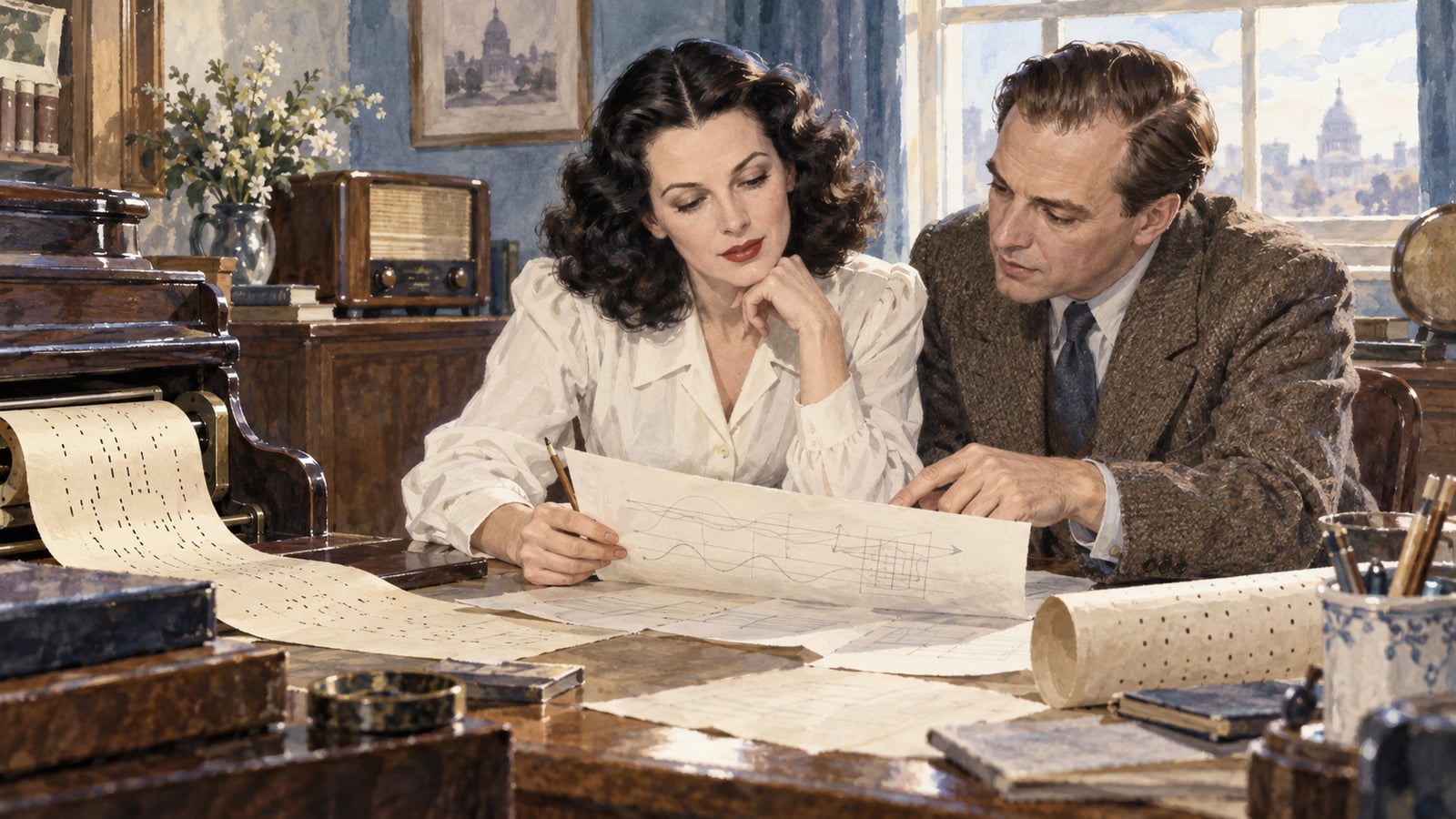
This is where the musical connection becomes useful. A player piano follows a perforated paper roll, carrying out actions in a predetermined sequence. The patent proposed paired records of this kind, one at each end of the communication link. Running them together would coordinate the changes in frequency. The comparison with two machines following the same score captures the central idea without requiring a piano to play inside a weapon.
The application was filed in 1941 and granted the following year. Lamarr's screen name does not appear on it. The document lists Hedy Kiesler Markey, her legal name at the time, alongside Antheil. The familiar Hollywood identity and the inventor in the patent record belonged to the same person.
A patent was not the same as a deployed system. The US Navy did not adopt the design during the Second World War. Lamarr also contributed through war-bond campaigns, while wider recognition of the invention arrived decades later. In 1997, she and Antheil jointly received the Electronic Frontier Foundation's Pioneer Award, long after his death.
Describing Lamarr as the sole inventor of Wi-Fi collapses that history into a different and misleading claim. Her collaboration with Antheil produced a specific proposal for coordinated frequency changes. An actor and a composer had tackled a problem in which two communicating machines needed to keep time together.
EDITORIAL RESPONSIBILITY
FactosBrain Editorial Desk
The FactosBrain Editorial Desk researched and reviewed this article under our editorial policy. We assess error reports under our corrections policy.