Look a little closer
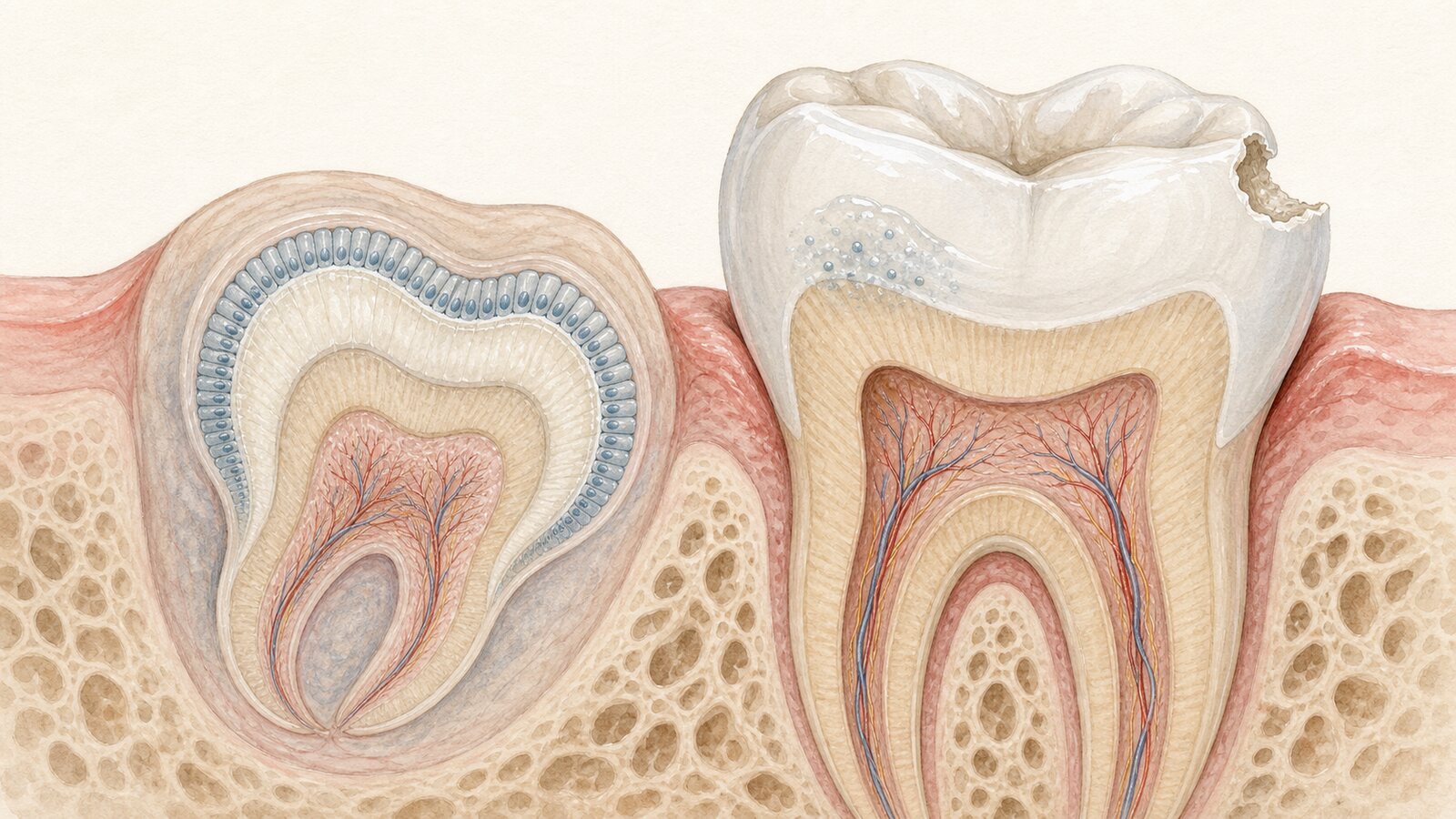
Tooth enamel does not grow back like bone chiefly because mature enamel contains no living cells capable of making more of it. Ameloblasts construct the enamel crown before a tooth erupts, then largely disappear as eruption occurs. Bone, by contrast, remains vascular and populated by cells that remove old matrix and deposit new matrix throughout life. Enamel trades that repair machinery for an exceptionally hard, densely mineralized surface.
Hardness and healing are different properties. Mature enamel is overwhelmingly mineral, organized mainly as tightly packed crystals related to hydroxyapatite. It has no blood vessels, nerves, or resident cells. That architecture makes an effective shield against chewing forces and repeated chemical challenges, but it leaves no cellular workforce or circulation inside the layer. If a piece breaks away, cells and nutrients cannot simply enter the gap and construct a replacement.
The original layer requires a carefully timed developmental process. Ameloblasts first secrete a protein-rich matrix and control how elongated mineral crystals begin and align. During maturation, much of the protein and water is removed while the crystals grow wider and thicker. The process produces both microscopic enamel rods and the precisely curved surface of a crown. Rebuilding it would therefore require far more than delivering calcium to an empty space; it would require recreating an organized tissue across several scales.
Around eruption, the biological factory is dismantled. Many ameloblasts undergo programmed cell death or regress, while the remaining reduced enamel-organ cells are lost or incorporated into tissues along the eruption path. The exposed enamel is consequently rather like a finished product whose makers have left. Bone keeps an active remodeling system: osteoclasts resorb mineralized matrix and osteoblasts lay down new material. Adult enamel has no equivalent resident cell cycle.
Enamel can nevertheless recover from a limited kind of early damage. Acids produced after eating can dissolve calcium and phosphate from the crystal surface, a process called demineralization. If the surface remains intact, minerals in saliva can return to partly dissolved regions, and fluoride can favor a mineral environment more resistant to future acid attack. This is the basis of remineralizing an early, non-cavitated lesion. It strengthens surviving crystal scaffolding rather than growing a new anatomical layer.
Remineralization is not regeneration. One resembles returning mineral to bricks that have begun to dissolve; the other would mean manufacturing missing bricks and rebuilding the wall's exact shape. Once the surface collapses into a cavity, or trauma removes a corner, the continuous scaffold and contour are gone. Saliva and fluoride do not reconstruct rows of enamel rods across that open volume. The word “repair” in discussions of early decay should not be read as evidence that a chipped tooth naturally replaces its missing enamel.
Nor is an entire tooth an inert stone. Beneath enamel, dentin is connected to living cells at the edge of the dental pulp, and the pulp contains nerves and blood vessels. In response to irritation, the dentin-pulp complex can produce limited defensive dentin on its inner side. That response may help protect the pulp, but it does not push outward and recreate the lost enamel surface. Different tissues within the same tooth therefore have very different capacities for defense and renewal.
Scientists are investigating biomimetic materials that guide enamel-like crystal growth and tissue-engineering approaches intended to reproduce ameloblast behavior. The challenge is formidable: a replacement must control nanometer-scale crystal orientation, larger rod patterns, crown shape, and durable bonding to a tooth already functioning in the mouth. Promising coatings or laboratory regeneration experiments are not the same as an established treatment that lets an adult tooth naturally grow a new enamel crown.
Enamel's apparent paradox follows from its design. It is built to remain extremely hard and stable after its specialized builders have gone, whereas bone remains a living construction site supplied by blood. Small mineral losses can be reversed while enough of the original crystal framework survives. Missing shape cannot. Enamel fails to regrow not because it is simply weaker than bone, but because the two tissues retain fundamentally different cells, circulation, and maintenance systems after maturity.
EDITORIAL RESPONSIBILITY
FactosBrain Editorial Desk
The FactosBrain Editorial Desk researched and reviewed this article under our editorial policy. We assess error reports under our corrections policy.