Look a little closer
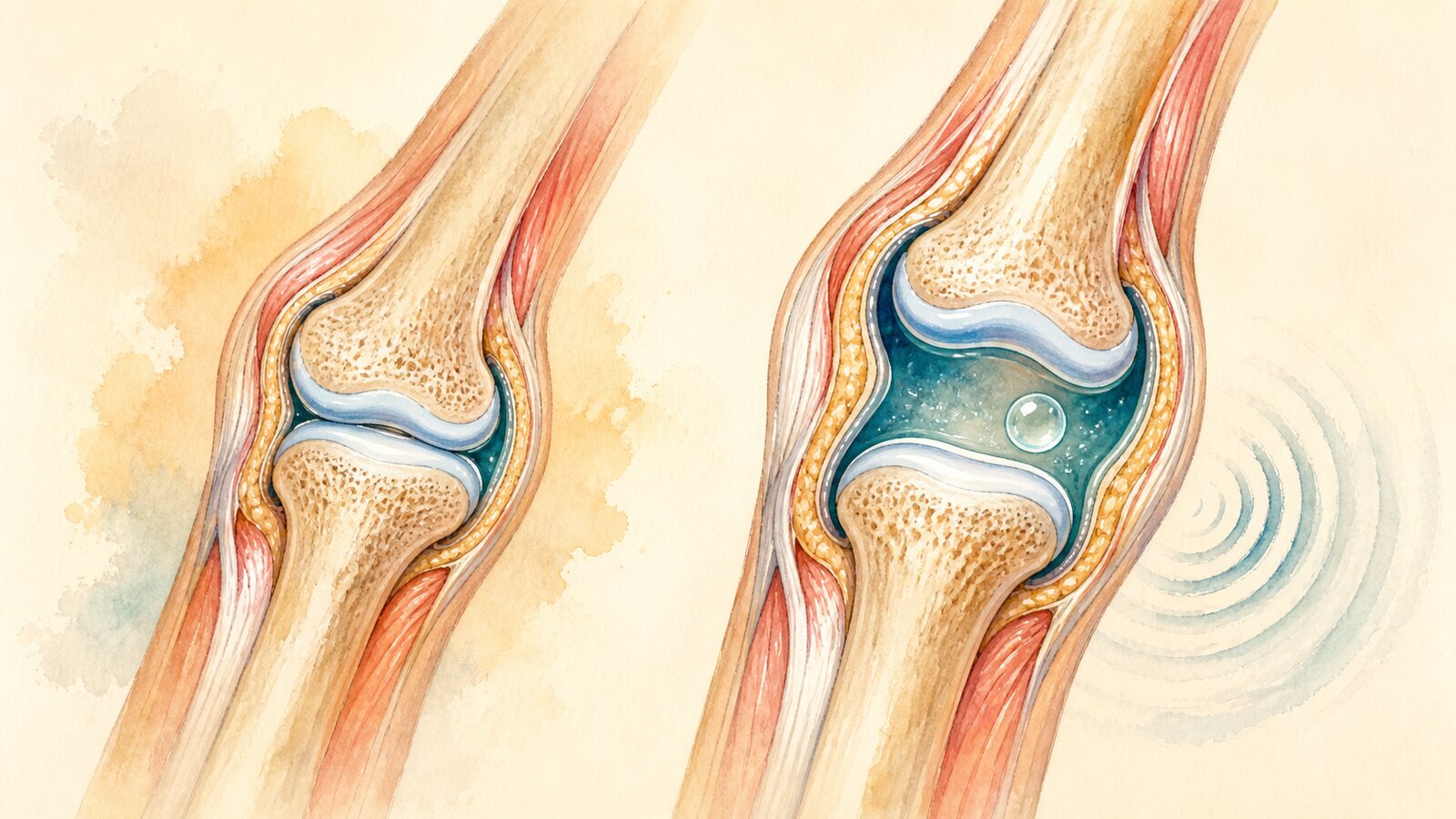
A knuckle cracks when the joint surfaces separate rapidly, pressure falls in the lubricating synovial fluid, and dissolved gas forms or enlarges a cavity. The sound is therefore not normally bone striking bone; it belongs to a sudden cavitation event inside a fluid-filled joint. Researchers still debate exactly how much of the acoustic pulse comes from the cavity's formation and how much may come from its immediate motion afterward.
A knuckle is a synovial joint. Smooth cartilage covers the ends of the bones, a capsule encloses them, and synovial fluid reduces friction between the moving surfaces. That fluid also contains dissolved gases, including nitrogen, oxygen, and carbon dioxide. At rest, the space between the surfaces is narrow, while fluid viscosity and attraction between the surfaces help resist separation. The joint thus provides both a sealed volume and a gas-bearing liquid in which a rapid pressure change can occur.
Pulling or bending the finger far enough increases the joint volume. If the surfaces separate faster than fluid can completely fill the widening space, pressure in the fluid drops. Dissolved gas then gathers into a comparatively large cavity. The combination of surface adhesion, applied force, and abrupt separation is often called tribonucleation: two surfaces immersed in liquid resist being pulled apart and then part suddenly. That fast transition launches a pressure wave that reaches the ear as a brief crack.
For decades, a popular account said that an existing bubble popped or collapsed completely to make the noise. A 2015 real-time magnetic-resonance study supplied a more direct view. Its images connected the crack with the sudden appearance of a dark cavity between the joint surfaces, and the cavity remained visible after the sound. A simple picture in which a bubble vanishes at the instant of cracking therefore cannot be the whole mechanism. Rapid cavity formation is tightly linked to the event.
A surviving cavity does not prove that every later change in it is acoustically irrelevant. A 2018 mathematical model proposed that a cavity could partially collapse and create the measured pressure waves without disappearing completely. MRI is powerful evidence about the structures visible before and after the crack, but it cannot resolve every extremely fast pressure oscillation. The cautious conclusion is that rapid separation and cavitation organize the event, while the precise contribution of subsequent cavity dynamics remains a subject for modeling and higher-speed measurement.
The same knuckle usually cannot be cracked again immediately. The newly formed cavity and its gas must disperse or redissolve, and the joint must return to conditions that permit another abrupt separation. During this refractory period, pulling the finger again cannot readily reproduce the same pressure drop. Its duration is not a universal stopwatch value: it can vary with the joint, the person, and the way the joint is manipulated.
Not every click or grind around a joint has this origin. A tendon may snap across a bony prominence, rough surfaces may produce crepitus, and injured cartilage or ligaments may create sounds during motion. A single clear crack deliberately produced by traction in a painless finger is therefore different from repeated noise accompanied by swelling, locking, instability, or pain. Calling all of these sounds 'bubbles' erases clinically and mechanically important distinctions.
The familiar warning that habitual knuckle cracking causes arthritis is not supported by the available observational evidence. A 2011 case-control study of 215 respondents found a similar prevalence of hand osteoarthritis among people who did and did not habitually crack their knuckles. Neither the duration of the habit nor an estimate of lifetime cracking exposure showed a clear association with osteoarthritis. Because the study reconstructed habits rather than randomly assigning them, however, it cannot rule out every conceivable effect of every technique.
A 2017 study combining physical examination with sonography likewise found no evidence that habitual crackers had more pain, swelling, disability, or reduced grip strength. Immediately after a crack, the manipulated joints showed a somewhat greater range of motion. Those findings reduce the plausibility of the broad arthritis claim, but they do not make forceful twisting harmless or guarantee that a previously injured joint should be manipulated.
The mere presence of a loud sound does not mean cartilage has worn away or a dangerous bubble has exploded. Ordinary pressure and gas physics can produce a sharp report in a normal synovial joint. Conversely, a sound accompanied by pain, warmth, swelling, locking, deformity, or a recent injury falls outside that simple explanation. The informative question is not only how loud the crack was, but what movement and symptoms came with it.
A cracking knuckle is thus a small, audible demonstration of fluid mechanics inside the body. Joint surfaces separate, fluid pressure drops, and a gas cavity appears; imaging of the cavity after the sound corrected the old story of total disappearance. Anatomy, cavitation, and acoustics all meet in that instant. The mechanism explains the familiar painless crack, but it should not be stretched into an explanation for every sound a moving joint can make.
EDITORIAL RESPONSIBILITY
FactosBrain Editorial Desk
The FactosBrain Editorial Desk researched and reviewed this article under our editorial policy. We assess error reports under our corrections policy.