Look a little closer
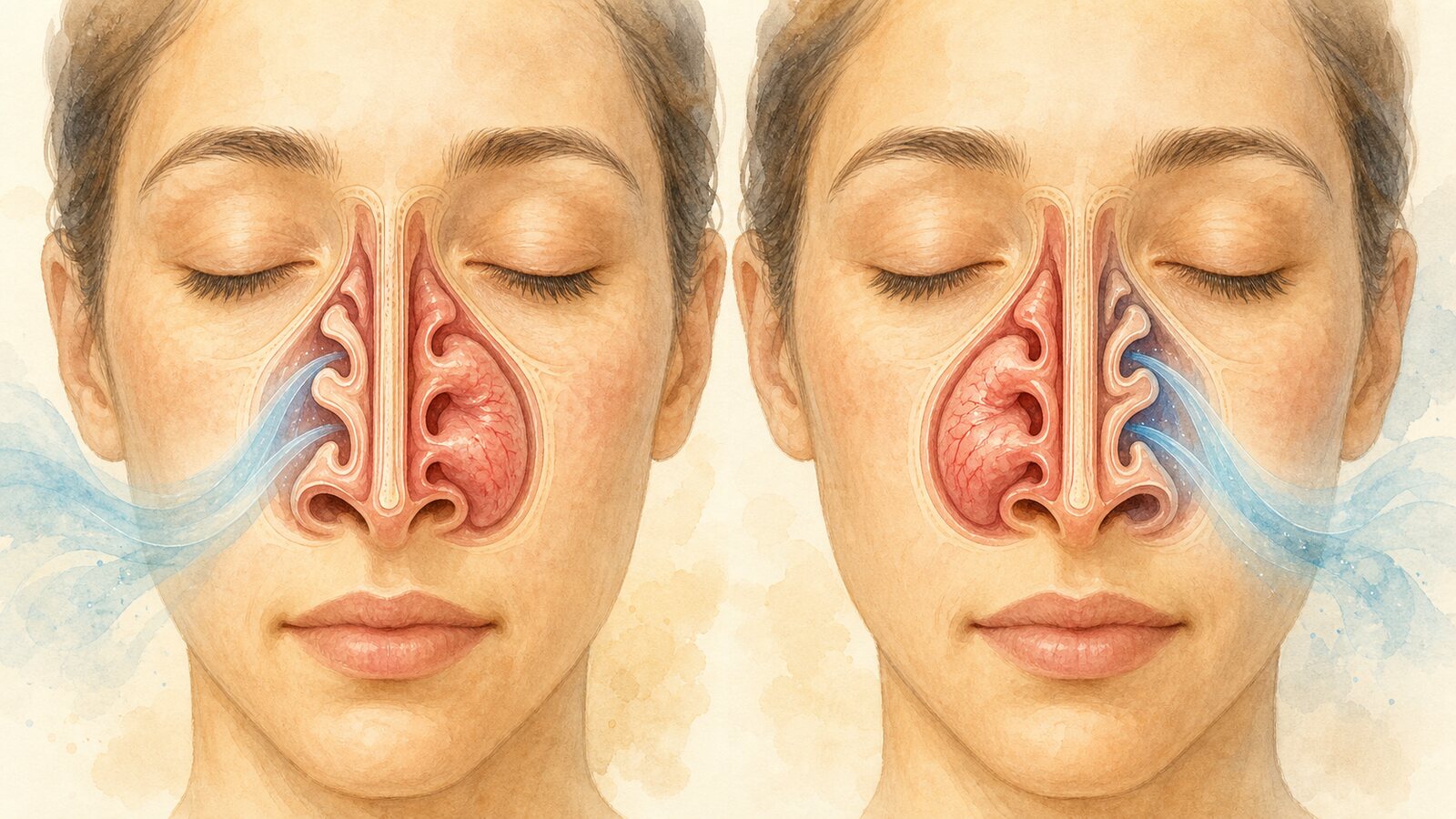
If one nostril feels clearer and the other becomes easier several hours later, the usual reason is the normal nasal cycle. Autonomic control changes the volume of vascular tissue covering the turbinates, narrowing one passage slightly while opening the other, then shifting the balance over time. The sides are not taking turns filling with mucus; their blood-rich lining is changing thickness.
Turbinates are curved shelves of bone projecting from the side walls of the nasal cavity. They are covered by mucosa rich in blood vessels and glands, and their folded shape exposes incoming air to a broad surface that helps warm, humidify, and filter it. When venous spaces beneath the lining hold more blood, the soft tissue expands into the airway. When the vessels constrict and contain less blood, the same passage grows wider. The rigid bony shelf itself does not swell.
This expansion and contraction is linked to the autonomic nervous system, which regulates vessels without conscious instruction. Relative sympathetic vasoconstriction can decongest one side while greater vasodilation makes resistance rise on the other. The two passages often change in opposite directions, redistributing airflow without greatly altering the total resistance of the whole nose. That compensation is one reason a healthy person usually does not notice which side is dominant.
The nasal cycle is not a clock that flips exactly every two hours. A 1977 study measured left and right resistance in 50 healthy participants at 15-minute intervals for roughly seven hours. Under the investigators' stated criterion, 72 percent showed a clearly defined cycle. That result does not mean everyone displays a perfect alternation at every moment. Whether a cycle is detected and how long it appears to last depend on the person, observation period, measurement, and threshold used.
A 2016 study recorded nostril-specific airflow for 24 hours in 33 healthy adults. Average dominance intervals lasted about two hours during wakefulness and about 4.5 hours during sleep, but variation within and between participants was large. There were also periods when opening on one side was not mirrored precisely by closing on the other. 'Every few hours' is a useful scale for the phenomenon, not a timetable that predicts an individual's nose.
Body position adds another asymmetry on top of the spontaneous cycle. In the 24-hour study, lying on one side was associated with greater airflow through the opposite nostril. Vascular and autonomic responses can make the dependent, lower passage relatively narrower. Feeling the left side open after lying on the right therefore does not show that the nasal cycle has failed. Posture and the underlying oscillation can be acting together.
Exercise, temperature, humidity, sleep state, hormones, and drugs can also influence vessels in the nasal lining. Increased sympathetic activity during exercise can constrict mucosal vessels and temporarily make both sides feel more open, while dominance intervals may lengthen during sleep. A single moment cannot reveal which side is inherently blocked. The pattern in one person changes with physiological conditions as well as with time.
What the alternation is for remains less certain than how it is produced. One proposal is that the more congested side restores heat and moisture or gives glands and the mucociliary system a different working condition while the open side handles more bulk airflow. Another is that fast and slow streams help sample odor molecules with different solubilities. Reviews find these functions plausible but not decisively established. Saying that each nostril closes specifically so it can 'rest' turns a hypothesis into a fact.
A cold or allergy makes the cycle easier to feel because inflammation may have already swollen both linings. A modest normal change then causes a much larger increase in resistance inside an already narrow passage. Mucus and inflammation are additional layers, not the mechanism of the underlying cycle. A deviated septum, polyp, or another structural condition can also narrow one side persistently. Alternation and severe obstruction that remains on the same side are not equivalent patterns.
Nor does the nose switch sides with every breath or route air to only one lung at a time. Even when one nostril is dominant, both are usually partly open, and their streams join behind the nose before entering the shared airway. What changes over hours is relative resistance. Blocking one side with a finger makes the contrast dramatic, but ordinary breathing uses the combined capacity of both passages.
The clearer nostril is therefore a moving outcome, not a permanently superior pipe. Autonomic changes in turbinate blood volume shift relative airway width, while posture, sleep, exercise, and inflammation reshape that baseline. The biological purpose of alternating remains open to investigation, but the mechanism explains why an ordinary left-right difference can reverse without either nostril being plugged by mucus.
EDITORIAL RESPONSIBILITY
FactosBrain Editorial Desk
The FactosBrain Editorial Desk researched and reviewed this article under our editorial policy. We assess error reports under our corrections policy.