Look a little closer
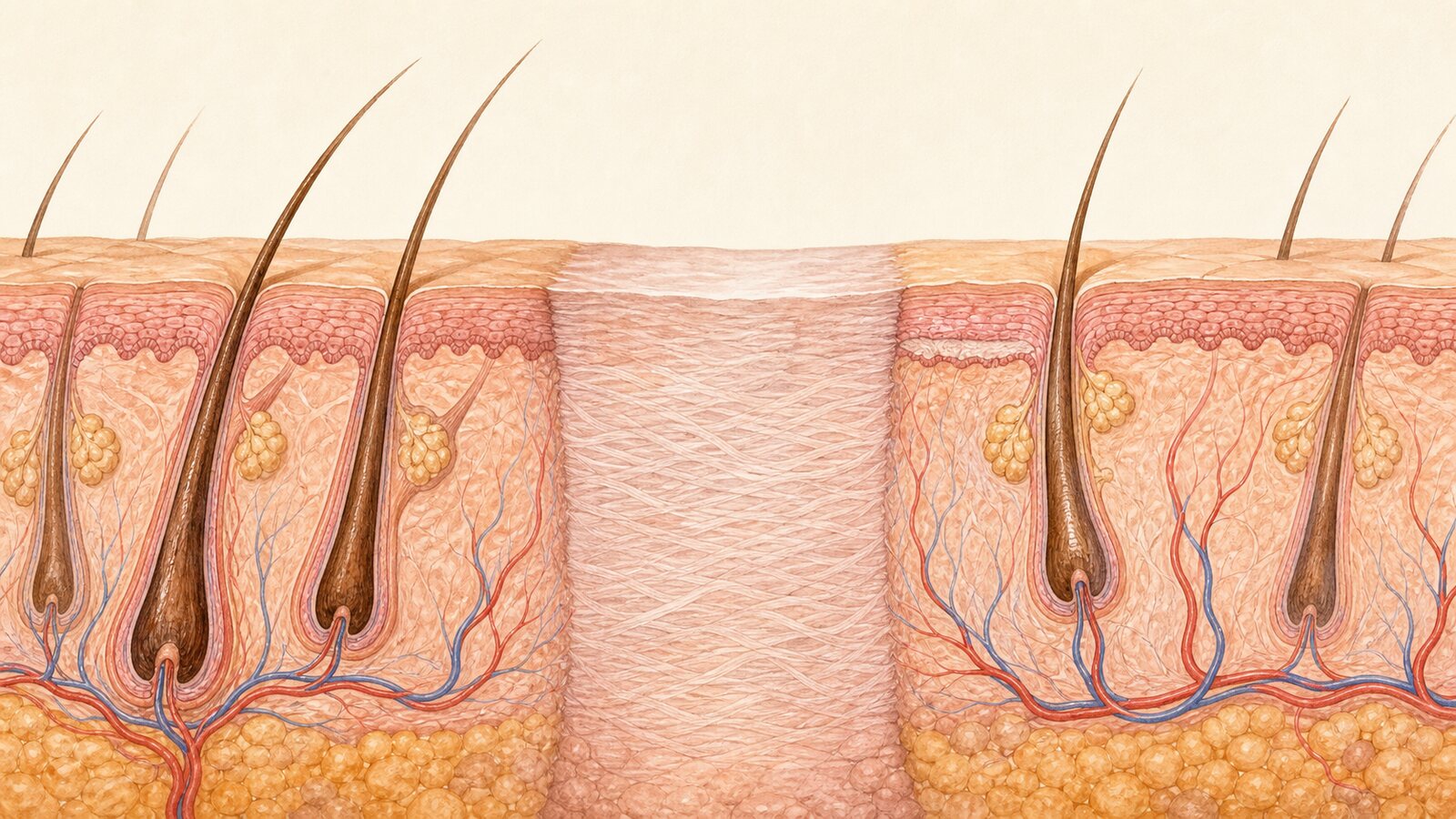
Hair often fails to grow on a scar because a deep wound destroys the follicles that manufacture hair, and adult skin usually closes the defect with fibrous collagen rather than rebuilding those intricate organs. A mature scar generally lacks hair follicles along with sebaceous and sweat glands. Once the follicular machinery is gone, covering the surface does not restore a place from which a hair can emerge.
A hair follicle is far more than the visible shaft. It is a miniature organ extending into the skin, with shaft-producing cells, a stem-cell niche that helps restart growth, a dermal papilla that exchanges developmental signals, and associated glands and muscle. Ordinary shedding is reversible because this apparatus remains in place and cycles through growth, regression, and rest. A smooth new epidermis alone cannot perform that cycle.
After injury, the body's urgent objectives are to stop bleeding, control contamination, and restore a barrier. Clotting and inflammation are followed by migration of epidermal cells across the gap. Fibroblasts proliferate, deposit collagen and other extracellular matrix, and help contract the wound while new vessels support the repair. This sequence can close a dangerous breach efficiently, but it does not precisely reproduce the original skin architecture.
Normal dermal collagen forms a multidirectional, basketlike network, and the boundary between epidermis and dermis is corrugated. In a mature scar, collagen bundles tend to be denser and more aligned, the junction becomes flatter, and cellularity and blood-vessel density decline during remodeling. The microenvironments that once supported follicles are absent. A scar may look like continuous skin from above while functioning as a different kind of repair tissue underneath.
Depth creates the crucial exception. If an abrasion or partial-thickness wound removes surface layers but leaves the lower follicle, its stem-cell compartments, and dermal papilla intact, the surviving follicle may produce hair again. Follicles also provide cells that help re-cover some shallow wounds. A deep burn, excision, or laceration that eliminates the entire structure is different: the surface can heal while the hair-production unit remains permanently missing.
A strand appearing within what looks like a scar does not necessarily prove that scar tissue generated a new follicle. Injury may have been patchy enough for one follicle to survive, a hair from the margin may angle across the scar, or the wound may have been shallower than it appeared. That is why the accurate rule is not that hair can never grow on any scar. Hair usually does not grow where a deep scar has replaced destroyed follicles.
There is an intriguing biological exception called wound-induced hair follicle neogenesis. In experiments, the centers of sufficiently large wounds in mice can reactivate parts of an embryonic signaling program and form new follicles. The result demonstrates that adult mammalian skin retains more regenerative potential than a simple scar might suggest. It does not show that small everyday injuries or ordinary human scars routinely generate replacement follicles.
Researchers are exploring whether that developmental capacity can be directed in people, but genuine follicle regeneration is a demanding target. Fibrosis must be moderated while epidermal and dermal cell populations meet in the right geometry and exchange signals in the right sequence. A working follicle also needs coordinated growth cycles, nerves, vessels, and associated structures. Softening or fading a scar and constructing a new hair-producing organ are therefore very different achievements.
Hair presence alone is not a reliable measure of whether a scar is healthy or needs treatment. Scars vary with injury depth, tension, location, inflammation, and individual biology; they can be flat, raised, discolored, numb, or sensitive. This structural explanation is not a diagnosis or treatment guide. New swelling, pain, breakdown, or other concerning changes deserve assessment independently of whether hairs are visible.
A hairless scar is therefore less a sign that repair failed than a record of what repair prioritized. The body rapidly seals an open defect with strong connective tissue instead of slowly reconstructing every appendage from the original blueprint. When a shallow wound spares a follicle, that surviving organ can resume its cycle. When a deep wound removes the stem-cell niche and signaling center, the skin can close successfully while leaving no factory capable of producing another hair.
EDITORIAL RESPONSIBILITY
FactosBrain Editorial Desk
The FactosBrain Editorial Desk researched and reviewed this article under our editorial policy. We assess error reports under our corrections policy.