Look a little closer
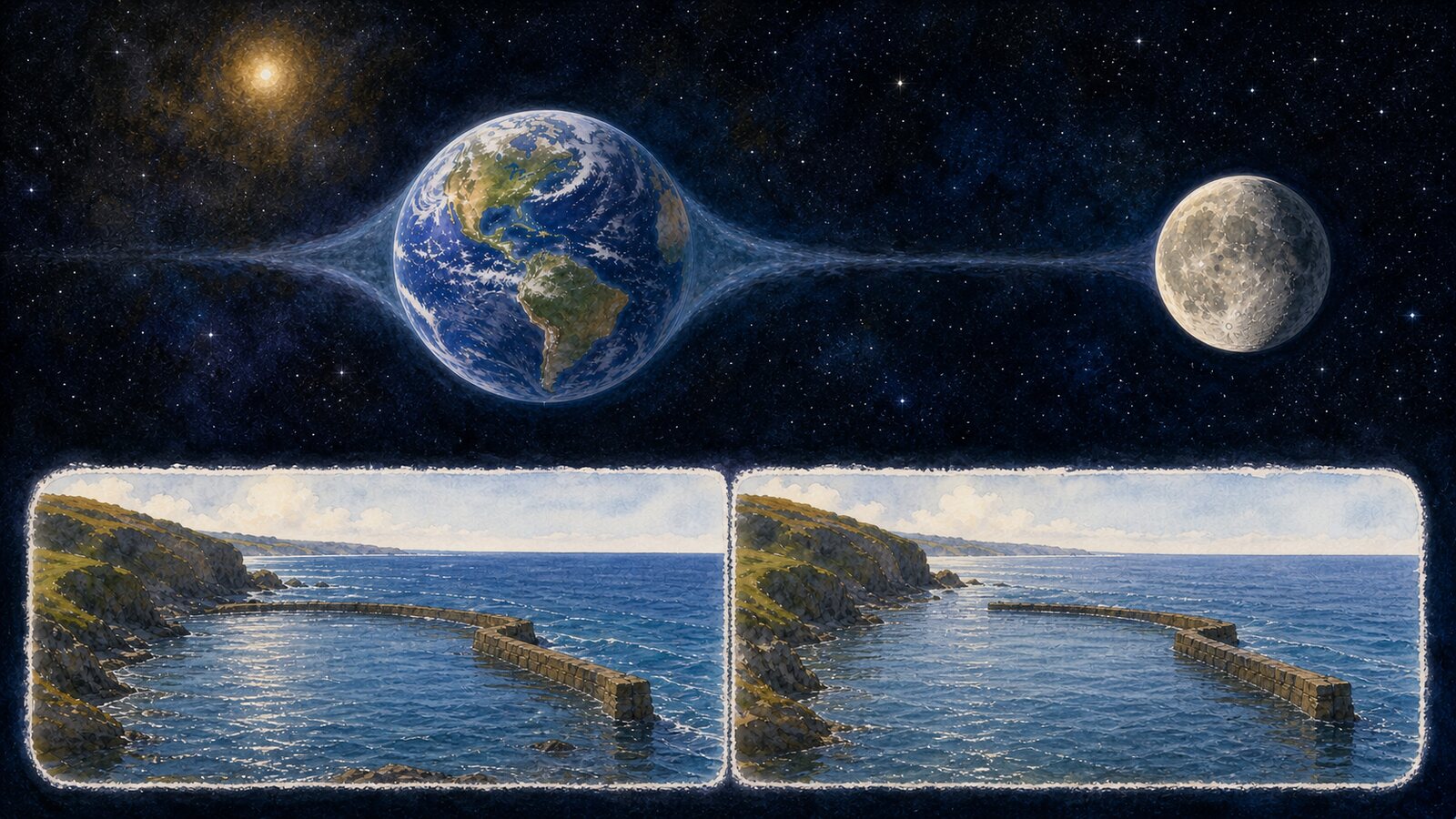
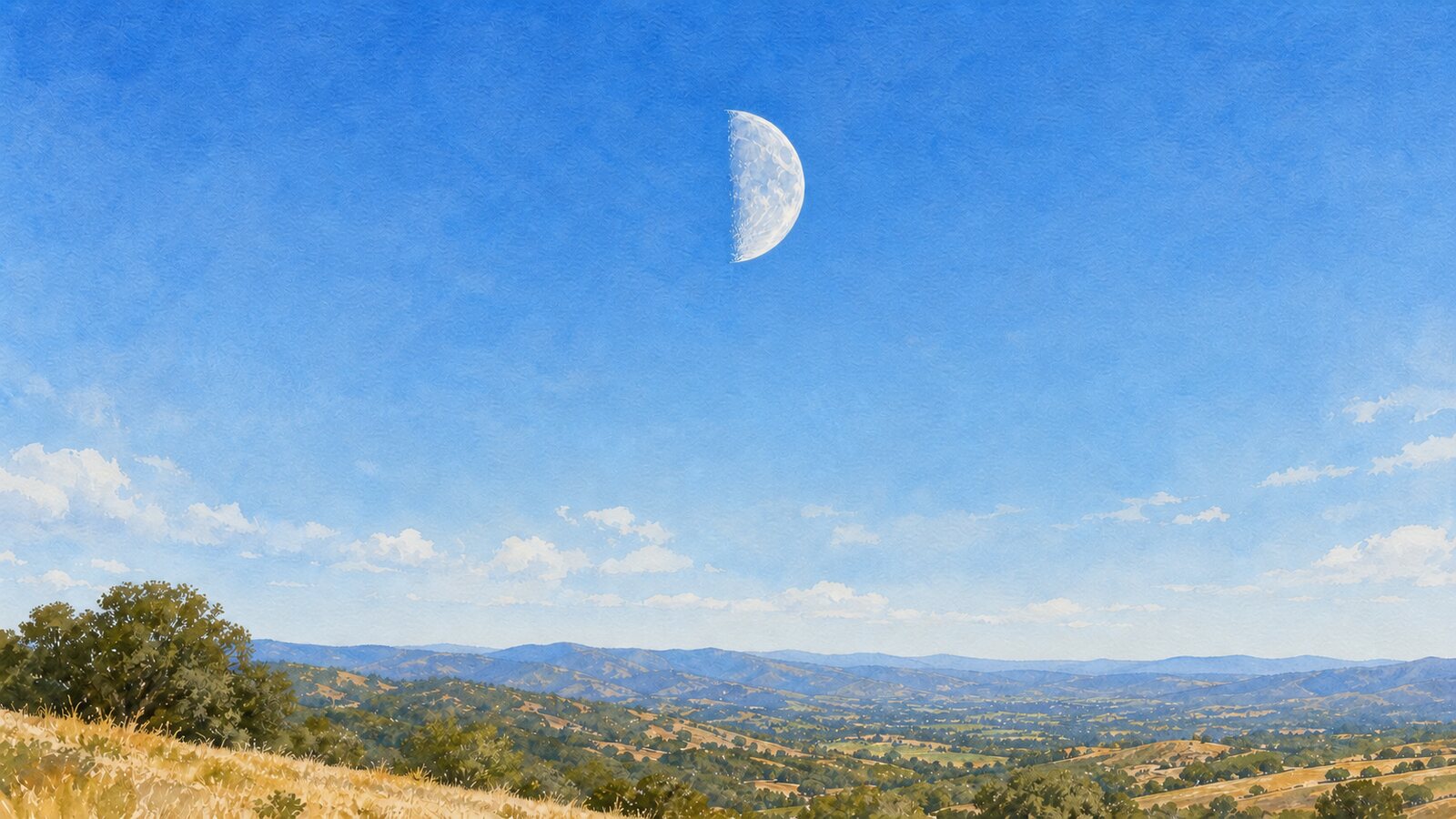
The Moon can appear in daylight because it is not a night-only object. As it orbits Earth, it spends roughly half of each day above a given observer's horizon, and its sunlit surface can reflect enough light to remain visible against the bright sky. Whether you actually notice it depends on lunar phase, its angular distance from the Sun, local rise and set times, and the clarity of the atmosphere.
The Moon produces no visible light of its own, yet the Sun always illuminates one lunar hemisphere. From Earth, we see the overlap between that sunlit half and the half facing us. The changing overlap makes crescents, quarter moons, gibbous phases, and the full Moon. These ordinary phases are not caused by Earth's shadow; that shadow reaches the Moon only during a lunar eclipse.
Day and night are consequences of Earth's daily rotation, while the Moon's schedule also reflects its monthly orbit. Against the background stars, the Moon moves eastward by roughly 13 degrees per day. Earth must therefore rotate a little farther before the Moon returns to a similar place in the sky, so moonrise occurs about 50 minutes later per day on average. The exact delay varies with the orbit, season, latitude, and horizon, but it steadily shifts the Moon through daylight as well as darkness.
First quarter offers the clearest example. At that phase the Moon lies about 90 degrees from the Sun in the sky, rises near noon, and sets near midnight, giving it an entire afternoon above the horizon. A waxing crescent shares some morning and afternoon sky with the Sun before remaining into the evening; a waxing gibbous Moon rises before sunset. After full Moon, the pattern moves to the morning: a waning gibbous or last-quarter Moon can linger for hours after sunrise.
Not every daytime phase is equally conspicuous. At new Moon, the Moon rises and sets with the Sun, but the side facing Earth is almost entirely dark and the Moon appears close to the Sun's glare. A full Moon occupies nearly the opposite direction, rising around sunset and setting around sunrise, so most of its above-horizon time is at night. Still, an almost-full Moon can rise before sunset, and a just-past-full Moon can remain briefly after sunrise.
The blue sky supplies the main visual obstacle. Molecules in the atmosphere scatter shorter wavelengths of sunlight efficiently, filling every daytime direction with background light. That glare overwhelms the tiny points of most stars. The Moon has an apparent diameter of about half a degree and presents a comparatively large sunlit disk, so it can preserve enough contrast to be seen. It nevertheless looks paler than it does at night, and a thin crescent close to the Sun may disappear into the scattered light.
A quarter or gibbous Moon well separated from the Sun is usually the easiest daytime target. Clean, dry air and a deep blue sky improve contrast, while haze and thin cloud erase it. Knowing approximately where to look matters just as much: a building or tree can block the Sun while you scan a broad area with unaided eyes. Never sweep binoculars or a telescope near the Sun without controlled solar-observing procedures, because accidental direct sunlight can cause immediate eye damage.
Seeing the Moon from one place does not mean that people on Earth's night side have somehow lost it. At any moment it is above the local horizon for a broad hemisphere of Earth, and that hemisphere is not identical to the daylit hemisphere. Rotation carries different locations into and out of view while the Moon's orbit changes the geometry from day to day. Observers around the world share essentially the same phase at a given time, although the disk's orientation relative to their horizon varies with latitude and hemisphere.
Follow the Moon at the same hour for several days and the pattern becomes tangible. A slim waxing Moon in the western evening sky stays up later and grows, whereas a waning Moon survives past dawn and crosses the morning sky. A daytime Moon is therefore not a misplaced nighttime symbol. It is the expected result when Earth's rotation, the Moon's orbital position, reflected sunlight, and the contrast of the atmosphere place a bright lunar surface above your horizon while the Sun is also up.
EDITORIAL RESPONSIBILITY
FactosBrain Editorial Desk
The FactosBrain Editorial Desk researched and reviewed this article under our editorial policy. We assess error reports under our corrections policy.