Look a little closer
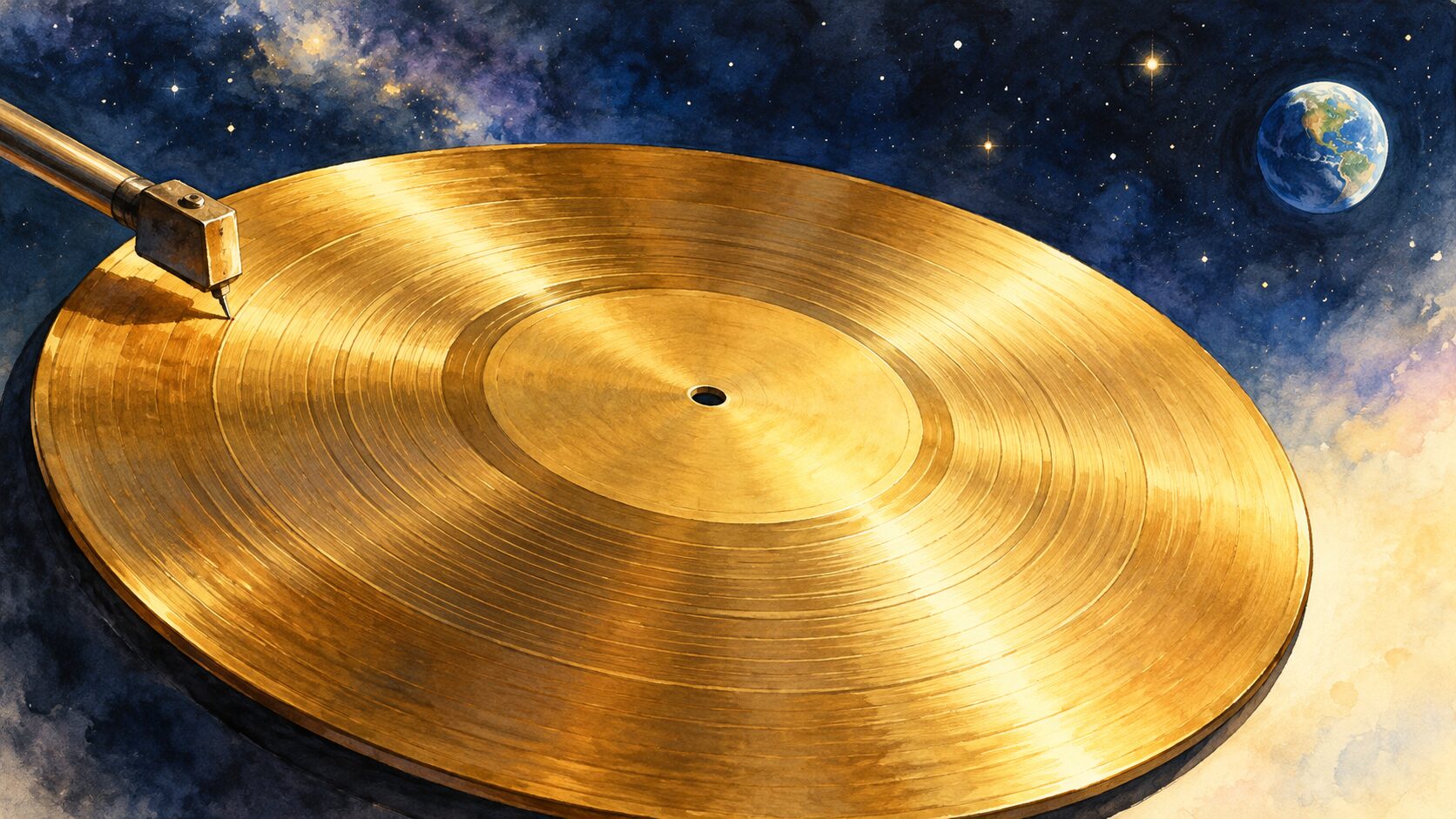
Voyager's Golden Record stores pictures as changing analog signals that can be reconstructed into images by arranging the recovered information into lines. The photographs are not tiny pictures engraved into the grooves, and they are not JPEG files waiting to be opened. Instead, a continuous recording carries the information needed to rebuild a two-dimensional image. The crucial additional ingredient is a set of instructions explaining how a signal unfolding through time should be turned back into positions across a picture, rather than simply treated as something to hear.
Each of the two Voyager spacecraft launched in 1977 carried a record with the same contents. Despite its name, the object is a gold-plated copper disc, about 30 centimetres across, rather than a disc of solid gold. Its selection includes music, natural sounds, greetings in different languages, and images introducing aspects of Earth. NASA lists 115 images encoded in analog form. A playback stylus and cartridge accompanied the record, together with a protective cover bearing diagrams intended to help a finder play the recording and interpret the information it contains.
The basic idea is to give a flat image a sequence. Imagine dividing a picture into narrow lines and representing the information along each line as a signal that changes over time. A player following a record groove can recover that sequence, but sending it to a loudspeaker would not make a picture appear. A reconstruction system must instead map the changes in the signal, and their timing, back onto locations in an image. A medium associated with sound can carry picture information because the recording preserves a varying signal, not an obligation to interpret everything as music or speech.
The cover explains the intended arrangement. According to NASA's description, a complete picture consists of 512 vertical lines, with roughly eight milliseconds corresponding to one picture line. Diagrams show how the lines are arranged, including the required interlacing. The principle resembles older television systems that construct pictures from a succession of horizontal lines, although the record's instructions specify vertical ones. The number 512 therefore describes the line structure of an individual reconstructed image. It is not the number of photographs on the record, and knowing it is part of decoding the recording correctly.
Even a receiver that reconstructs lines could get the picture's proportions wrong. The first image therefore contains a circle, and the cover reproduces this test picture for comparison. If the reconstructed shape looks like a stretched oval, the receiver has a clue that the horizontal and vertical proportions need adjustment. A photograph of an unfamiliar animal would offer a less obvious check: a finder might not know whether the animal was naturally elongated or the decoding had distorted it. The circle supplies a reference for checking the reconstruction process before trying to interpret the later pictures.
Playback speed presents another translation problem. The instructions specify 3.6 seconds per revolution, equivalent to sixteen and two-thirds revolutions per minute. But an unknown finder cannot be assumed to share the human definition of a second. The cover therefore uses a time interval associated with a particular transition of the hydrogen atom as a reference, expressing the recording's timing relative to it with binary numbers. The diagrams also show the stylus position and indicate that playback proceeds from the outside inward. Physical timing, mechanical orientation, and picture layout all have to work together.
None of this means that the record continuously plays itself or broadcasts Earth's music into space. It is a physical object carried by a spacecraft, and a finder would have to recover and interpret its contents. Even instructions based on diagrams and physics depend on the recipient recognizing what they are intended to communicate. The designers supplied clues across a possible language barrier, but could not guarantee that a recipient exists, encounters the spacecraft, or successfully understands the drawings. The record's carefully specified reconstruction method should be distinguished from certainty that anyone will ever use it.
The pictures on the Golden Record show why keeping information also requires keeping a way to interpret it. Surviving grooves alone would not be enough: a receiver needs the right playback timing, line boundaries, arrangement, and image proportions. Once the test circle appears correctly, there is a basis for applying the same reconstruction rules to the other images. Sending a view of Earth therefore involved more than choosing which scenes to include. It also meant explaining how to recover a picture to someone who might never have seen the depicted objects, used the recording technology, or shared the makers' language.
EDITORIAL RESPONSIBILITY
FactosBrain Editorial Desk
The FactosBrain Editorial Desk researched and reviewed this article under our editorial policy. We assess error reports under our corrections policy.