Look a little closer
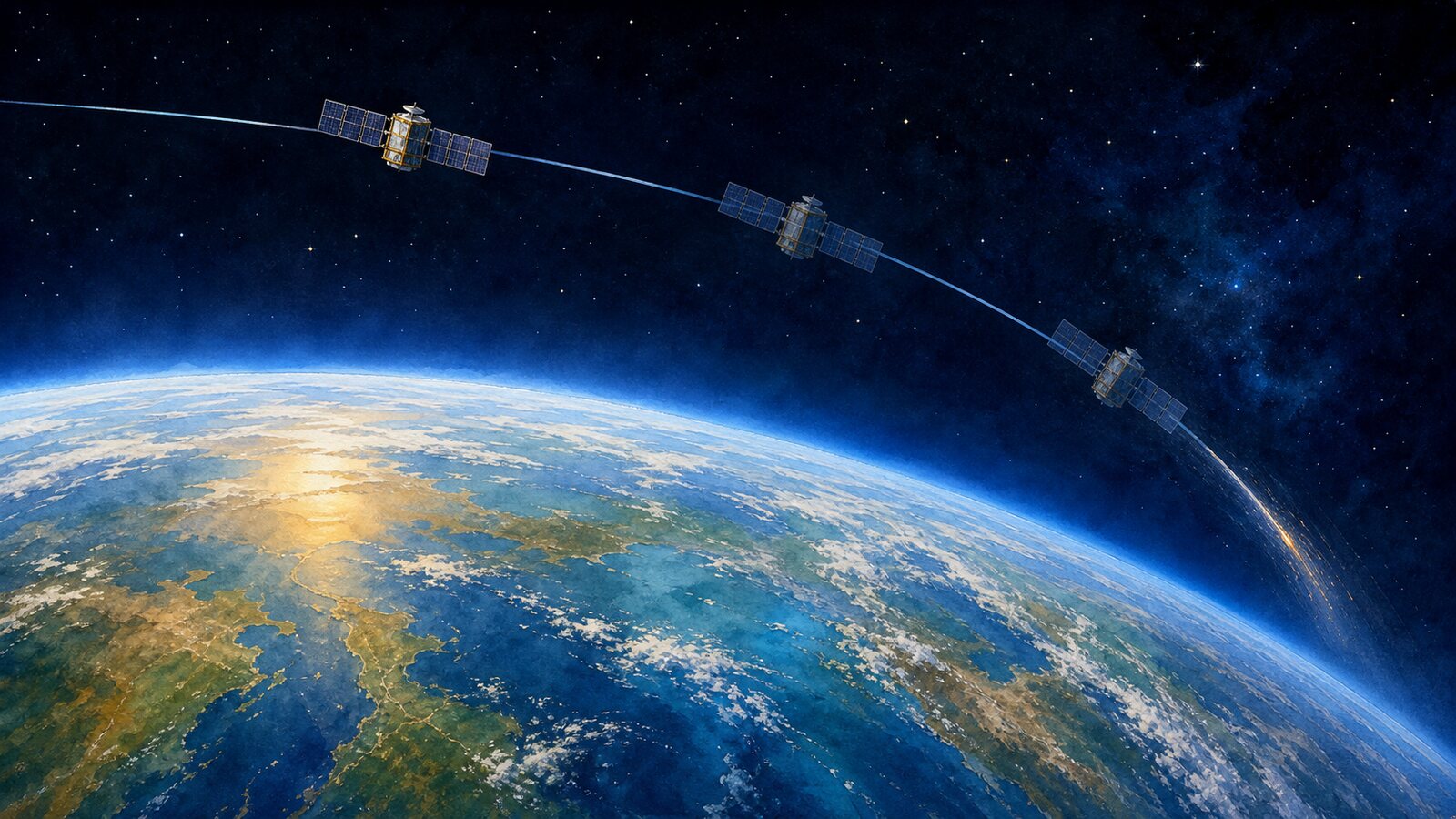
An orbiting satellite has not escaped gravity and is not simply floating. It is continually falling toward Earth, but it also moves sideways so fast that Earth's curved surface falls away beneath it as it descends. The satellite repeatedly misses the ground, and that sustained miss is an orbit.
Without gravity, the satellite would continue in a straight line tangent to its path. Earth's gravity instead accelerates it inward, changing the direction of its velocity moment by moment. Forward motion and inward fall combine into a curve. In a nearly circular orbit, gravity supplies exactly the centripetal acceleration needed to keep redirecting the satellite around the planet rather than letting it follow the tangent into space.
If the sideways speed is too small, the curved trajectory intersects Earth and the object descends into the atmosphere or strikes the surface. With the appropriate speed, the trajectory curves at the same rate as the planet beneath it. Greater speed can produce a larger elliptical orbit, and enough speed can create an open path that escapes Earth. Reaching altitude is therefore only part of launch: a rocket must also build the large horizontal velocity that makes a lasting miss possible.
The claim that gravity nearly disappears above the atmosphere is incorrect. At the height of the International Space Station, Earth's gravitational pull is only moderately weaker than at the surface. Astronauts seem weightless because the station, their bodies, and loose objects inside are all accelerating together under gravity. With no floor continuously supporting their weight, they float relative to one another. This shared free fall is microgravity, not the absence of gravity.
A satellite also does not need an engine continuously pushing upward against gravity. In an ideal vacuum with no disturbances, it coasts with the velocity supplied during launch while gravity bends the direction of travel. Engines are needed to reach orbit, transfer between orbits, adjust orientation, avoid hazards, or replace losses in the real environment. They are not an invisible pedestal firing every second to hold an ordinary stable orbit at a fixed height.
Orbits need not be perfect circles. In an ellipse, both the distance from Earth and the satellite's speed change. The satellite accelerates as it descends toward the closest point and slows as it climbs toward the farthest point, exchanging gravitational potential energy and kinetic energy. It remains in free fall throughout. Gravity does not switch off on one half of the path and seize the satellite again on the other; it shapes the entire ellipse.
A geostationary satellite is not physically motionless either. It circles eastward above the equator at an altitude of about 35,786 kilometers, completing one orbit in one sidereal day. Because that period and direction match Earth's rotation, the satellite appears to remain over the same longitude to an observer on the ground. Gravity is still curving its path. The apparent hovering comes from synchronized rotation, not from exemption from orbital motion.
Real low Earth orbit is not a perfect vacuum. Extremely thin upper-atmospheric gas strikes a satellite and exerts drag, removing orbital energy. The orbit gradually descends; as the air grows denser at lower altitude, decay can accelerate until reentry. Solar activity heats and expands the upper atmosphere, changing its density and making the lifetime of a low object variable. Falling and missing can continue for years, but it is not automatically permanent.
Spacecraft such as the International Space Station therefore receive occasional reboosts to restore lost altitude and energy. Earth's nonspherical gravity field, the Moon and Sun, and solar radiation pressure can also shift an orbit's orientation and position. Station-keeping maneuvers keep operational satellites within an assigned region despite these perturbations. Correcting real-world drift is a different task from continuously cancelling Earth's gravity.
Newton's cannon thought experiment gives the idea a memorable form. Imagine firing a projectile horizontally from a mountain above the atmosphere. A slow shot hits nearby; a faster shot lands farther around the curve. At sufficient horizontal speed, the projectile falls by about the same amount that the surface curves away and travels all the way around Earth. Actual launch vehicles replace the impossible mountain and cannon with staged propulsion that builds both altitude and sideways speed.
Describing a satellite as a stationary object balanced between gravity and rocket thrust hides the essential physics. It is a falling object whose inertia carries it forward while gravity turns its velocity inward. In near-vacuum, that carefully arranged miss can persist for a long time; when drag or other forces change the energy and direction, the orbit evolves. A satellite stays up not because it has stopped falling, but because it falls around a round world.
EDITORIAL RESPONSIBILITY
FactosBrain Editorial Desk
The FactosBrain Editorial Desk researched and reviewed this article under our editorial policy. We assess error reports under our corrections policy.