Look a little closer
The alphabet begins A, B, C not because those letters form the most logical ranking of sounds or shapes, but because later writing communities inherited an extremely old sequence. The backbone of the English order traveled from ancient West Asian alphabetic traditions through Phoenician, Greek, Etruscan, and Latin. Why the earliest users chose that precise order in the first place remains unknown.
Letters have no natural queue. A writing system could put lip sounds first, rank signs by frequency, or group similar shapes, yet the familiar A-to-Z line follows none of those principles consistently. Alphabetical order is not part of the rule that connects a sign to a sound; it is a shared list attached to the whole set. A language could still be written if children learned its symbols in another order, but dictionaries and directories work only when their users know the same convention.
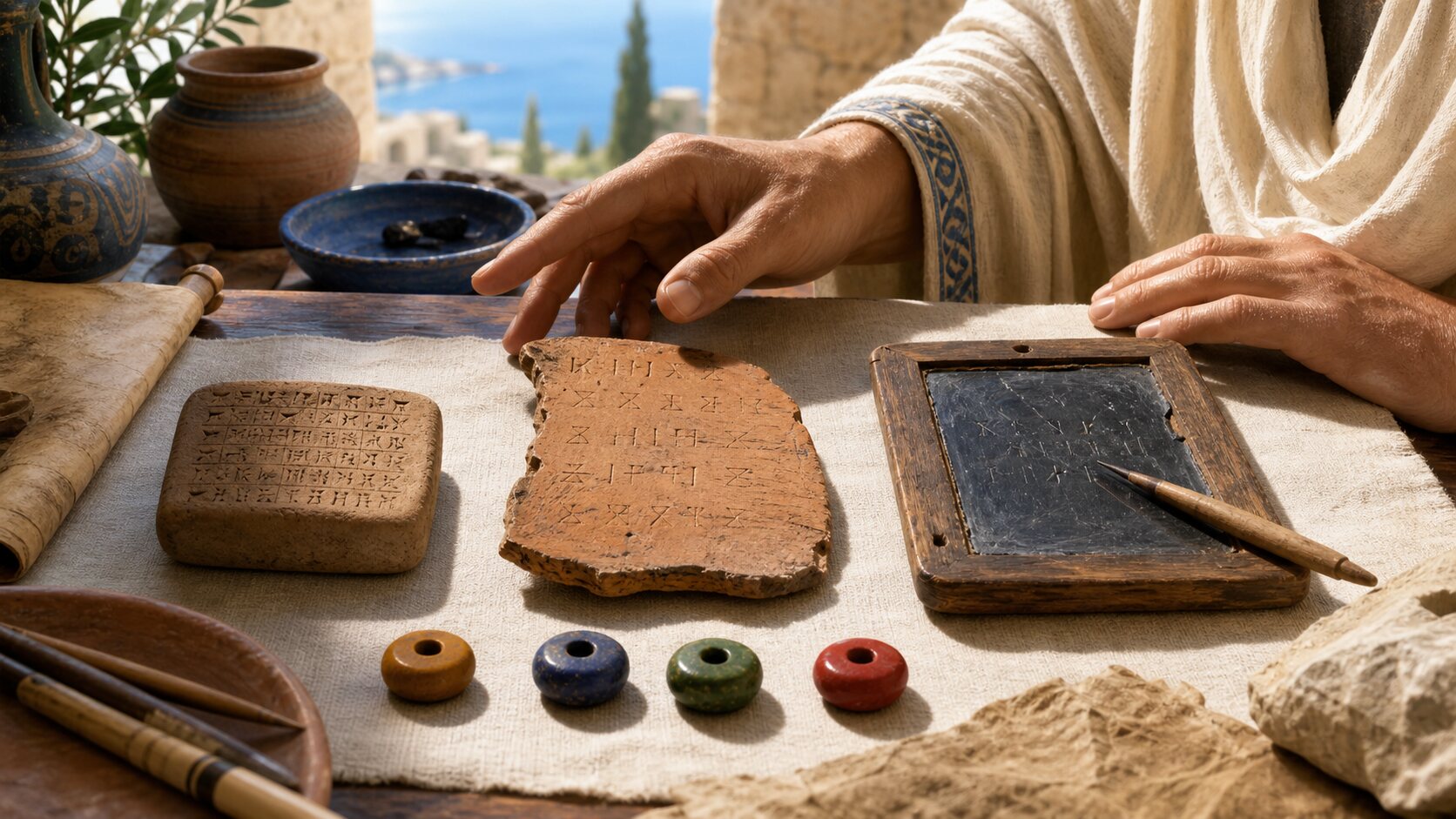
Evidence from the ancient city of Ugarit, on the coast of present-day Syria, shows just how old that convention is. During the second millennium BCE, Ugaritic scribes pressed wedge-shaped signs into clay to write an unusual alphabetic form of cuneiform. Excavators have found several abecedaries—school exercises that list signs in sequence—whose opening order closely parallels the later Northwest Semitic tradition. Ugaritic signs and the later Phoenician set are not identical, but the tablets demonstrate that the sequence existed before Phoenician writing reached its widest influence. Other Ugaritic material preserves a different order related to South Semitic traditions, reminding us that antiquity had more than one alphabetical lineage.
Phoenician communities carried a compact consonantal script around the Mediterranean while retaining the inherited order. Its early letter names began approximately aleph, beth, gimel, and daleth, each name starting with the sound represented by its sign. When Greek speakers adapted this script early in the first millennium BCE, they made a consequential change: signs for consonants Greek did not need were reassigned to vowels. Yet much of the sequence and many names survived. Aleph and beth became alpha and beta, followed by gamma and delta.
The Greek alphabet did not instantly settle into one universal set of 24 letters. Local versions differed in forms, sound values, and additions, but a recognizable sequence remained a teachable and recitable frame. Etruscans in Italy adopted a western Greek-related script, and Romans subsequently reshaped that inheritance for Latin. English ABC is therefore not a direct photocopy of Greek. It is the latest section of a route on which each language altered the inventory while usually preserving the underlying order.
The seams in today's sequence reveal those alterations. Early Latin C could represent sounds now divided between C and G; a modified form, G, was later inserted into the seventh position. Z, which had occupied that area, was dropped when its sound was unnecessary in Latin, then restored at the end alongside Y for spelling Greek loanwords. J, U, and W became independent letters much later as uses of I and V separated or combined. The modern 26-letter list is not an untouched ancient object. It resembles a building expanded repeatedly on an inherited foundation.
A fixed order survives because it becomes more valuable as more people share it. Scribes and pupils could recite letter names, check for omissions, and copy practice lists against a stable sequence. Ordered letters could also support numerical values and alphabetic poems. Centuries later, dictionaries, catalogs, personnel lists, and filing systems turned memorized order into a search technology. Replacing it would force every user and reference work to change together. Its strength lies less in intrinsic perfection than in coordination.
There are proposals for the order's ultimate origin. Scholars have explored mnemonic groupings, a lost teaching chant, relationships among letter names, and stages in the creation of the signs. None is secured by a surviving explanation from the first arrangers. Gaps remain between the earliest alphabetic inscriptions and the first complete ordered lists, while the Northwest and South Semitic traditions preserve different ancient sequences. Archaeology can push the convention backward and trace routes of borrowing; it cannot yet recover the intention that launched the first recitation.
Even the word 'alphabet' compresses this history. It combines alpha and beta, the first two Greek letter names, which themselves descend from older aleph and beth. A, B, and C are therefore not the opening steps of a natural law. They are a cultural fossil: a Bronze Age teaching order repeatedly adjusted for new languages, yet preserved for thousands of years because a common sequence is easy to learn and enormously useful to share.
EDITORIAL RESPONSIBILITY
FactosBrain Editorial Desk
The FactosBrain Editorial Desk researched and reviewed this article under our editorial policy. We assess error reports under our corrections policy.