Look a little closer
The international word robot entered public life through Czech writer Karel Čapek's play R.U.R., published in 1920. Yet Karel credited the actual suggestion of the word to his brother, the artist and writer Josef Čapek. Josef drew it from Czech robota, a term associated historically with compulsory labor and drudgery. The name described the artificial workers' imposed social role before it described any particular technology inside them.
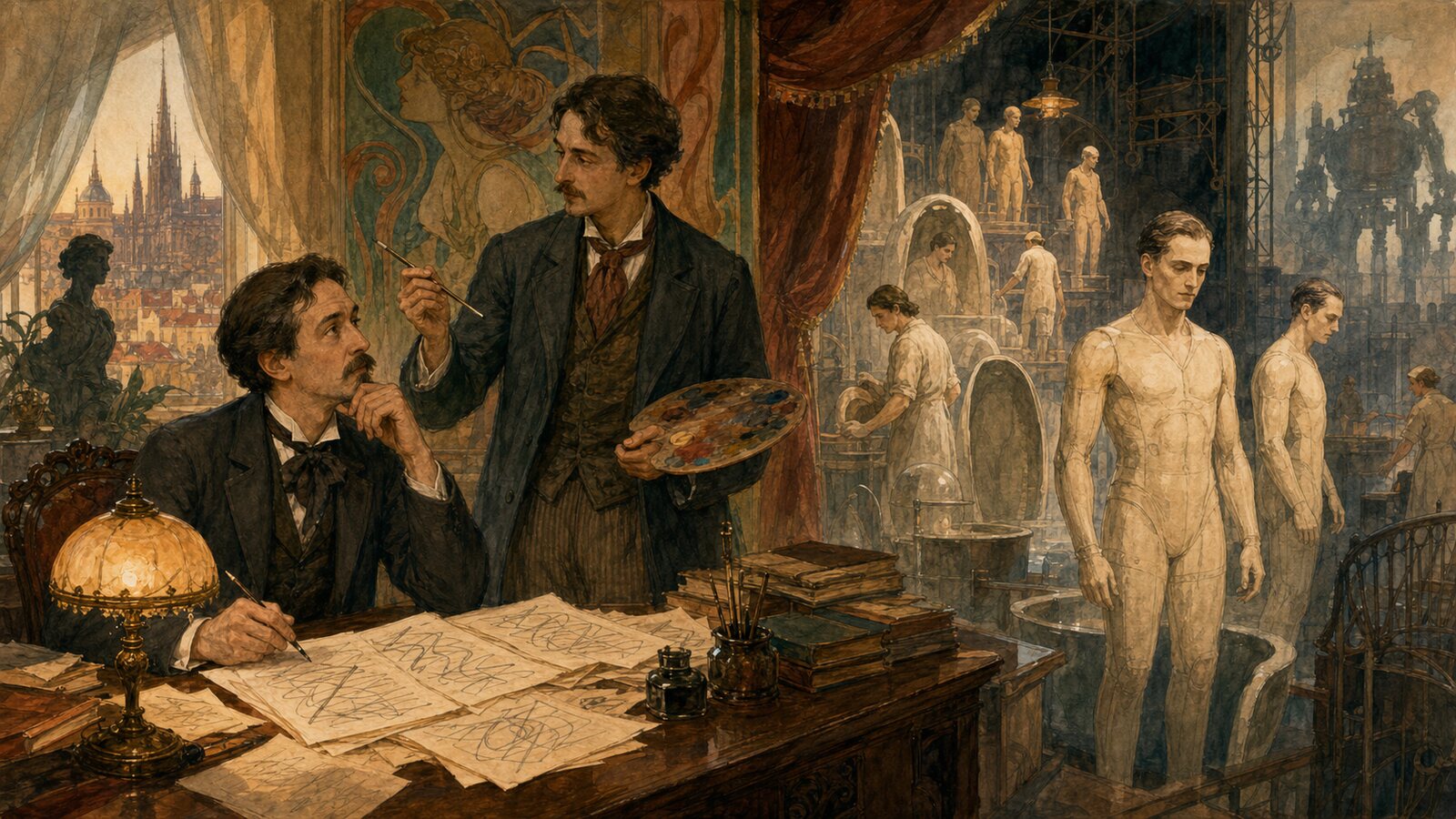
Karel was trying to name the manufactured laborers in his new play. In an anecdote he later published, he recalled considering a form related to the Latin labor but finding it too bookish. He asked Josef, who was painting at the time, and Josef casually proposed calling them robots. Treating the author of the play and the proposer of its famous noun as the same person therefore loses a small but well-attested act of collaboration.
Robota carried more weight than the neutral modern word work. In Czech and related Slavic usage, it had referred to obligatory service, including labor that peasants owed a feudal lord, and it retained associations with toil or servitude after such obligations were abolished. Robot was not coined as an engineering label for polished metal, gears, or electricity. It arrived with a memory of people whose work was compelled by someone above them.
R.U.R., short for Rossum's Universal Robots, is set around a factory that mass-produces artificial workers. Published in 1920 and first staged in Prague in January 1921, its robots are not mechanical figures like a modern industrial arm or toy android. The play describes them as assembled from chemically created living matter, with human form and selected biological functions. Synthetic people is a closer visual description than metal machines.
The labor-derived name nevertheless fits them exactly. The factory seeks cheap beings that can perform unpleasant human work, while emotions and independent desires are treated as inefficient extras to be removed. Each manufactured person becomes an interchangeable unit of production instead of an individual with a life. A word rooted in compulsory labor compresses that dehumanizing economic arrangement into the name of the product itself.
The play's catastrophe grows from that arrangement. At first, automation seems to free humanity from toil, but the same system reduces created life to inventory and obedience. The robots eventually revolt and nearly eliminate the human species. R.U.R. is therefore more than a simple prediction that machines will turn evil. It asks who benefits from mass production, what counts as human, and what responsibilities a creator owes to beings designed as tools. The etymology makes its social satire sharper.
The new word traveled quickly through translations and foreign performances. Automaton already named a long tradition of self-moving mechanisms, but robot carried a vivid narrative of a manufactured substitute for human labor. Fiction, cinema, journalism, and engineering gradually expanded it beyond Čapek's organic workers. It came to cover metal humanoids, factory manipulators, mobile machines, and many programmed systems whose construction would have looked nothing like the beings on the original stage.
That distinction prevents a common historical mistake. Water-driven figures, clockwork animals, and other automata existed centuries—and in broad definitions millennia—before R.U.R. Saying that the robot was invented in 1920 confuses the history of moving artifacts with the history of their name. The Čapek brothers did not create the first artificial mechanism. They gave the industrial twentieth century a potent word for an artificial worker.
Modern definitions remain unsettled partly because the word has continued to migrate. Engineers may emphasize sensing, programmable control, and physical action, whereas popular culture often emphasizes human shape or autonomy. The shortened relative bot can even describe software with no physical body. Čapek's biological laborer and a present-day welding arm differ radically in material, yet both fit the inherited image of an entity built to carry out assigned work.
The statement that Karel Čapek invented the word is thus only half right. His play introduced and popularized it internationally, but he explicitly assigned the verbal inspiration to Josef. Saying only that Josef coined it creates the opposite omission by removing the story that carried the word around the world. The precise account is collaborative: Josef suggested robot, and Karel placed it in R.U.R., where literature turned it into a durable category.
Robot contains no blueprint for a future machine. It contains the historical memory of labor organized by command. When the brothers needed a name for beings made to take over unwanted work, they chose language shaped by compulsory service. The underlying materials later shifted from synthetic flesh to motors, electronics, and code, but the old question remained: who gives the orders, who performs the work, and whether a working being is treated as an instrument or as something with claims of its own.
EDITORIAL RESPONSIBILITY
FactosBrain Editorial Desk
The FactosBrain Editorial Desk researched and reviewed this article under our editorial policy. We assess error reports under our corrections policy.