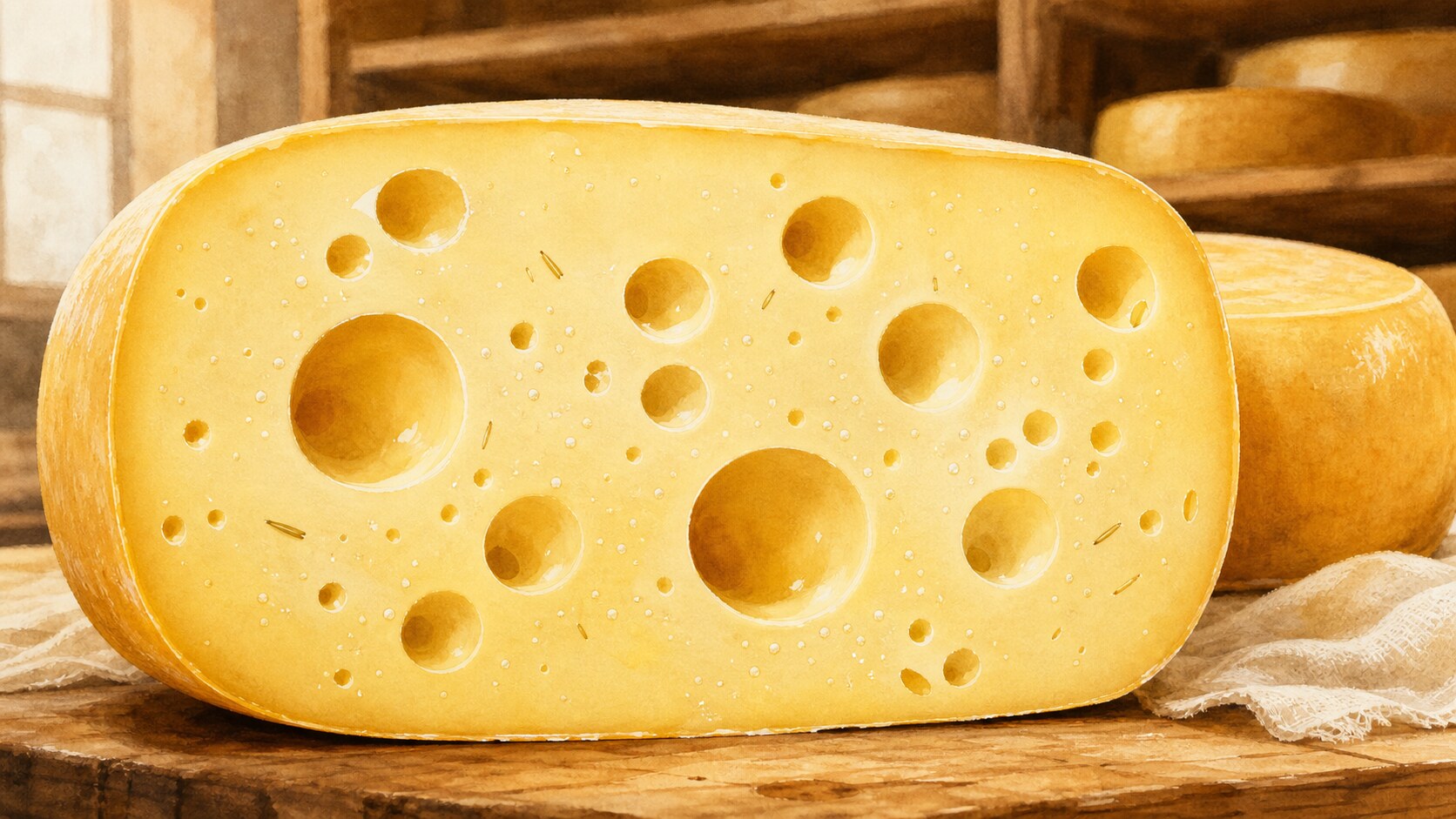
The holes in Swiss-type cheeses such as Emmental are bubbles of carbon dioxide that grow during ripening. Saying only that bacteria make gas is incomplete, however. Each bubble also needs a microscopic place where it can begin.
Early in cheesemaking, lactic acid bacteria convert milk sugar into lactate. Propionic acid bacteria later use that lactate and produce propionate, acetate and carbon dioxide. The process supplies both nutty flavor compounds and the gas behind the openings.
The firm but yielding cheese matrix keeps much of the gas from escaping. As carbon dioxide gathers in one place, it pushes curd aside and enlarges a rounded cavity known in cheesemaking as an eye.
A bubble does not easily start inside a smooth matrix. Research found that tiny air-filled cavities in plant particles, including traces of hay entering milk, can act as nuclei. Bacterially produced carbon dioxide collects there and expands them into visible eyes.
This also explains why Emmental developed fewer holes after cleaner, closed milking and filtration systems became common. Hay particles are not the gas source or simply dirt; in extremely small amounts they help determine where and how many bubbles start.
Not every cheese from Switzerland has holes. Cultures, ripening temperature and time, the texture of the cheese and the number of nuclei all influence eye formation and size. The familiar pattern emerges only when fermentation, structure and a suitable starting point work together.
Cheesemakers can use a warmer stage early in ripening to manage propionic bacteria and gas production. Too much gas too quickly may create unwanted cracks, while an overly firm matrix can prevent round eyes from expanding. The openings are therefore not random damage but an outcome of controlling microbes, moisture, acidity, temperature and texture together.
The hay-particle finding did not overturn the bacterial explanation. Propionic bacteria remain the source of carbon dioxide; microscopic particles provide places where that gas can begin collecting. Choosing between 'bacteria made the holes' and 'hay made the holes' misses the complementary roles of gas production and bubble nucleation.
EDITORIAL RESPONSIBILITY
FactosBrain Editorial Desk
The FactosBrain Editorial Desk researched and reviewed this article under our editorial policy. We assess error reports under our corrections policy.