Look a little closer
Cooked onions taste sweeter mainly because pungent sulfur chemistry fades, water loss concentrates sugars that were already present, and browned aromas reinforce the perception of sweetness. Heating does not simply manufacture a large new store of sugar. Raw onions already contain glucose, fructose, and sucrose, while some of those sugars are consumed or transformed during browning. The change is a combination of chemistry, concentration, and sensory contrast.
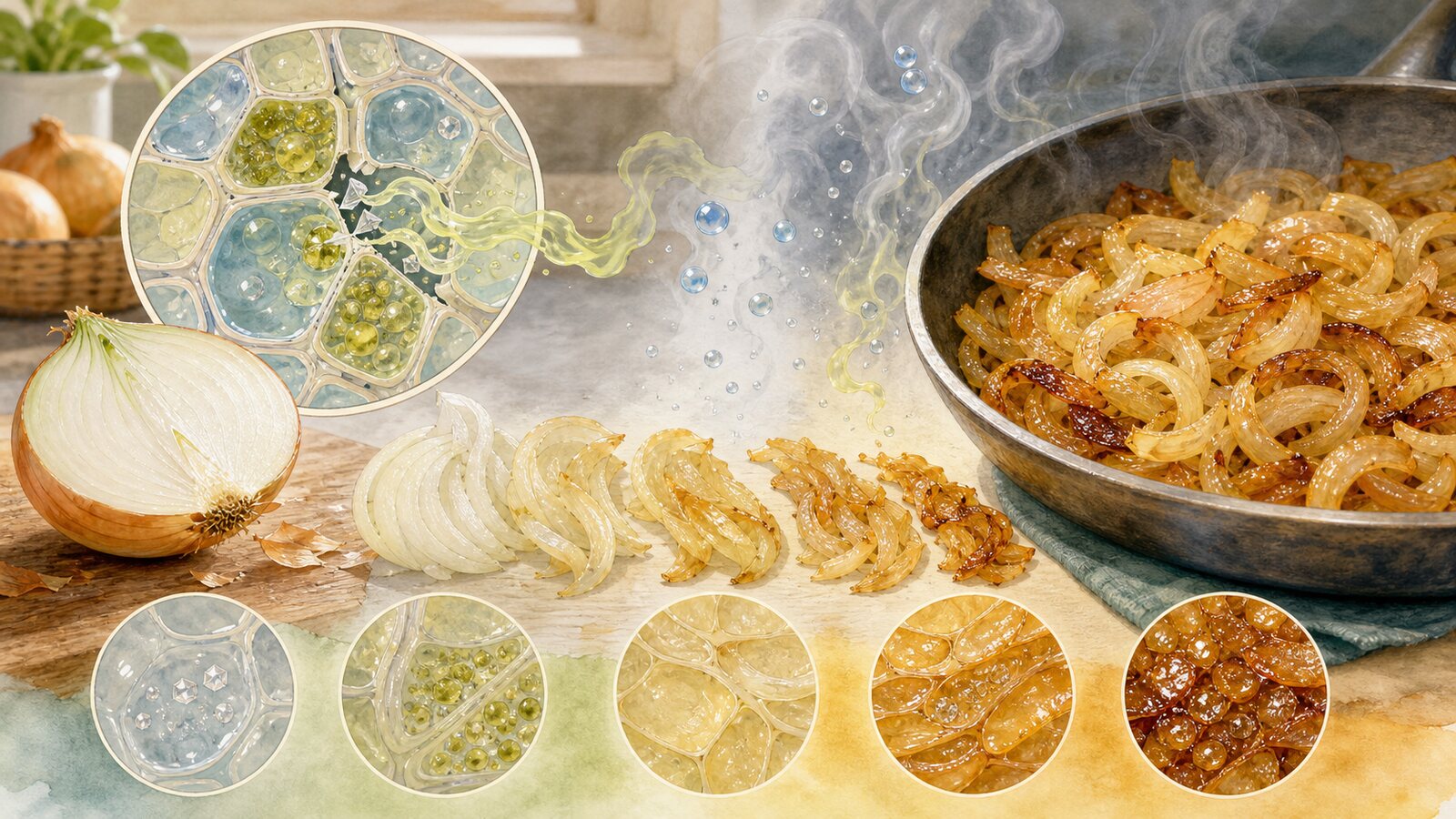
An intact onion keeps its sharp defense system compartmentalized. Sulfur-containing precursors and an enzyme called alliinase occupy different parts of its cells. Cutting or chewing ruptures those barriers and lets the enzyme act, rapidly producing unstable sulfur compounds. Some create the characteristic bite and smell; a volatile tear-producing compound reaches the eye and stimulates nerves that trigger washing tears. The pungency is therefore assembled after damage rather than stored as one ready-made liquid.
Heat changes that reaction network. Alliinase is a protein, so sufficient heating disrupts its structure and activity. Sulfur compounds already formed can evaporate or convert into less aggressive products. As their sting stops dominating the nose and mouth, the onion's existing sweetness becomes easier to notice. Even with no increase in sugar, removing a powerful competing sensation changes the balance. Heating a whole onion before extensive cutting can also yield a different aroma because the enzyme may be disabled before precursors mix freely.
Water provides the next part of the answer. A raw onion is mostly water. Early in cooking, softened cell walls release abundant juice, and evaporation limits the temperature while moisture remains at the surface. The pieces first become translucent and limp, almost as though they are steaming or simmering. As vapor escapes, the onion loses mass and volume. Sugars and many flavor compounds that began in a large, watery portion are then packed into a smaller mouthful.
Substantial brown flavor develops only after exposed areas become dry and hot enough. Reducing sugars can react with amino compounds through the Maillard reaction, producing many aromas and brown pigments. Sugars can also break down and recombine through caramelization under suitable conditions. The two processes may both produce browning, but they are not synonyms. Because onions supply sugars and amino acids, a pan can host overlapping thermal reactions rather than one pure textbook mechanism.
Those aromas alter the judgment of sweetness. Toasted, nutty, and jam-like notes resemble flavors learned from sweet foods. What people call flavor combines taste receptors with retronasal smell, texture, and temperature, so the brain does not assess dissolved sugar in isolation. Softer tissue, reduced pungency, concentrated soluble material, and warm browned aromas all point in the same direction. A chemical measurement of total sugar and a person's sweetness rating need not rise by the same amount.
Sugar does not continuously increase during this process. Experiments heating onion varieties at different temperatures have found losses of some sugars at high temperatures. Sugar becomes feedstock for browning chemistry, and boiling can leach soluble sugars into cooking water. In a pan, however, the total amount may fall while water falls even more, leaving a greater concentration in each remaining piece. Separating total quantity, concentration, and perception resolves the apparent contradiction.
Slow cooking helps these stages occur across the onion rather than only at a few scorched edges. If intense heat reaches a dry patch while most released water is still present elsewhere, thin pieces can burn and become bitter before the bulk has softened. Moderate heat allows moisture to leave, then gives broad surfaces time to brown. Pan size, crowding, slice thickness, stirring, salt, and acidity all change the timing, so no single number of minutes defines the transformation.
Different cooking methods also create different kinds of sweetness. Boiling can suppress enzyme activity and pungency, making an onion taste mild, yet dissolved sugar may enter the water and the wet surface cannot develop much roasted aroma. A whole baked onion softens in its own moisture before the exterior browns. Thin slices cooked for a long time in a broad pan lose more water and expose more surface. These results differ because the relative contributions of sulfur loss, concentration, and browning differ.
The starting onion matters too. So-called sweet cultivars are not perceived as sweet solely because they contain vastly more sugar; their balance of sugars and pungent sulfur chemistry differs. Growing conditions, soil sulfur, water supply, harvest stage, and storage can change both sides of that balance. Respiration and preparation for sprouting alter carbohydrates during storage. Two onions cooked identically therefore need not reach identical sweetness or aroma.
A browned onion is not raw sugar revealed by a single reaction called caramelization. Cell disruption starts sulfur biochemistry; heat disables and transforms its sharp products; evaporation shrinks the watery tissue; and several browning pathways turn sugars and amino compounds into new aromas. Together these changes alter concentration, contrast, texture, and smell. That sequence explains how a crisp, stinging slice becomes soft and sweet-tasting even though cooking may have used up part of the sugar with which it began.
EDITORIAL RESPONSIBILITY
FactosBrain Editorial Desk
The FactosBrain Editorial Desk researched and reviewed this article under our editorial policy. We assess error reports under our corrections policy.