Look a little closer
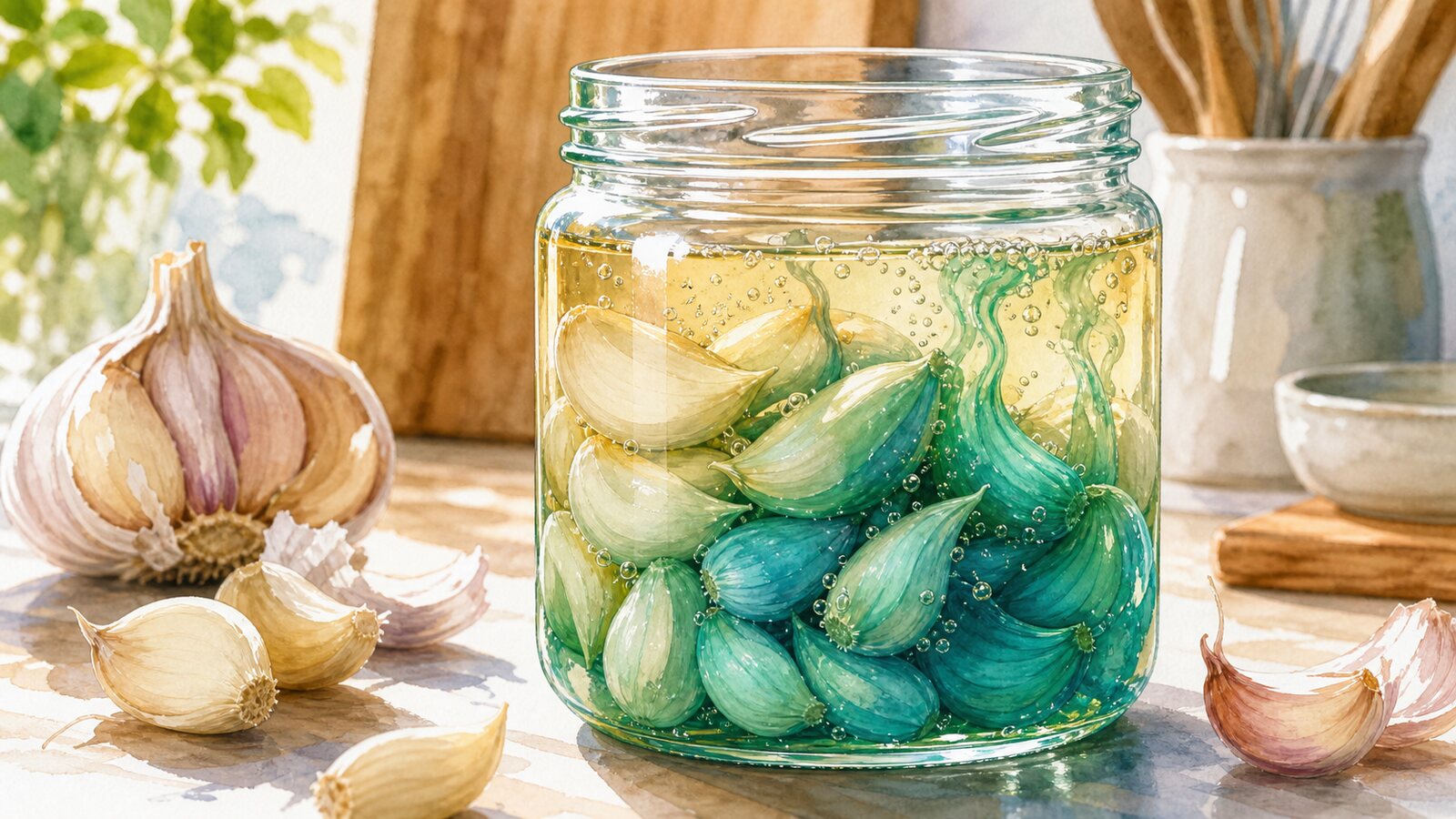
Pickled garlic turns blue, turquoise, or green mainly because acid and tissue damage bring garlic enzymes together with sulfur-containing precursors, starting a chain that produces blue-purple and yellow pyrrole pigments. Those colors overlap to look green. In a normally prepared pickle, the discoloration itself is not evidence of mold or decay, although color alone cannot certify that every preservation method was safe.
An intact clove is living plant tissue that keeps reactive ingredients in separate cellular compartments. Sulfur-bearing compounds such as alliin and isoalliin occupy one region, while the enzyme alliinase is stored largely in vacuoles. Cutting or crushing breaks those boundaries. The enzyme then converts the precursors into thiosulfinates, including compounds related to allicin, which also help create the familiar burst of pungent garlic aroma.
Vinegar pushes that damage-and-mixing process in a different direction. Acetic acid makes cellular barriers more permeable and creates a low-pH environment in which 1-propenyl thiosulfinates derived especially from isoalliin can react further with amino acids. The products assemble carbon-nitrogen rings called pyrroles. A 2017 study that isolated the color compounds and examined them with chromatography and mass spectrometry found not one green molecule but a mixture of many purple-blue and yellow species. Their combined absorption is what the eye interprets as blue-green.
This is not a clove rapidly manufacturing chlorophyll like a sunlit leaf. Nor is contact with copper a necessary universal explanation, although metal ions can alter color in some foods and older household advice often emphasizes cookware or water. Researchers can reproduce garlic greening in controlled systems made from the plant's own precursors, enzymes, amino acids, and acid. Modern chemical evidence therefore places garlic's sulfur chemistry at the center of the ordinary pickling phenomenon.
Some cloves green dramatically while others in the same recipe remain ivory because the starting materials vary. Cultivar, maturity, dormancy, handling, and storage temperature all affect how much isoalliin and related precursor is available. A 2023 Food Chemistry study compared garlic pre-stored at several temperatures and found that cloves kept at 4, 8, or 16 degrees Celsius greened more readily after pickling than those kept at 24 or 30 degrees. The cold treatments also altered glutathione and energy pathways associated with precursor accumulation.
Acidity is not a one-direction switch in which ever more acid guarantees ever more green. An early enzymatic stage must first make reactive thiosulfinates, and a later set of nonenzymatic reactions builds the colored structures. Conditions that disable alliinase too soon can interrupt the first stage, while insufficient acidity can slow later chemistry. Laboratory simulations of traditional Laba garlic found that both alliinase and acetic acid were required, with the overall sequence favored by a compromise between the different stages' preferred conditions.
The hue can also change while the jar stands. Blue-purple and yellow components do not necessarily form or persist at identical rates, and some pigment diffuses out of the cloves into the brine. One clove may have suffered more membrane damage or contain more precursor than its neighbor, leaving white, pale aqua, and deep green pieces together in one vessel. The patchwork records local reaction history rather than the application of an external dye.
In northern China, Laba garlic deliberately uses this chemistry: emerald cloves are a desired seasonal food, not a manufacturing failure. Producers who want white pickled garlic instead try to control storage history, blanching, pH, and enzyme activity. The contrast shows why appearance must be interpreted in context. Greening can change a consumer's expectation of a product without implying that the clove has suddenly become poisonous or that every aspect of flavor and nutrition has moved in the same direction.
Food safety still has to be assessed independently of pigment. Researchers can reproduce the color with garlic's own enzymes and chemical precursors in the absence of spoilage organisms, so blueness by itself does not prove that a clove has decayed. Conversely, an expected shade cannot validate the recipe, acidity, seal, or storage conditions. The startling color in an otherwise sound acidic pickle is best understood as garlic's compartmentalized defense chemistry being dismantled and recombined into a visible family of pyrrole pigments.
EDITORIAL RESPONSIBILITY
FactosBrain Editorial Desk
The FactosBrain Editorial Desk researched and reviewed this article under our editorial policy. We assess error reports under our corrections policy.