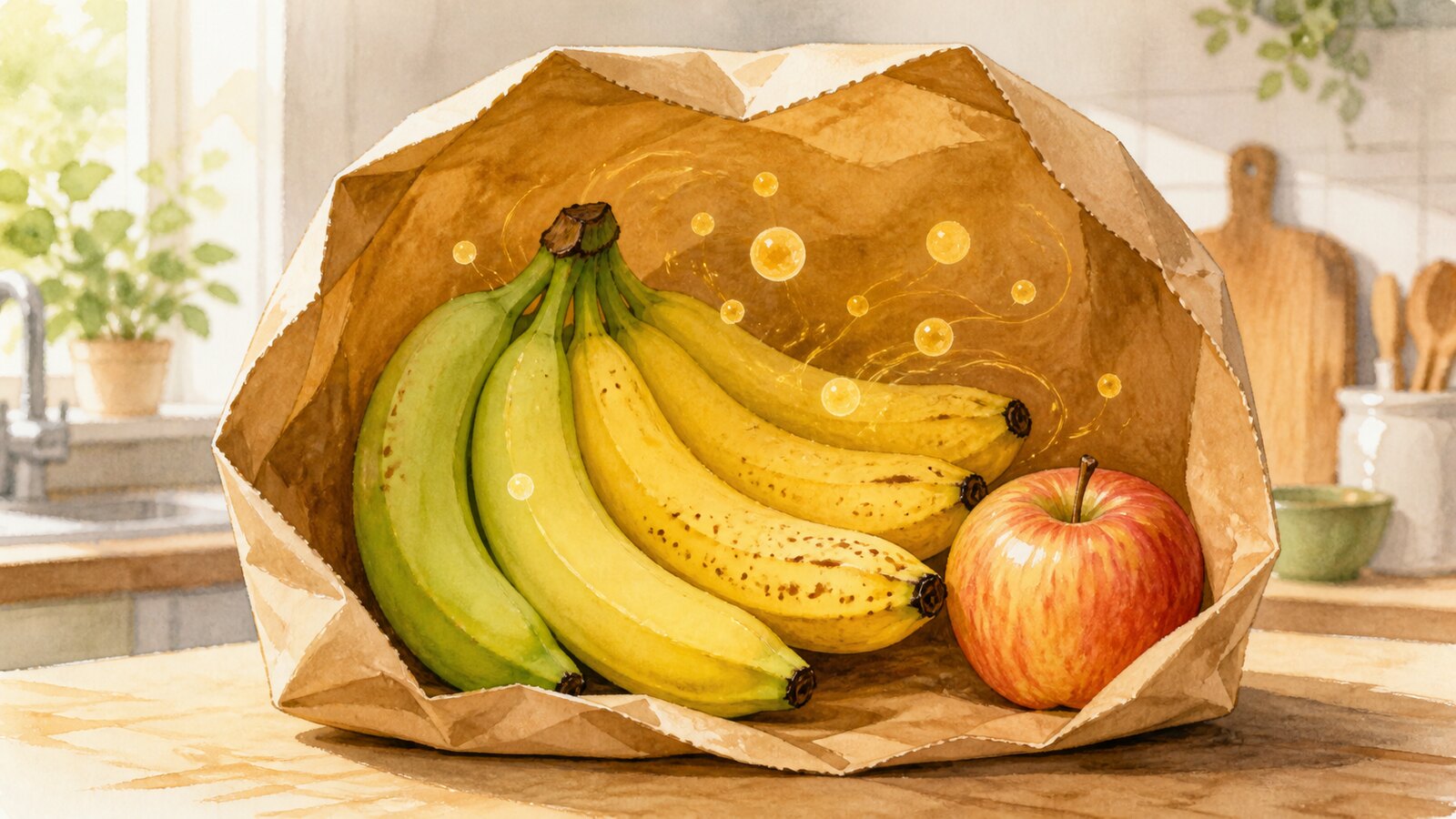
Bananas ripen faster in a paper bag mainly because ethylene, a gaseous plant hormone released by the fruit, remains at a higher concentration around it than it would in an open room. The signal accelerates coordinated changes that convert starch to sugar, soften tissue, reduce green color, and build ripe aromas. Darkness or the brown color of the paper is not the switch that starts ripening.
A banana is a classic climacteric fruit, meaning that ripening continues after harvest and is associated with a sharp rise in respiration and ethylene production. Ethylene does not heat the fruit like a fuel. It binds to cellular receptors and alters signaling that controls ripening genes and enzymes. A mature green banana can consequently move from a firm, starchy state into an edible ripe state through an organized physiological program.
A banana left on a counter still releases ethylene, but the gas diffuses into the much larger room and is removed by ventilation. A paper bag creates a small air volume around the fruit without becoming completely airtight. If ethylene is generated faster than it escapes, its local concentration rises and exposure lasts longer. Adding a ripe apple or another ripe banana can speed the process because that fruit supplies additional ethylene to the same enclosed space.
The response involves far more than peel color. Chlorophyll is dismantled, revealing yellow pigments that were already present. Stored starch is converted into glucose, fructose, sucrose, and related carbohydrates, making the pulp taste sweeter. Changes to pectin and other cell-wall components loosen the tissue and soften the fruit. Acids, astringency, and numerous volatile molecules also change, producing the recognizable aroma and flavor of a ripe banana.
Banana ripening has an amplifying component: an ethylene signal can promote the fruit's own ethylene-production machinery. Exposing a mature green banana to ethylene can trigger a brief production peak together with the respiratory climacteric. Commercial handlers use this biology in controlled rooms, applying a known ethylene concentration while managing temperature, humidity, oxygen, and carbon dioxide for uniform results. A household paper bag is not a precision chamber, but it recruits the same signaling system by concentrating what the fruit releases.
Paper and plastic do not create identical miniature atmospheres. Plastic can retain abundant water vapor, allowing condensation to collect on the peel and favoring decay. A tightly sealed bag can also reduce oxygen and allow carbon dioxide to accumulate; sufficiently high carbon dioxide can delay normal ethylene action. Paper slows the loss of ethylene while allowing moisture and other gases to pass gradually. Its usefulness comes from that imperfect enclosure rather than from maximum possible sealing.
The bag cannot make every banana ripen equally well or on the same schedule. Harvest maturity, cultivar, starting color, bruising, and temperature all affect the response. Temperatures that are too low can cause chilling injury and disrupt peel color, aroma, and normal ripening, while excessive warmth increases water loss and decay. Ethylene advances the ripening program of a mature fruit; it cannot instantly turn physiologically immature tissue into a high-quality ripe banana.
Brown spotting belongs to later stages of the same accelerated timeline. As tissue ages and cell compartments lose integrity, oxidative enzymes can contact phenolic compounds and produce browning. The pulp may become softer and taste sweeter for a time, but continued breakdown eventually becomes senescence and decay. Keeping the bag closed longer does not indefinitely extend ideal ripeness. It moves the whole sequence forward, including the point at which eating quality begins to decline.
Not all fruits use the banana's strategy. Apples, pears, peaches, avocados, and other climacteric fruits can continue ripening after harvest through ethylene-linked processes. Fruits commonly classified as non-climacteric, including grapes and strawberries, do not complete the same starch, sweetness, and texture program after picking merely because they share a bag with a banana. The method changes the signal environment; it is not a universal ripening machine.
A paper bag therefore speeds a banana by linking gas retention to the fruit's own physiology. The banana emits ethylene, the bag keeps more of that signal nearby, and cellular responses change pigment, starch, cell walls, and aroma together. The fact that paper still exchanges moisture and air is part of the explanation: successful ripening needs a concentrated signal, but it does not benefit from every gas and drop of water being trapped without limit.
EDITORIAL RESPONSIBILITY
FactosBrain Editorial Desk
The FactosBrain Editorial Desk researched and reviewed this article under our editorial policy. We assess error reports under our corrections policy.