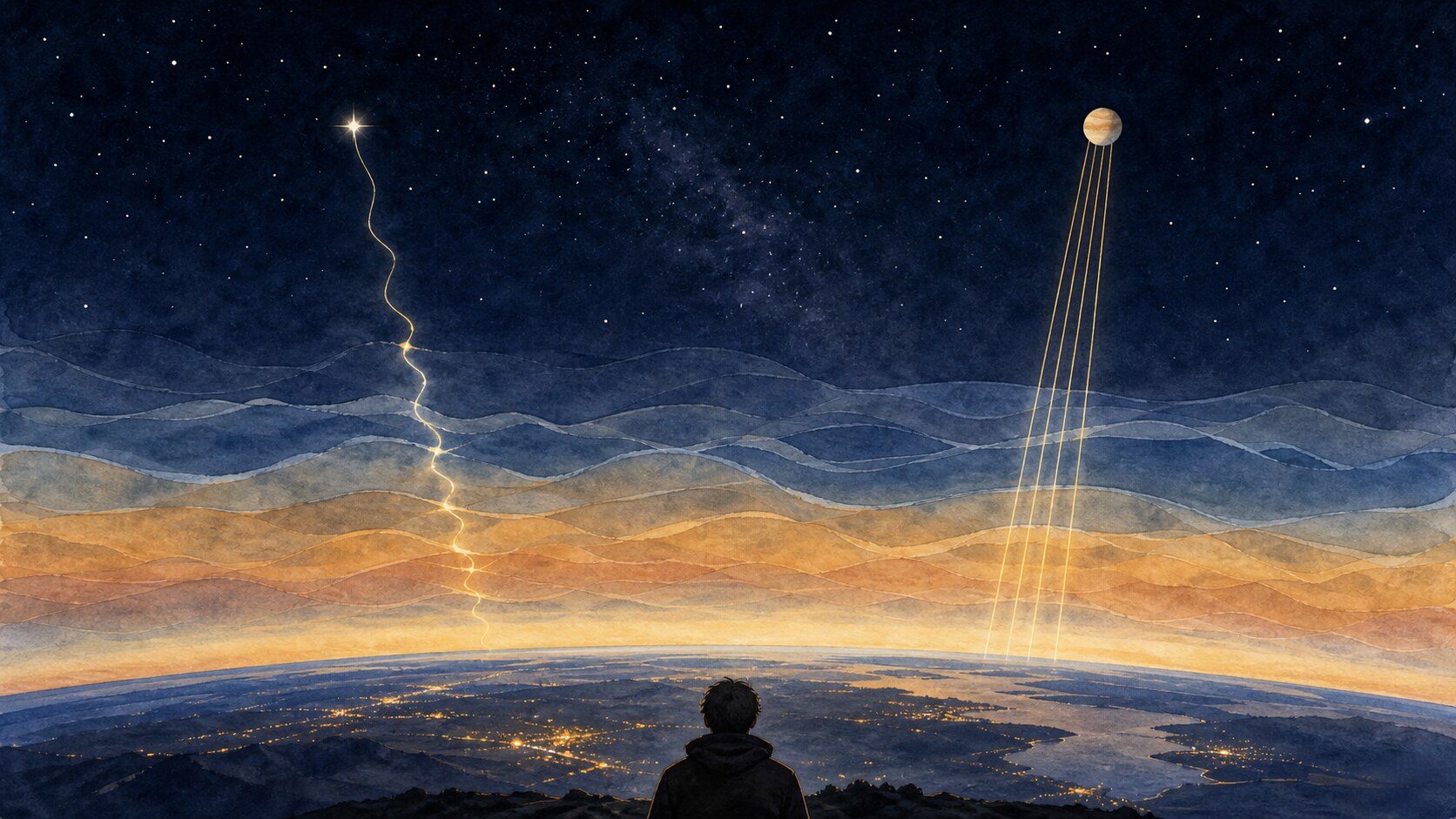
Stars twinkle while planets usually appear steadier because of Earth's atmosphere and the objects' apparent sizes, not because the stars themselves are shaking. A distant star reaches the unaided eye as an unresolved point. A nearby planet, though tiny, has a finite disk. Atmospheric fluctuations strongly affect a point source, while signals from different parts of a disk tend to average together.
The atmosphere is not a uniform transparent sheet. Moving pockets of air with different temperatures and densities have slightly different refractive indices. As starlight crosses those layers, its path and focus change from moment to moment, shifting the apparent position and brightness. Because wavelengths bend by slightly different amounts, a bright star near the horizon can also seem to flash in several colors.
A star may be as large as the Sun or larger, but its great distance makes it point-like at the resolution of the eye. When turbulent air alters that narrow bundle of light, much of the observed source changes together. Astronomers call the resulting rapid variations in brightness and position atmospheric scintillation.
Planets are far closer and subtend small disks even when they look like points without magnification. Light from different places across a planetary disk follows slightly different atmospheric paths. A momentary brightening or dimming of one portion is partly balanced by fluctuations elsewhere. The eye combines those rays, leaving the total light steadier than that from a star.
It is therefore too simple to say that planets never twinkle. A planet with a small apparent disk, especially near the horizon, can scintillate after its light crosses a longer and often more turbulent path. Stars generally twinkle less when they are high in the sky, where their light passes through less atmosphere. On a very unstable night, the distinction may be less obvious.
Instruments above the atmosphere do not experience this atmospheric twinkling. Ground observatories choose high, dry sites and can use adaptive optics, measuring rapid distortions and reshaping a mirror to compensate. The familiar shimmer does not show a star changing its true output from instant to instant; it reveals moving air between the source and the observer.
EDITORIAL RESPONSIBILITY
FactosBrain Editorial Desk
The FactosBrain Editorial Desk researched and reviewed this article under our editorial policy. We assess error reports under our corrections policy.