An explosion in open space would not send an airborne boom to a distant listener. Sound is a mechanical wave: vibrations pass from one particle of matter to its neighbors. In the near-vacuum between planets, particles are generally far too sparse to maintain that chain as an ordinary audible pressure wave.
On Earth, a speaker moving back and forth alternately compresses and expands nearby air. Those pressure variations travel through molecules and eventually move an eardrum. Water molecules can carry sound underwater, and vibrations can move through the atomic structure of a solid. Sound does not require air specifically, but it does require a material medium.
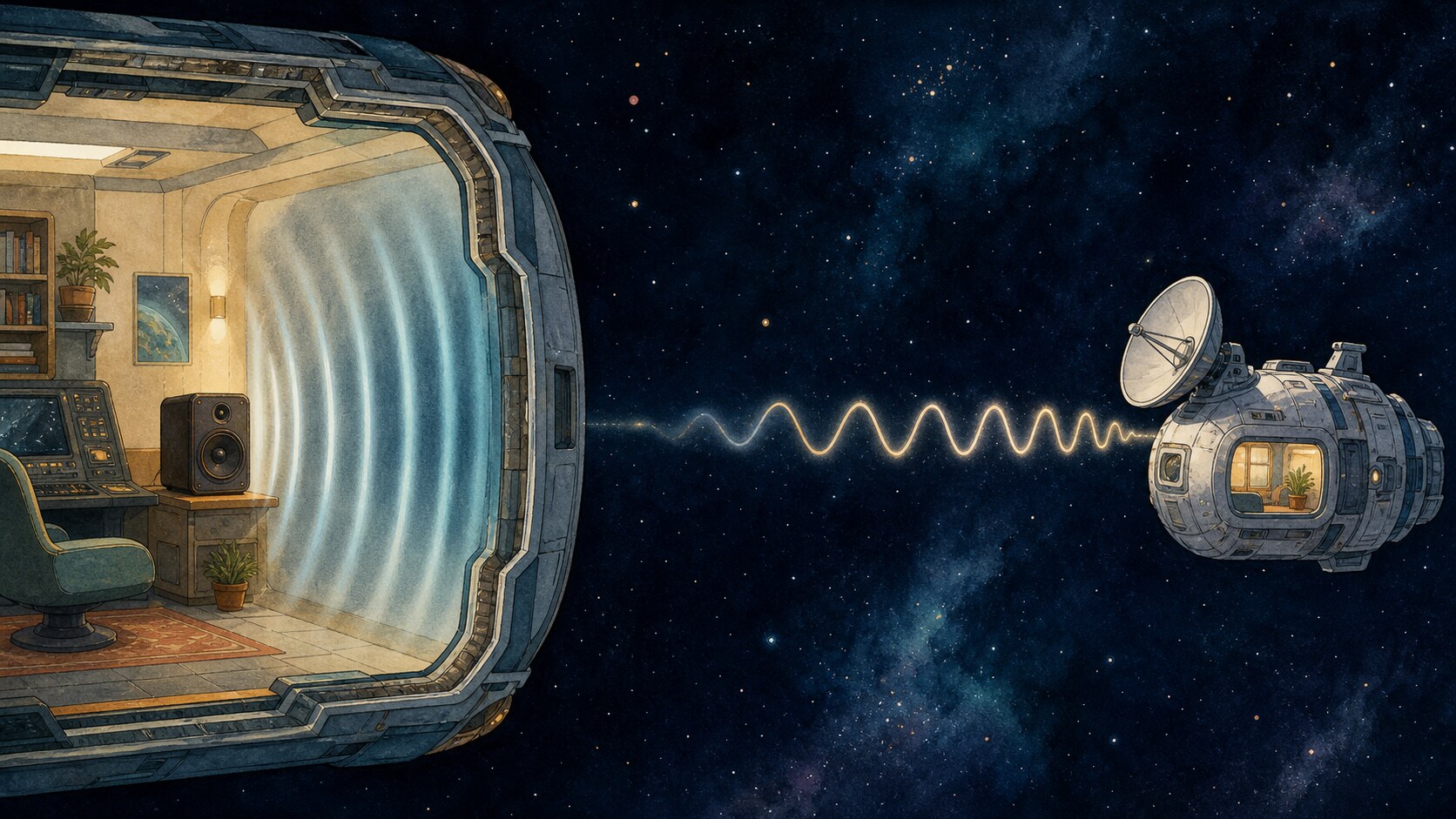
Space is not perfectly empty. It contains thin gas, plasma and dust, yet most interplanetary space is much too tenuous to transmit familiar sound. Local exceptions matter: sound can travel inside a spacecraft, within a spacesuit or through a planet's sufficiently dense atmosphere because those places contain particles close enough to interact.
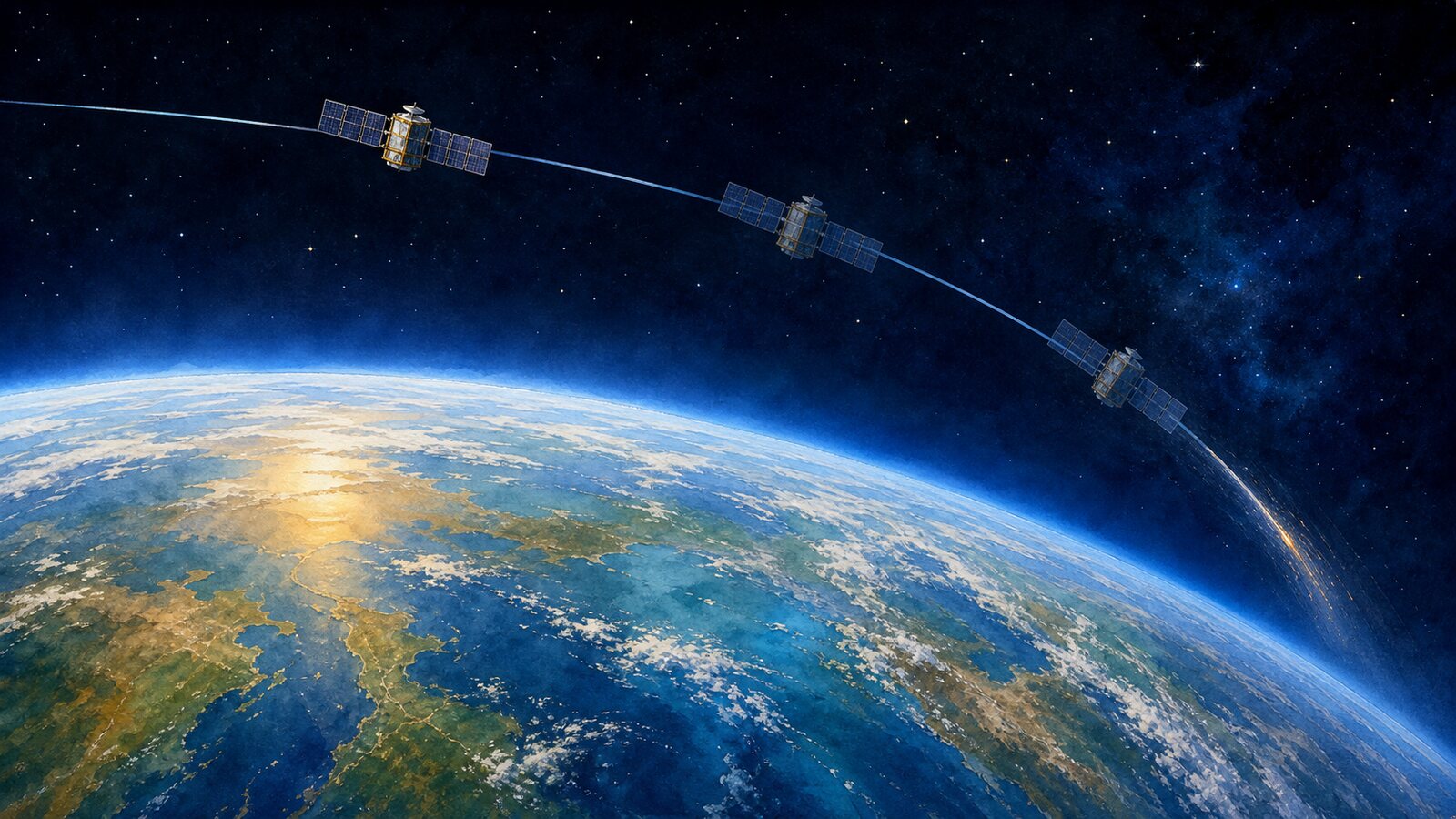
Astronauts use radio not because their voices cross the vacuum as sound. A microphone detects the pressure wave inside a suit and converts it to an electrical signal. A transmitter encodes that information onto electromagnetic radio waves, which can cross a vacuum. Receiving equipment then converts the signal back into sound beside the other astronaut's ear.
Movies therefore use artistic license when an external spacecraft explosion produces a huge boom in every direction. A shock wave can exist within the explosion's expanding gas, and debris striking a hull could make the solid structure vibrate. But no airborne sound bridges the mostly empty distance between separated objects.
The widely shared “sounds of space” from NASA and ESA need the same distinction. Instruments measure radio emissions, electrical and magnetic plasma waves, or changing particle data. Researchers can shift frequencies into the audible range or map measurements onto audio. The result can reveal patterns and make data accessible, but it is not a microphone recording pressure waves in a vacuum.
Saying space is silent does not mean it lacks activity or waves. Electromagnetic and plasma phenomena move throughout it, while sound exists in local regions containing enough matter. The decisive question is the type of wave: sound needs coupled particle motion, whereas light and radio consist of changing electric and magnetic fields that can cross empty space.
EDITORIAL RESPONSIBILITY
FactosBrain Editorial Desk
The FactosBrain Editorial Desk researched and reviewed this article under our editorial policy. We assess error reports under our corrections policy.