Look a little closer
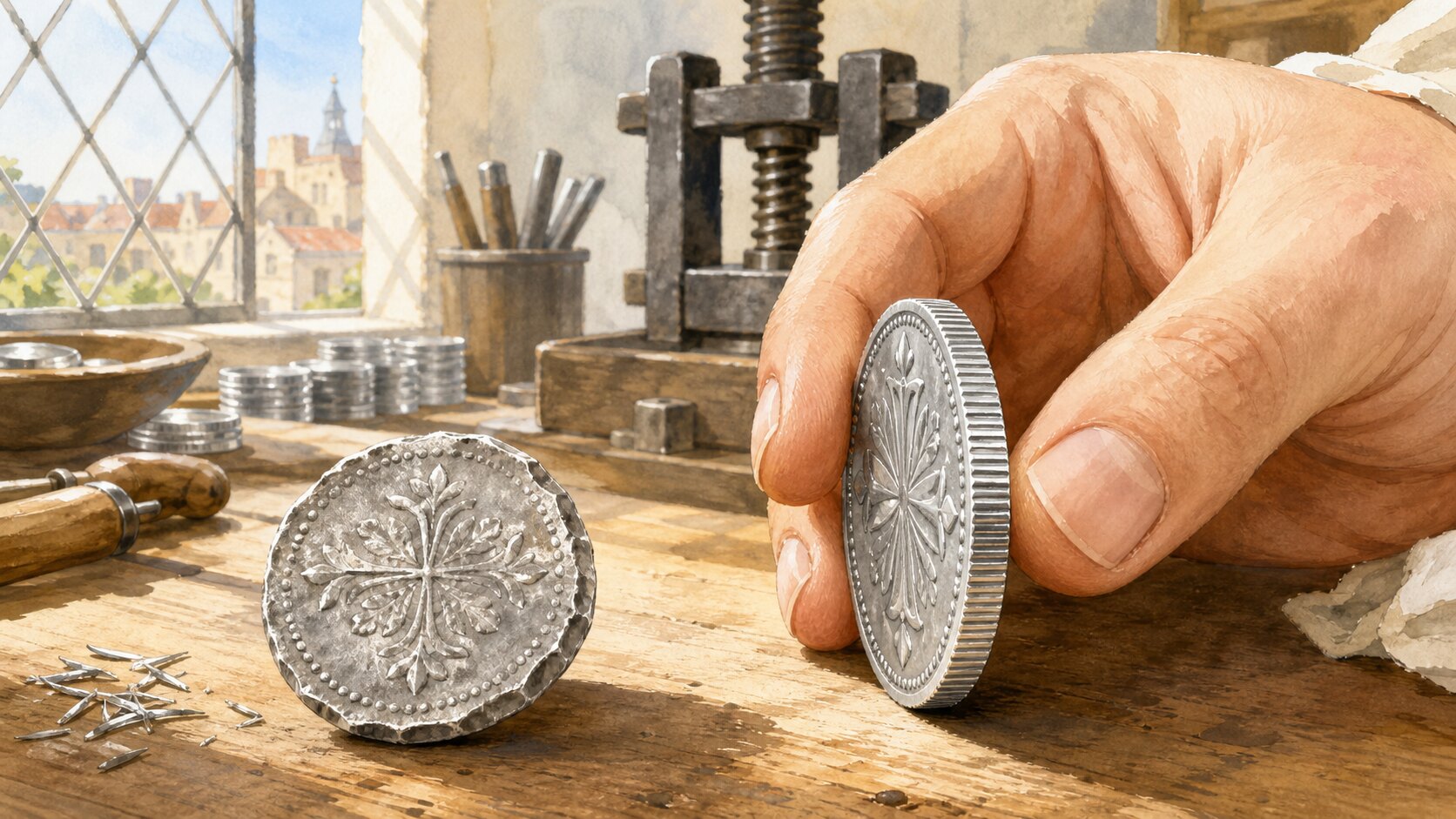
The fine grooves on some coin edges began as a way to expose clipping—the theft of tiny amounts of precious metal from gold and silver coins. A continuous pattern of reeds or lettering established a visible boundary, so shaving the circumference broke or removed the pattern. Most circulating coins today contain far less metal value than their denomination, yet the old feature survives with newer jobs: denomination recognition, anti-counterfeiting, machine identification, and design.
Hammered coins gave a thief useful camouflage. A moneyer placed a metal blank between dies and struck it by hand, so the resulting piece might be irregular, off-center, or poorly filled at the perimeter. Gold and silver coins derived much of their accepted value from a specified weight and fineness, not merely from an official number. A sliver removed from one coin looked trivial, but metal collected from many coins could be melted or reused while the lightened pieces were passed on.
The deeper problem was that an honest irregular edge and a deliberately reduced edge could be difficult to distinguish. If merchants began rejecting underweight money, full-weight pieces tended to be hoarded, melted, or selected for export while worn and clipped pieces remained in circulation. A mint therefore needed more than an attractive border. It needed a repeatable public line showing where the original circumference had been, making subsequent subtraction conspicuous.
Rolling mills and screw presses made that line practical on a large scale. The Royal Mint Museum records that machinery overseen by French engineer Pierre Blondeau under Charles II produced thicker, more uniform machine-struck British coinage beginning in 1662 and enabled security devices such as milling and edge lettering. Some large gold and silver pieces bore a Latin edge inscription meaning “an ornament and a safeguard.” If the words or regular pattern disappeared, the missing metal was harder to disguise.
This history should not be compressed into the popular claim that Isaac Newton invented ridged coins. Newton did become Warden and then Master of the Royal Mint, vigorously pursued counterfeiters, and participated in the Great Recoinage of 1696. But British machine-struck coins with processed edges were in production decades before he joined the Mint, and Continental European experiments preceded those. Reeding emerged from a long technical transition involving uniform strip, accurately cut dies, powerful presses, and edge-working machinery—not one famous person's isolated invention.
A modern mint does not normally carve every groove into each finished coin. In the production sequence described by the United States Mint, a blank first passes through an upsetting mill that raises a protective rim, becoming a planchet. During striking, upper and lower dies impress the faces while a collar contains the metal flowing outward under pressure. The collar can form a plain, reeded, or lettered edge at that moment. Some designs use another route: U.S. dollar coins, for example, receive a smooth edge in the press and later have lettering rolled onto it by a separate machine.
Not every coin is reeded because the edge is part of a denomination's complete specification. Official coin terminology distinguishes plain, reeded, lettered, and decorated edges. Giving similarly sized pieces different edge textures helps people distinguish them by touch in a pocket or low light, and it can provide an accessibility cue for people with limited vision. Vending, sorting, and counting equipment may also evaluate edge behavior alongside diameter, thickness, mass, and electromagnetic properties. The grooves are useful, but they are only one signal.
Security remains relevant even though its target has changed. Shavings from an ordinary copper- or nickel-based circulation coin are generally worth less than the face value, so historical clipping offers little profit. A precisely controlled count, spacing, or interruption of reeds can instead make faithful counterfeiting more demanding. Since 2021, the American Eagle silver bullion coin has included a deliberate reeded-edge variation as an enhanced security feature. Such a device does not authenticate a coin by itself; alloy, dimensions, mass, surface relief, and other overt or covert features work together.
A worn or incomplete edge is not automatically evidence of theft. Years of contact can soften reeds, while weak strikes, misaligned collars, or other minting errors can leave unusual edges. Conversely, a deliberately plain edge does not mean a coin lacks security: shape, multiple metals, fine surface features, and machine-readable material responses can carry that burden. Those little ridges are therefore neither a useless ornament nor a timeless solution to one crime. They are a visible remnant of the era when a coin's perimeter guarded its precious-metal weight, adapted into the modern language of recognition and layered security.
EDITORIAL RESPONSIBILITY
FactosBrain Editorial Desk
The FactosBrain Editorial Desk researched and reviewed this article under our editorial policy. We assess error reports under our corrections policy.