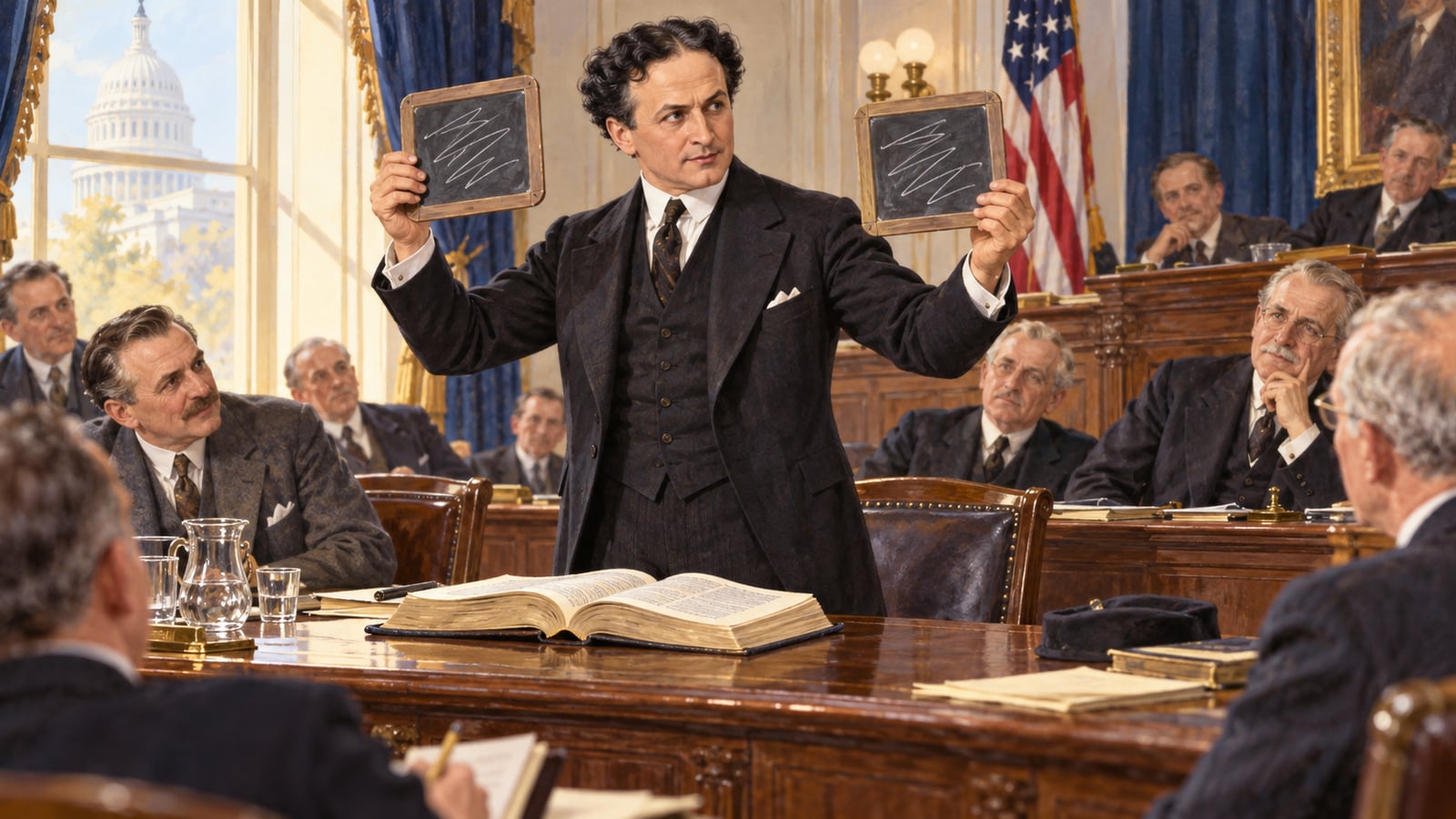
Harry Houdini arrived at a congressional hearing with a pair of slates. He had them examined and asked a representative to insert a card into a dictionary. Soon a slate supplied the page number and words from that page. It looked like a message obtained with supernatural assistance. Houdini had already told everyone that it was a trick.
The occasion was a 1926 hearing on a bill aimed at paid fortune-telling and related fraudulent practices in Washington, D.C. Representative Sol Bloom initially expected to explain his business in about twenty minutes. The printed proceedings eventually covered four hearing dates spread across February and May.
For Houdini, the difference between his profession and a fraudulent séance was what the customer understood. A theater audience paid to enjoy an illusion. Someone seeking a dead relative's voice might pay because they believed the communication was real. Reproducing the effect by ordinary means challenged its use as evidence of a spirit's presence.
His slate performance developed into a reading for Representative Florence Kahn. Houdini invoked George Washington as a spirit guide and produced a message bearing Benjamin Franklin's name. Asked whether she had recently received an important letter she had decided not to answer, Kahn replied that she had received sixty-eight. The official transcript records laughter and applause.
The representatives then wanted an explanation. After mentioning his obligations as a magician, Houdini described gathering information and making deductions and guesses. He had heard Kahn express interest in receiving a message. What looked like access to another world could begin with attention to people in the room.
That did not settle the matter. One spiritualist responded that Houdini was demonstrating his own spiritual powers. His insistence that he was performing a trick had failed to determine what everyone else thought they had witnessed.
Later hearings became noisier still. Investigator Rose Mackenberg described visits to mediums, who disputed her testimony. Her account of a claim about White House séances prompted an official denial. The New York Times reported demands that police be called as accusations flew. The proceedings had become an argument about who had said what as well as what mediums could do.
Supporters described the measure as protection against fraud. Opponents saw a threat to their religion. The bill never emerged from committee. Houdini could reproduce a supposedly supernatural effect before the representatives, explain his lack of supernatural powers, and still leave a room full of people disagreeing about what the demonstration meant.
EDITORIAL RESPONSIBILITY
FactosBrain Editorial Desk
The FactosBrain Editorial Desk researched and reviewed this article under our editorial policy. We assess error reports under our corrections policy.