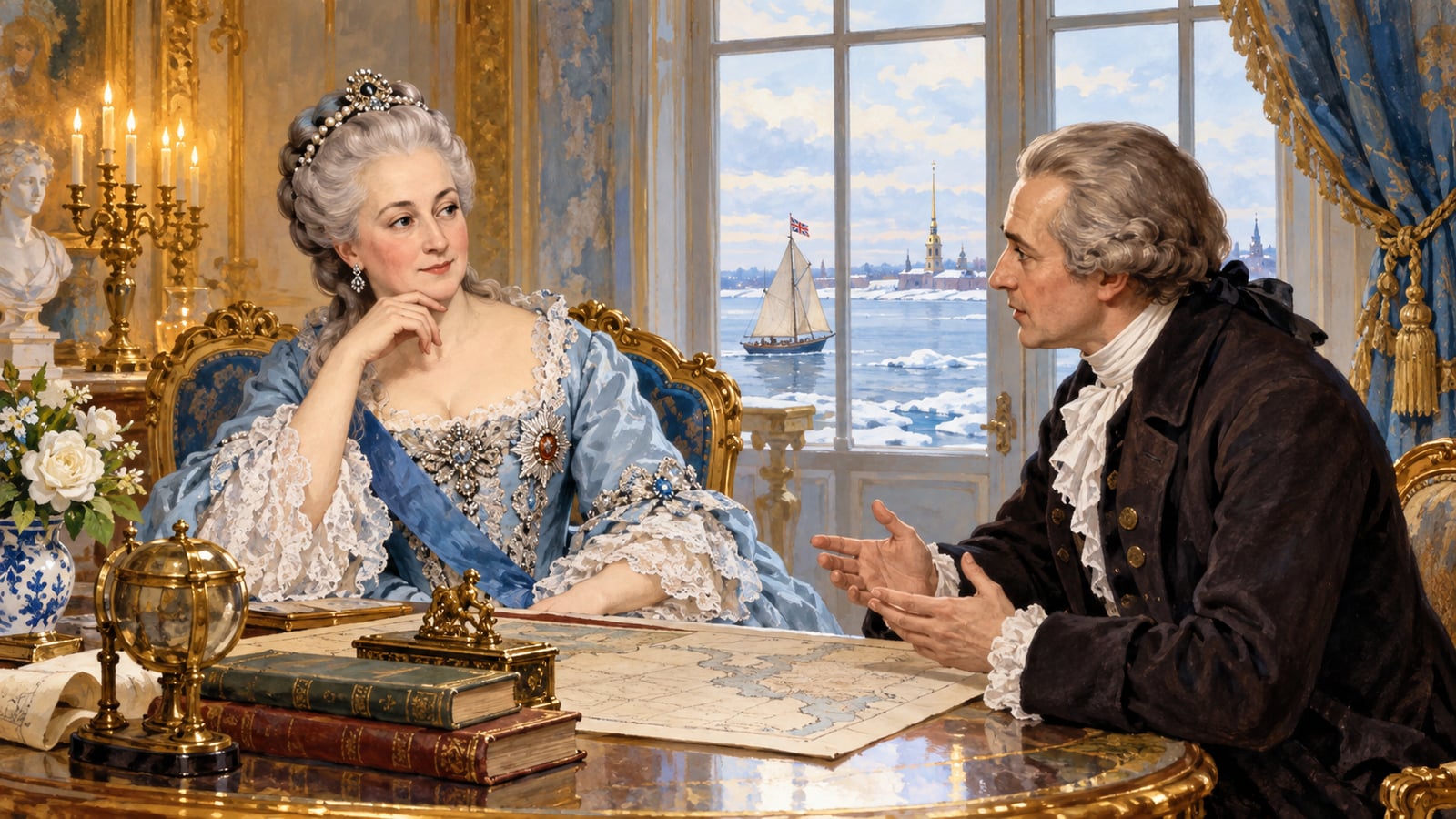
Thomas Dimsdale traveled to Russia to give its empress a disease she did not yet have. The English physician's task was to inoculate Catherine II against smallpox. Success could protect her from a devastating infection. Failure might leave a foreign doctor responsible for the death of a sovereign.
In 1768, this meant variolation: using material from human smallpox to induce an illness expected to be milder than naturally acquired infection. It preceded the cowpox-based vaccination associated with Edward Jenner. Catherine's decision involved deliberately undergoing illness in the hope of avoiding something worse.
Dimsdale had an established practice and a family in England. At fifty-six, he initially declined the invitation. Renewed approaches persuaded him to travel with his son Nathaniel, a medical student. In Russia they received generous accommodations and attention, but the hospitality did little to remove the burden of the undertaking.
Catherine was well informed about inoculation and intended to go first before having her son Paul treated. When Dimsdale sought assistance from court physicians, she objected that they lacked experience in the procedure. Her confidence placed him at the center of the project rather than allowing him to share much of its responsibility.
His own account described anxiety spoiling the grandeur around him. Historian Lucy Ward's research also uncovered a striking precaution: Catherine had a yacht made available in the Gulf of Finland so that he could escape if events went badly. The arrangements considered his survival as well as hers.
The inoculation took place privately at night. Catherine then moved to a summer palace, where Dimsdale followed her progress. The operation itself could not provide an immediate verdict. Recovery had to follow. When it did, his account recorded an enormous release of worry.
Paul was subsequently inoculated successfully too. What had begun in secrecy became a public occasion for thanksgiving. Dimsdale received a barony, money and a pension. He and Nathaniel remained in Russia to undertake further inoculations.
The doctor did not need the emergency departure prepared for him. In 1781 he returned to Russia on another invitation, this time to inoculate Catherine's grandsons. The family whose future had made his first assignment so daunting was ready to entrust another generation to him.
EDITORIAL RESPONSIBILITY
FactosBrain Editorial Desk
The FactosBrain Editorial Desk researched and reviewed this article under our editorial policy. We assess error reports under our corrections policy.