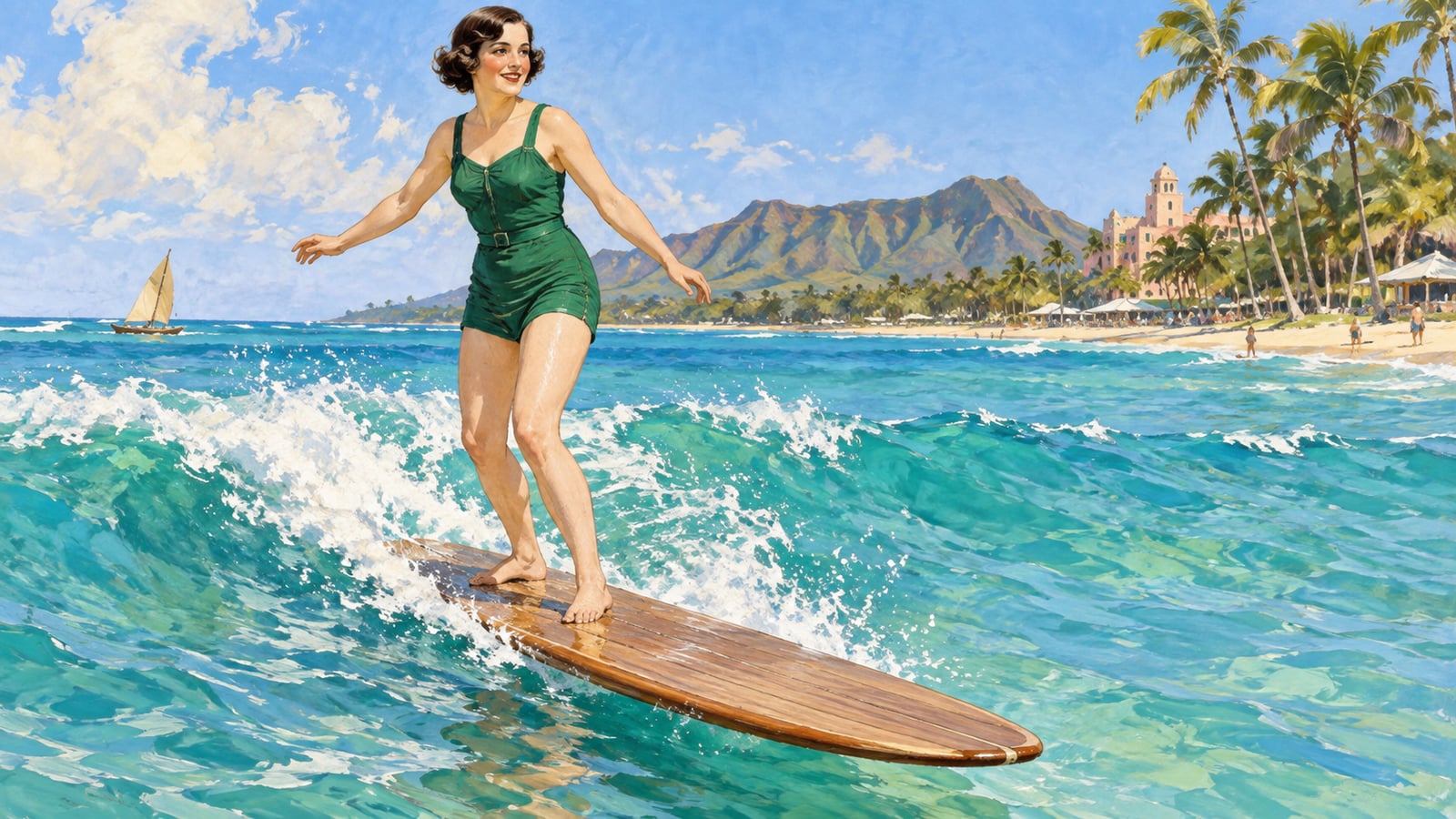
On Agatha Christie's first attempt at surfing in Hawaii, her board made better progress toward the beach than she did. A wave separated them, leaving her to swim after it. Her husband, Archie, also lost his board. Experience in South Africa had given the couple confidence. It had not prepared them for that day's conditions at Waikiki.
It was 1922, and the Christies were traveling with a mission promoting the forthcoming British Empire Exhibition. Archie had joined the expedition, and Agatha went with him, leaving their young daughter in her sister's care. The journey took them far beyond the settings familiar to her first readers. She sent letters home to her mother, recording the places and experiences along the way.
In South Africa, the couple had discovered riding waves while lying on wooden boards. At Muizenberg, those boards were light enough to carry easily. Hawaii presented a different challenge. The Museum of British Surfing describes the substantial solid-wood boards then in use: maneuvering one of these meant dealing with considerable size and weight, quite apart from learning what to do on a wave.
Getting back to shore was only part of the undertaking. First came the effort of reaching the waves. Losing the board added another swim. The elegant ride visible from the beach concealed a great deal of work before the successful moment—and after the unsuccessful ones.
Christie later recalled that the early days could be painful, although occasional exhilarating runs kept punctuating the discomfort. Local assistance helped her choose when to set off. Recognizing a suitable wave mattered as much as enthusiasm. Gradually she progressed beyond simply hanging on for the ride.
Standing up became the next ambition. After roughly ten days, she began trying to rise onto her knees during a run and then get to her feet. Attempts ended in falls before one finally carried her upright all the way toward the shore. In her autobiography, she remembered the achievement with unmistakable delight.
The tour also left a less slippery record. Her grandson, Mathew Prichard, later assembled letters and photographs into The Grand Tour. Among the surviving images is a young Christie beside a large surfboard. The photograph preserves a different accomplishment from the puzzles associated with her name: she had learned to stay on the thing.
EDITORIAL RESPONSIBILITY
FactosBrain Editorial Desk
The FactosBrain Editorial Desk researched and reviewed this article under our editorial policy. We assess error reports under our corrections policy.