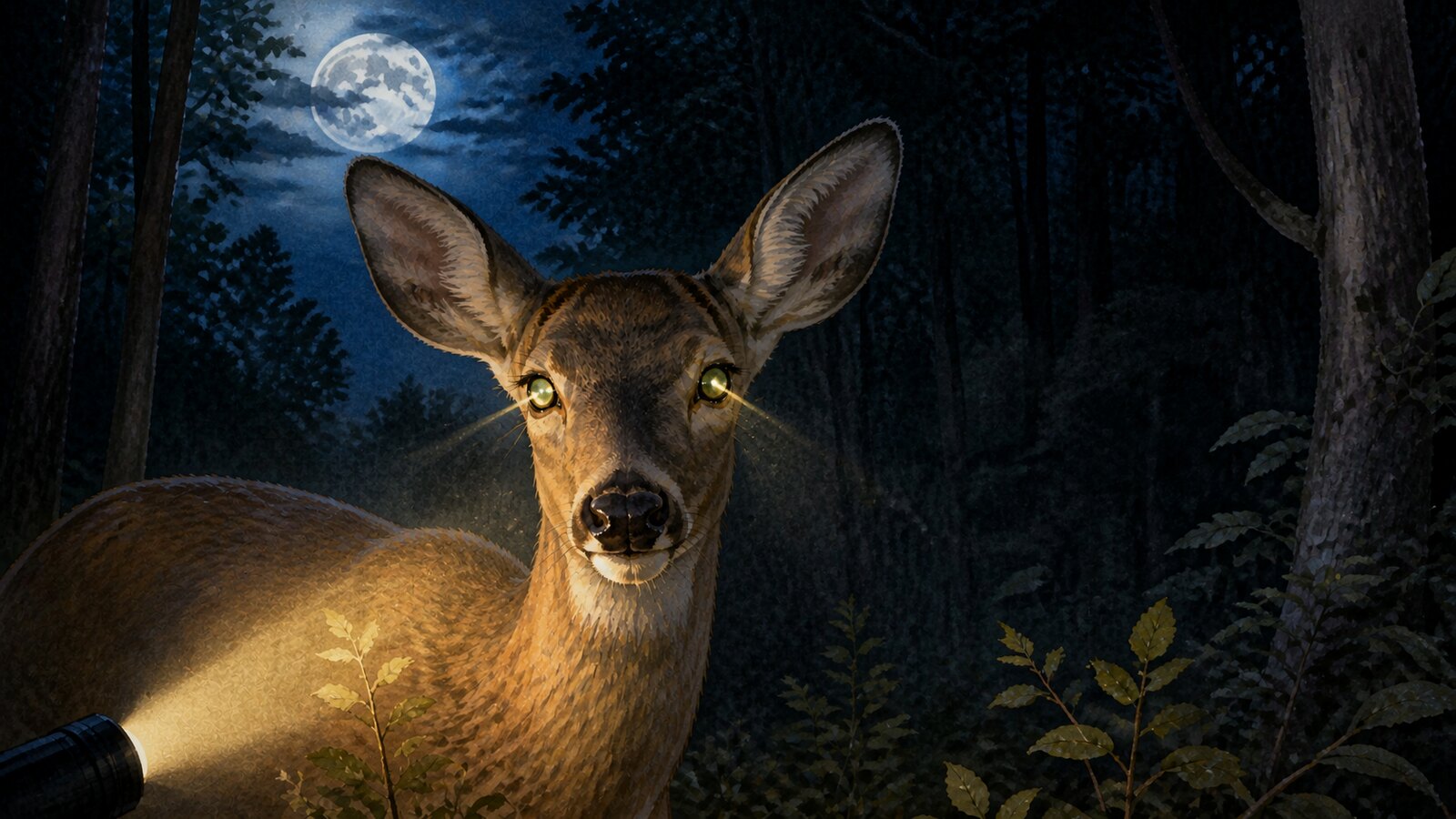
When some animals' eyes flash in headlights or a flashlight beam, the eyes are not producing light. A reflective structure behind the retina, called the tapetum lucidum, sends incoming light back through the eye. Some of that returned light exits through the pupil toward the observer. Eyeshine is therefore the visible by-product of a system that gives dim light another chance to be detected.
Light first passes through the cornea and lens and is focused on the retina. Photopigments in retinal rods and cones can absorb photons and begin a neural signal, but not every photon is captured on its first passage. In an eye with a tapetum, light that passes through the receptor layer reaches the reflector rather than simply disappearing into darker tissue behind the retina.
The tapetum is not one universal sheet of silvered mirror. Different groups of vertebrates build reflective layers from specialized cells, fibers, crystals, or intracellular structures. Their microscopic spacing and organization can strongly return particular wavelengths. Reflected light crosses the photoreceptor layer again, increasing the probability that a photon missed on the way in will stimulate a receptor on the way back.
The geometry explains why eyeshine appears strongest when the observer is near the light source. Much of the returning light travels back toward the direction from which it arrived. A person holding a flashlight close to eye level, or a camera whose flash sits beside the lens, is well placed to receive it. Someone standing far to one side may see little glow from the same animal. This directional reflection is unlike bioluminescence, which originates in an organism.
Eyeshine may look yellow, green, blue, orange, or nearly white. Its color depends on the material and layered structure of the tapetum, the species and sometimes the animal's age, the spectrum of the lamp, and the angles of illumination and viewing. Even the two eyes of one animal may look different if its head is turned. Color alone is consequently an unreliable way to identify a distant animal.
Reusing light has a tradeoff. Sending photons through the retina a second time can improve sensitivity when photons are scarce, but reflected light may also spread and blur fine spatial information. A tapetum does not simply double vision or guarantee a perfectly sharp night image. It shifts the balance toward detecting faint objects, while optical design and neural processing determine how much detail is retained.
A dilated pupil adds to the effect. In darkness, a large pupil admits more of the lamp's light and allows more reflected light to leave. The pupil begins to constrict under bright illumination, but that response is not instantaneous. Prolonged bright beams can temporarily disrupt an animal's dark adaptation or orientation, so responsible nighttime observation uses restrained light, distance, and brief exposure.
Humans normally lack a tapetum lucidum. The red-eye seen in flash photographs has related geometry but a different reflecting surface: flash light enters a wide pupil and returns from blood-rich retinal and choroidal tissues. It is most conspicuous when the room is dark and the flash is close to the camera lens. Calling human red-eye a tapetal reflection confuses two distinct anatomical mechanisms.
Not every nocturnal animal has a tapetum, and having one does not mean an animal is active only at night. Cats, deer, and many other vertebrates possess versions of the structure, but different lineages use different reflective materials and arrangements. Other animals meet low-light demands with larger eyes, more rods, wide pupils, or specialized neural processing. Night vision is a package of adaptations, not a single mirror shared by all species.
Animal eyeshine is thus returned external light created by anatomy and viewing position. A photon crosses the retina, reflects from the tapetum, receives another opportunity to stimulate a receptor, and may then emerge through the pupil toward the lamp. The sudden green or golden flash is not a supernatural glow. It reveals a finely structured optical system that extracts more information from the limited light available after dark.
EDITORIAL RESPONSIBILITY
FactosBrain Editorial Desk
The FactosBrain Editorial Desk researched and reviewed this article under our editorial policy. We assess error reports under our corrections policy.