Look a little closer
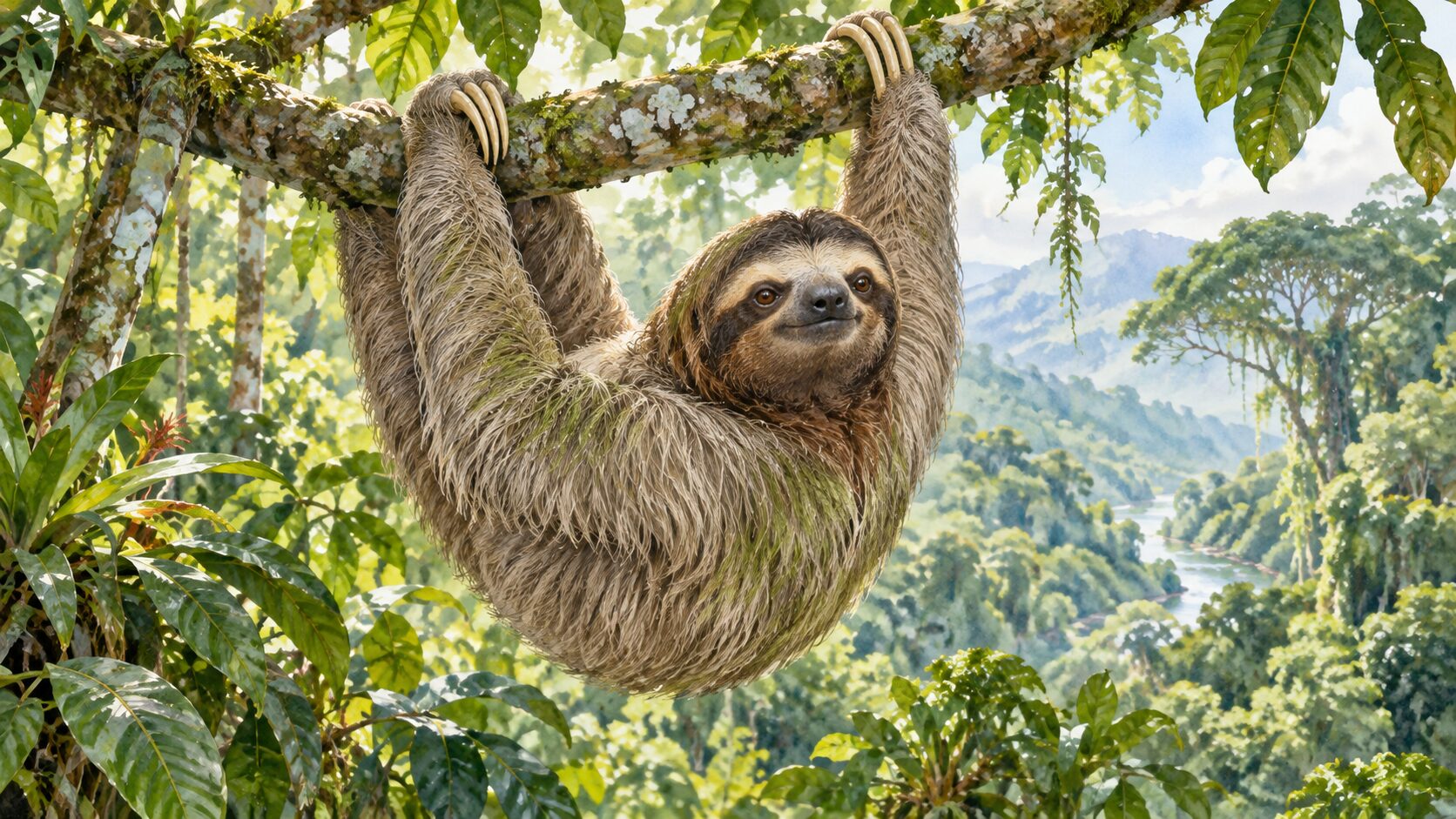
The green tint in a sloth's coat comes mainly from green algae living on its hairs, rather than from the animal producing naturally green fur. These tiny photosynthetic organisms add color to a coat that is otherwise grayish or brownish. Not every sloth looks vividly green, however, and a coat that appears brown can still contain algae. Visible color is therefore a useful clue to this small community, but it is not a reliable yes-or-no test for whether algae are present on an individual animal.
Algae are organisms that can contain pigments used in photosynthesis; many are familiar as the green growth seen in wet places. On a sloth, microscopic cells contribute their color to the appearance of the hairs they inhabit. This does not mean that the mammal has turned into a plant or that its own body cells can live on sunlight. The photosynthetic resident and the animal carrying it are different organisms. In this relationship, fur supplies a surface on which other life can establish itself, rather than becoming a leaf in a different form.
That surface has unusual physical features. Sloth hairs can have longitudinal grooves or transverse cracks, depending on the kind of sloth. Such small spaces may help provide places for algae to attach and encounter moisture. The Smithsonian's National Zoo describes algae giving two-toed sloths a greenish appearance under moist conditions. Still, a feature that helps a resident organism does not automatically prove that the feature evolved specifically to cultivate it. Showing that hair can offer a suitable habitat and explaining the evolutionary origin of that hair structure are related but separate research problems.
The identity of the green residents has been investigated directly. A 2010 study examined sloth hair using microscopy and molecular analysis, finding a diverse algal community and a close association with algae in the group Trichophilus. The significance goes beyond recognizing a green coating: superficially similar hairs need not host identical communities. Microscopy shows the organisms associated with the hair, while genetic evidence helps distinguish groups that might otherwise be difficult to separate by appearance alone. The explanation is therefore based on examining the residents themselves, rather than simply guessing from the animal's color.
Algae are not the only inhabitants. Moths, other arthropods, fungi, and bacteria also occur in the fur, making the sloth an interesting example of a mobile habitat. Its residents travel with it while remaining exposed to conditions in the surrounding forest, including moisture and light. Yet sharing the same coat does not establish that every inhabitant helps every other one. A close association between species can be described broadly as symbiosis; mutualism is the more specific claim that both partners benefit. That stronger claim requires evidence of benefits, not just evidence that the organisms live together.
Camouflage is a familiar proposed benefit. Greenish fur among leaves and branches seems plausibly less conspicuous, at least to a human observer. But this impression does not measure how predators actually detect sloths or how much the coloration improves survival. A 2021 review of the sloth-fur ecosystem emphasized gaps in the empirical support for some proposed relationships. Identifying algae as the source of the color is one question. Demonstrating that a particular advantage explains the persistence of the association is another, and the second requires more than an appealing visual match with the forest.
Another proposal links moths, algae, and sloth nutrition. A 2014 study investigated associations among moth abundance, inorganic nitrogen, and algal biomass in fur, and found algae in some digestive samples. The researchers interpreted their findings as support for a possible three-way mutualism in which moths help sustain algae and sloths obtain nutrients from them. However, variables increasing together do not establish every causal step. Algae reaching the digestive tract also does not, by itself, demonstrate that they are a major food or provide a substantial nutritional benefit. Later review leaves the behavior and size of any benefit as questions requiring care.
A green sloth thus presents both an established observation and an unfinished ecological explanation. Its coat can carry other living organisms, and those organisms can visibly change its appearance. How much the arrangement helps the mammal must be tested separately. A brown-looking individual should not automatically be classified as algae-free, and a greener one should not automatically be described as farming its own food. The most concrete discovery is already unusual enough: the outer covering of a mammal can function as a habitat whose residents have their own identities, requirements, and relationships.
EDITORIAL RESPONSIBILITY
FactosBrain Editorial Desk
The FactosBrain Editorial Desk researched and reviewed this article under our editorial policy. We assess error reports under our corrections policy.