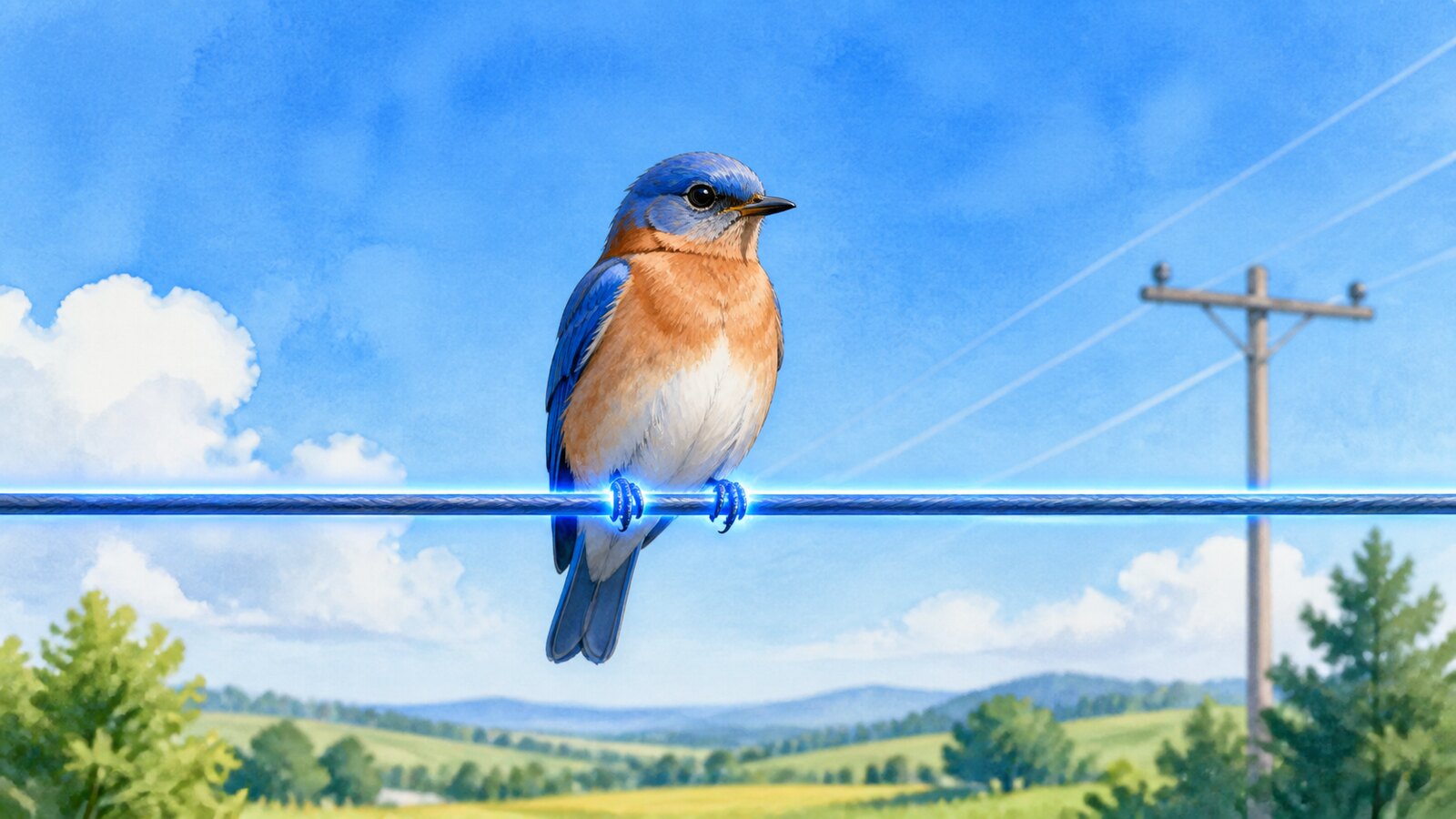
A bird perched with both feet on one power line is usually unharmed because there is almost no voltage difference across its body. The wire may be thousands of volts above ground, but two nearby points on the same good conductor are at nearly the same electric potential. With little difference to drive charge from one foot through the body to the other, only a negligible current takes that route.
Shock is not determined by a high voltage number in isolation. Voltage is a difference in electric potential between two points, while current depends on that difference and the resistance of an available path. If the whole bird rises to the line's high potential together, its feet can still be almost level electrically. A large potential relative to distant ground does not automatically create a large potential across the animal.
A real wire has some resistance, so the two contact points are not mathematically identical in potential. The short metal segment between the bird's feet, however, has far less resistance than the bird's body. Nearly all line current continues through the metal, and only the tiny voltage drop along that short span appears across the bird. Saying the harmful current is very small is more accurate than insisting that it is exactly zero.
This does not mean electricity chooses only one path of least resistance. When parallel paths exist, current divides among them according to their resistance and the voltage across them. The bird is technically one parallel route between two points on the wire. Its relatively high resistance and the extremely small voltage difference give it a minuscule share. The familiar slogan about a single easiest path hides the decisive voltage condition.
The situation changes when the bird connects points at substantially different potentials. Touching another phase conductor with a wing, or contacting an energized line and grounded hardware at the same time, places a large voltage across its body. Current can then complete a circuit through tissue, causing burns and disrupting nerves, muscles, and the heart. The safety applies to one isolated conductor, not to every perch on electrical equipment.
Large raptors can face greater risk than small birds because their wings and legs span more hardware. They may bridge two energized components or an energized component and a grounded crossarm. U.S. energy assessments describe actual avian electrocutions in those terms and note that closely spaced distribution equipment can be especially troublesome. The difference is contact geometry, not a species-wide immunity to electricity.
Dry feathers can contribute insulation, but they are not the main explanation for an ordinary bird on one bare wire. Its feet contact the conductor, and its body can conduct electricity. Wet or dirty feathers may insulate less effectively, and direct contact by feet, skin, or wing joints can increase danger when two potentials are bridged. The claim that birds survive because they are special insulators cannot explain these accidents.
A grounded person touching the same line encounters a very different circuit. Feet on soil, a ladder, a building, or another conductor can keep part of the body near ground potential. A hand on the energized line then creates a large hand-to-foot voltage and a path toward ground. Trying to imitate a bird is lethal: merely approaching the line may involve other contacts or an electrical arc before equal potential is established.
At sufficiently high voltage, direct contact is not always required. An electric field can break down an air gap and form an arc, with the necessary distance depending on voltage, geometry, humidity, and other conditions. A downed line also creates changing ground voltage around its contact point, producing dangerous step potential between a person's feet. Safe clearance cannot be judged casually by sight.
A bird on a wire is therefore safe for a specific electrical reason, not because birds resist electricity. Its two feet usually touch nearly equal potentials on one conductor, so little current crosses its body. Contact with another wire or grounded structure can reverse that condition instantly. The scene demonstrates the real question behind shock: not merely whether an object is energized, but whether a significant voltage and current path exist across the body.
EDITORIAL RESPONSIBILITY
FactosBrain Editorial Desk
The FactosBrain Editorial Desk researched and reviewed this article under our editorial policy. We assess error reports under our corrections policy.