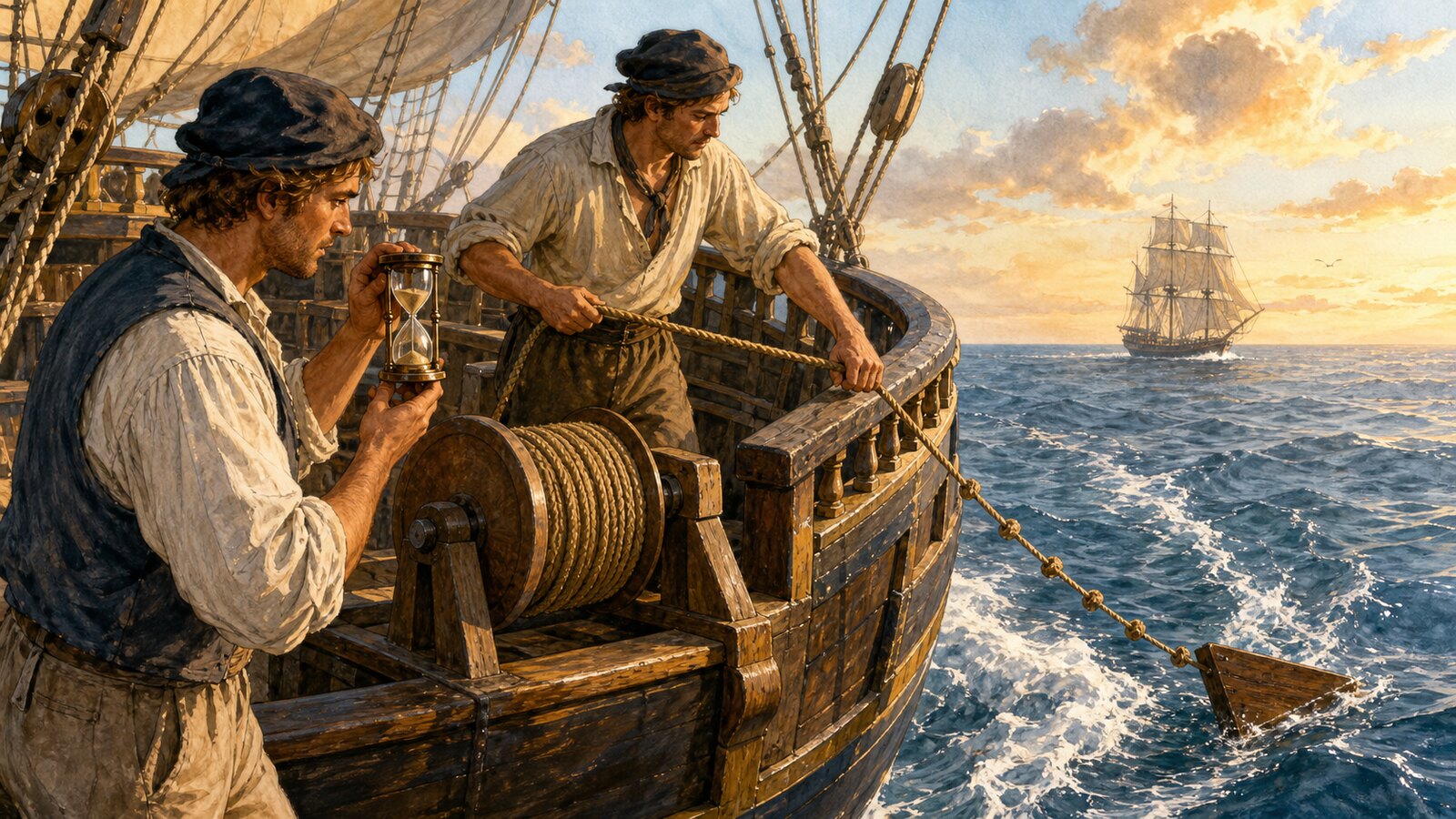
Ship speed is measured in knots because mariners once counted actual knots in a calibrated line. They threw a drag device from the stern, let line pay out for a timed interval, and counted the markers that passed through their hands. The count served as a speed reading. Although modern ships use electronic instruments, the word for the rope markers remains the name of the unit.
The instrument was called a common log or chip log. A weighted wooden board, often shaped like a sector or triangle, was arranged to resist the water while the ship moved ahead. It was attached to a long line wound on a reel. As the board lagged behind, the line ran out from the stern by an amount related to the ship's distance through the water.
A small sandglass called a log glass supplied the time interval. Sailors coordinated throwing the log, turning the glass, allowing the line to run, and stopping it when the sand expired. The line's knots were measurement marks rather than decoration. Counting how many calibrated intervals passed in a fixed time turned the basic equation—speed equals distance divided by time—into a reading usable on a moving deck.
Knot spacing and glass duration were chosen together so that the count corresponded to nautical miles per hour. Exact arrangements varied with period, navy, and the contemporary length assigned to a sea mile, so every historic log was not built to one timeless standard. Wet or stretched rope, waves, currents, board motion, and human timing all introduced error. Even so, the method produced repeatable estimates without a mechanical computer.
Today one knot is defined as exactly one nautical mile per hour. The international nautical mile is exactly 1,852 meters, making one knot 1.852 kilometers per hour, or about 0.514 meters per second. A knot is a unit of speed, not distance. Saying “knots per hour” for ordinary speed mistakenly divides by time twice; a vessel travels at ten knots, not ten knots per hour.
The nautical mile developed from a different idea than the statute mile used on roads. Marine position is expressed in latitude and longitude, and one nautical mile was historically associated with one minute of latitude along a meridian. Earth is not a perfect sphere, so the actual ground length of an arc minute varies. The modern international definition avoids that variation by fixing the unit at 1,852 meters.
This connection makes nautical units convenient on charts. A navigator can relate distance to the latitude scale and can combine speed and time directly: twelve knots sustained for two hours corresponds to twenty-four nautical miles. Aviation also uses nautical miles and knots because long-distance navigation shares the same global latitude-and-longitude framework, not because aircraft inherited a literal rope trailing behind them.
Modern ships no longer need to stream a knotted line for routine measurements. Satellite navigation derives speed over ground from changing position, while Doppler logs and other sensors can estimate speed through the water. A current makes those values differ. Both may be displayed in knots, so the reference—water or ground—is as important as the numerical unit when interpreting a bridge display.
Knots persist for more than sentimental tradition. Nautical miles for distance, hours for time, and knots for speed form a coherent international navigation system. The exact modern definition removes the local variations and much of the measurement error of old log lines, while the name preserves their method. Surviving log reels, lines, wooden chips, and sandglasses in maritime collections make the etymology unusually tangible.
The knot therefore joins a hand-counted rope marker to a geographic system of navigation. A resistant board, calibrated line, and short sandglass once converted a ship's motion into a number of knots. Satellites and acoustic sensors now make the observation, but one knot still means one nautical mile in one hour. The old instrument and the modern chart remain connected every time a ship's speed is reported.
EDITORIAL RESPONSIBILITY
FactosBrain Editorial Desk
The FactosBrain Editorial Desk researched and reviewed this article under our editorial policy. We assess error reports under our corrections policy.