Look a little closer
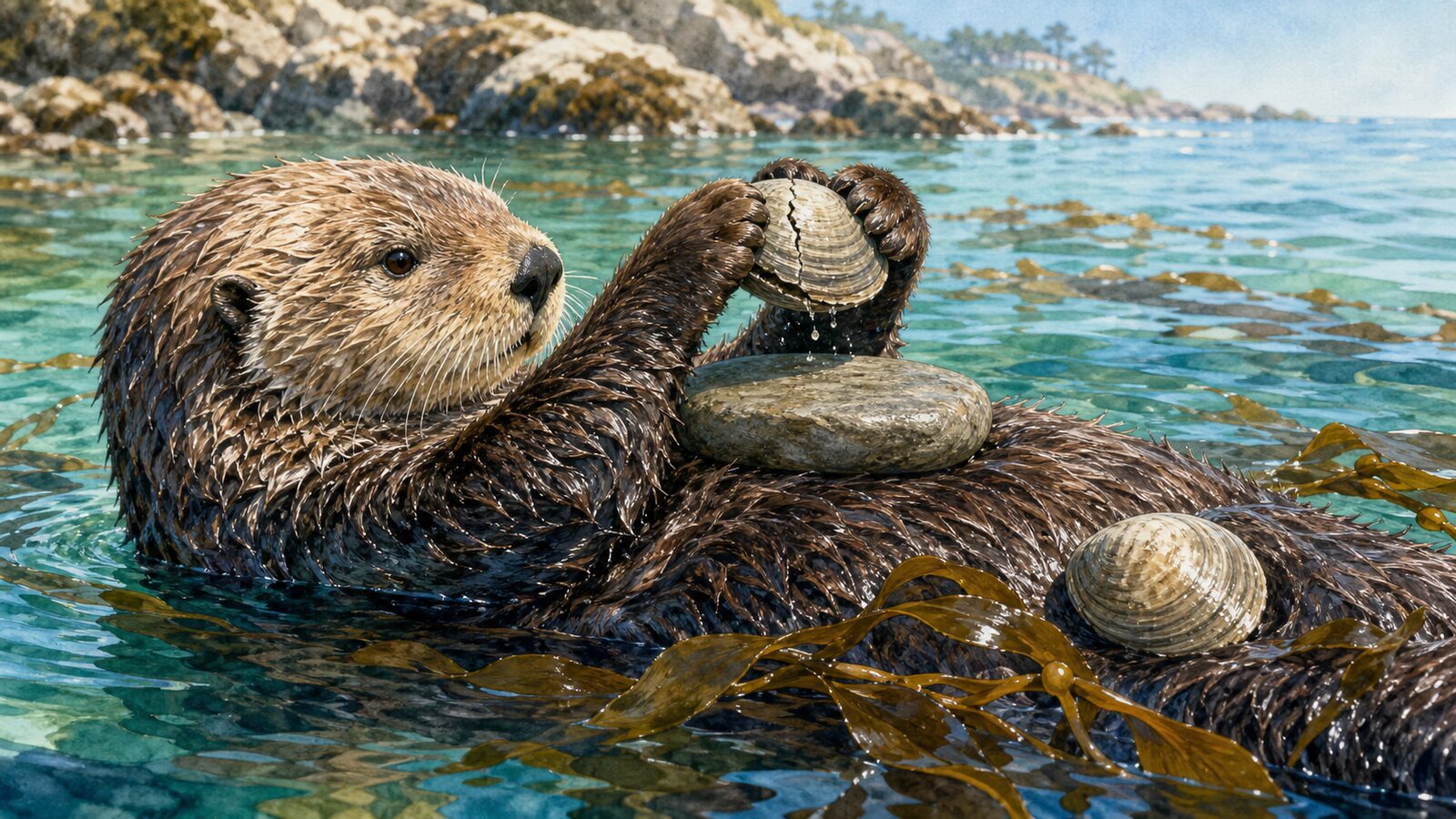
Sea otters crack shellfish with stones because repeated impacts can open prey that is difficult to process with teeth alone while reducing dental damage. A stone may serve as an anvil on the chest, or it may be wielded as a hammer. The behavior is not merely playful spectacle. It changes the mechanics of feeding, broadens the menu available to an otter, and helps meet the animal's unusually high energy demands.
An otter dives for bottom-dwelling invertebrates such as urchins, abalone, crabs, clams, mussels, and marine snails, then commonly returns to the surface to eat while floating on its back. Sea otters depend heavily on extraordinarily dense fur rather than a thick blubber layer for insulation and maintain a high metabolism. They may consume about a quarter of their body mass daily. Failing to open a substantial catch is therefore an expensive loss of diving effort and food.
There is no single stone technique. An otter can balance a broad rock on its chest and pound a shell against it, hold a smaller stone and strike the prey, hit food against a fixed emergent rock, or sometimes knock two shellfish together. In behavioral biology, a tool need not be manufactured. An external object counts when the animal deliberately manipulates it to change the force applied to another object and achieve a result.
Impact does more than make the otter generically stronger. Repeatedly biting or prying a hard shell can chip and wear tooth enamel. A blow against a small contact area concentrates energy where a crack can start, and successive blows extend that fracture until the shell opens. A stone anvil also provides a firm opposing surface for slippery prey while the otter is moving with the water. Less biting may then be needed to reach the edible tissue.
The value of this option rises as local prey changes. Preferred items such as large abalone and urchins may become scarce after sustained predation. Otters then broaden their diets to crabs, clams, mussels, and small snails whose shells can be mechanically demanding or hazardous to teeth. If the force required exceeds an individual's practical bite capacity, a tool makes a previously inaccessible meal possible. Local abundance and an individual's dietary specialization therefore shape how often stones are useful.
A 2024 study combined long-term observations of 196 radio-tagged southern sea otters in California with estimates of prey strength, bite ability, tool use, and tooth condition. Tool users, especially females, accessed larger or harder prey and showed less dental damage. Female tool users could consume prey up to 35 percent harder than the prey handled by male tool users. The researchers interpreted tool use as a behavioral way for generally smaller females with lower biting capacity to bridge a mechanical difference.
Not every otter uses a tool at every meal. An earlier study of 211 tagged individuals across five California study areas found relatively similar, low-to-moderate use where preferred food was abundant. In food-limited areas, individual rates ranged from almost none to tool use during most prey captures. The prevalence of hard-to-access prey in an individual's specialized diet was the strongest predictor, while age, sex, and feeding habitat also contributed. “Sea otters use rocks” describes a species repertoire, not an identical habit shared at the same frequency by all animals.
The popular claim that every otter owns one cherished stone for life goes beyond the evidence. Loose skin beneath the forelimbs can hold captured food during a dive, and an otter can retain and reuse an object during a foraging bout. Temporary storage is not proof of permanent ownership. Otters also use shells, fixed rocks, and occasionally other suitable objects, so the relevant skill is selecting and applying a workable tool rather than possessing one symbolic favorite.
Tool use is not a perfectly uniform reflex either. Pups spend a long period with their mothers and have opportunities to encounter prey handling at close range, while individuals refine techniques suited to their habitat and diet. The large observed variation shows that body size alone does not determine behavior. Experience, available prey, and individual specialization matter, although the relative contributions of inherited tendencies and social learning must be tested rather than assumed for every population.
A sea otter's stone is therefore a feeding device that changes the costs of life at sea. It transfers repeated impact to a shell, helps preserve teeth, and unlocks calories in prey that another individual might abandon. Where preferred food has declined, that small behavioral difference can influence what an otter can eat, how long its teeth remain functional, and whether it can meet the energetic demands of survival and raising a pup.
EDITORIAL RESPONSIBILITY
FactosBrain Editorial Desk
The FactosBrain Editorial Desk researched and reviewed this article under our editorial policy. We assess error reports under our corrections policy.