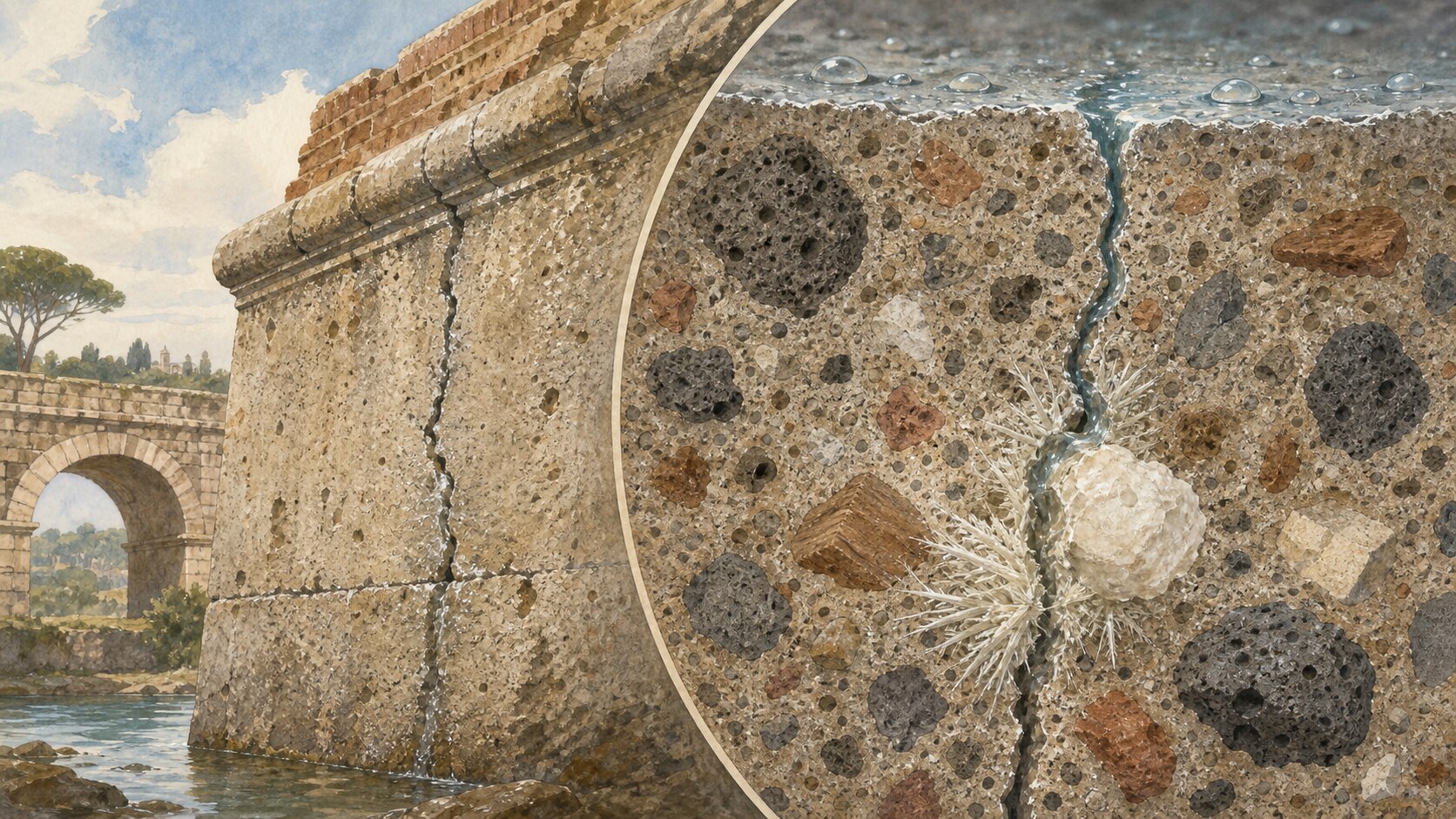
Not every batch of Roman concrete lasted for two thousand years. Countless buildings collapsed, were dismantled, or disappeared. Yet some harbors, sea walls, domes and masonry structures have endured remarkably well. Their survival is not best explained by a single lost secret ingredient. It reflects a combination of lime and volcanic materials, exposure to water, the geometry of massive structures, and designs that often kept the material in compression. Recent work adds another possible contributor: the small white lime fragments visible in some Roman mortar may not have been mere defects.
Roman builders combined lime, water, aggregate such as stone or broken brick, and volcanic material often called pozzolana. Silica- and aluminum-rich volcanic ash can react with lime to form binding phases that resist water better than lime alone. This is commonly called a pozzolanic reaction. There was no one recipe across the Roman world, however. Available ash, aggregate, intended use and building period differed. Treating harbor concrete and an inland wall as identical materials hides differences that matter for both chemistry and durability.
White lime clasts in hardened Roman mortar were long interpreted as signs of incomplete mixing. A 2023 Science Advances study argued that, in some samples, they may have formed when quicklime was mixed hot with the other ingredients. Quicklime reacts strongly with water and releases heat. The resulting lime inclusions can be rich in calcium and have a fine, brittle architecture. That finding does not prove that every pale particle was deliberately engineered, but it changes the easy assumption that an uneven-looking ingredient must be evidence of poor workmanship.
The proposed self-healing mechanism begins when a small crack meets water. If the crack crosses a lime clast, reactive calcium-bearing material can dissolve and move into the damaged space. Minerals such as calcium carbonate can then form in the crack, partly filling it and restricting the path for more water. This is an inorganic chemical process, not a concrete version of biological healing. It also does not promise to close every crack instantly or completely. Water, reactive material and suitable crack conditions all have to be present.
Marine Roman concrete adds another part of the story. In some harbor structures, long contact among seawater, volcanic materials and the cementing matrix can lead to the growth of new minerals, a change associated with durability in research on those materials. That process should not simply be merged with the lime-clast mechanism observed in terrestrial samples. The label Roman concrete covers a diverse family of materials used in different places and conditions, so its long life can arise through more than one pathway.
Comparisons with modern concrete also need care. Cement is a binder; concrete is the composite made when a binder is combined with water and aggregate. Most modern structural concrete uses Portland cement and is optimized for standardized strength, rapid construction and particular engineering requirements. Its chemistry is not the same as a Roman pozzolanic binder. Thickness, reinforcement, loading, freeze-thaw cycles, salt exposure and maintenance differ as well. The age of a Roman structure alone cannot show that an ancient recipe would directly replace a modern structural material.
There is also a survival bias. The structures available for study are the ones that made it through erosion, disasters, reuse and war, while the failures are much less visible. That does not erase the value of the evidence. It makes the question more precise: which combinations of ingredients, microstructure, shape and environment gave certain structures a better chance of lasting? Answering that question may help engineers design materials that need fewer repairs and serve longer.
The most useful lesson from Roman concrete is not that the past offers a universal formula. It is that a lime particle that looks imperfect may, under particular conditions, become a source of calcium for sealing a crack, and that durable construction requires materials and environment to be considered together. Experiments on hot mixing and lime clasts support a promising mechanism, but a modern building material would still need separate tests for strength, reinforcement compatibility, manufacturing emissions and long-term performance in many climates. The achievement is finding testable conditions, not declaring a mystery solved.
EDITORIAL RESPONSIBILITY
FactosBrain Editorial Desk
The FactosBrain Editorial Desk researched and reviewed this article under our editorial policy. We assess error reports under our corrections policy.