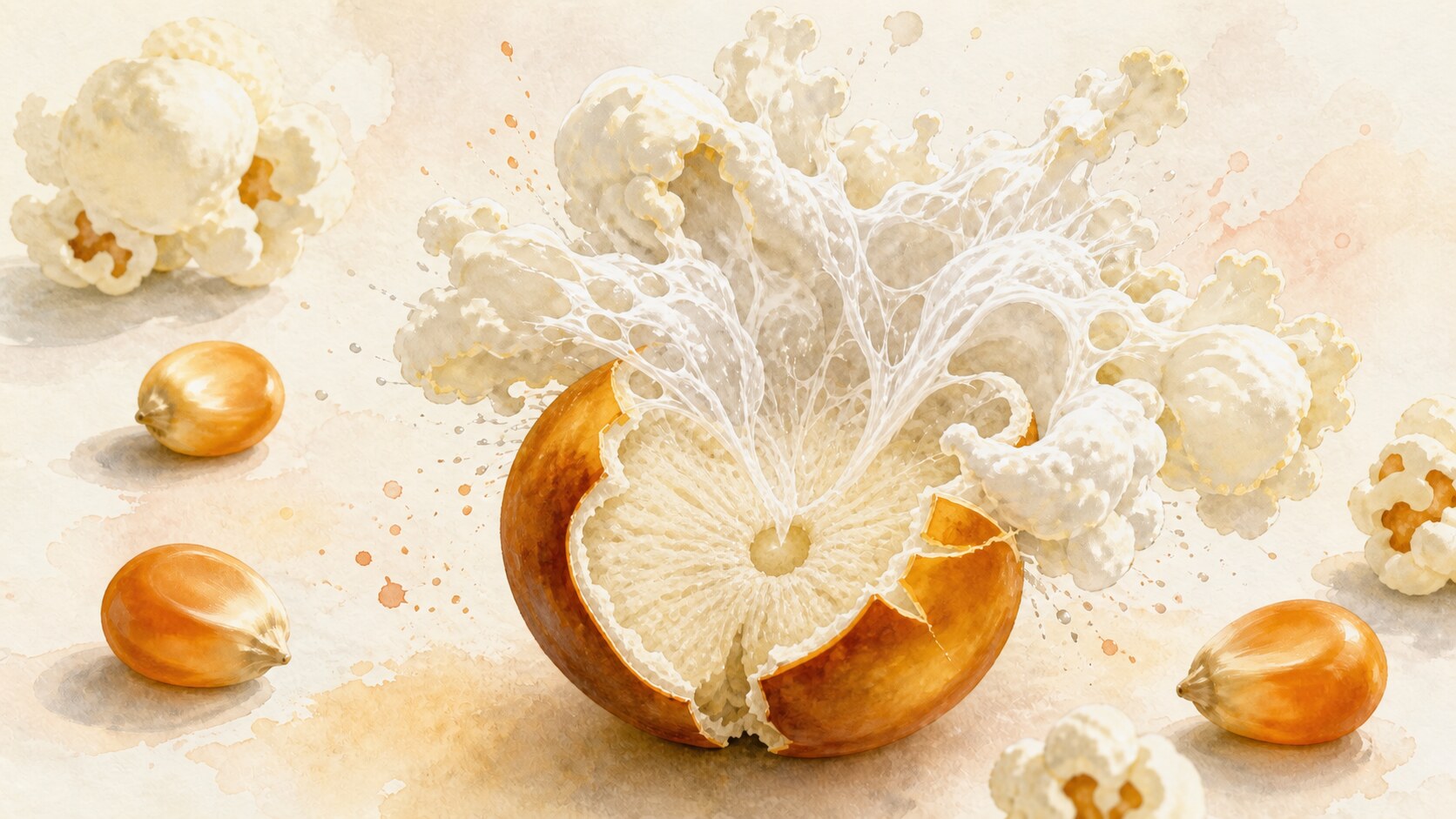
A popcorn kernel behaves like a tiny pressure cooker. Heat raises the vapor pressure of water inside while the tough outer hull holds it in. When that shell finally exceeds its strength, it fractures; hot, softened starch expands in a rush and then cools into the pale foam we eat.
Popcorn differs from most other corn first in its dense outer layer, called the pericarp. A strong, intact pericarp slows moisture loss and allows pressure to accumulate. The amount of water matters as well. Food scientists report that kernels pop best when moisture accounts for roughly 13 to 14.5 percent of their weight.
Water and starch change together during heating. Trapped moisture grows hotter and pressurized, softening the hard starch granules into a pliable, flowable mass. The kernel is not simply an empty chamber filled with steam. Liquid water remains just before rupture, and the combination of hot water and vapor creates conditions more like a sealed cooker.
Experiments found a sharp transition near 180 degrees Celsius, where almost all tested kernels popped. Around that point, pressure inside was estimated to reach roughly 10 bar. Once it exceeds the hull's resistance, a small crack races open. The abrupt pressure drop lets some water flash into expanding vapor and drives the gelatinized starch through the broken shell.
The emerging starch inflates into a foam containing vapor and air, effectively turning much of the kernel inside out. As moisture escapes and the structure cools, the foam sets into a crisp white flake. Its mass changes relatively little, but its volume grows dramatically and its density falls.
The familiar noise and jump are not merely two indistinguishable effects of one explosion. In synchronized high-speed video and acoustic recordings, the onset of the pop was consistent with excitation by released water vapor. The footage also showed a starch 'leg' forming against the ground and compressing before it propelled the kernel upward.
An unpopped kernel often has a cracked or weakened hull that leaked moisture before enough pressure developed, or it has dried too far. Extra water alone is not a guarantee; variety, shell strength and moisture must work together. A single piece of popcorn compresses a phase change, pressure-vessel fracture and starch foaming into a few hundredths of a second.
EDITORIAL RESPONSIBILITY
FactosBrain Editorial Desk
The FactosBrain Editorial Desk researched and reviewed this article under our editorial policy. We assess error reports under our corrections policy.