Look a little closer
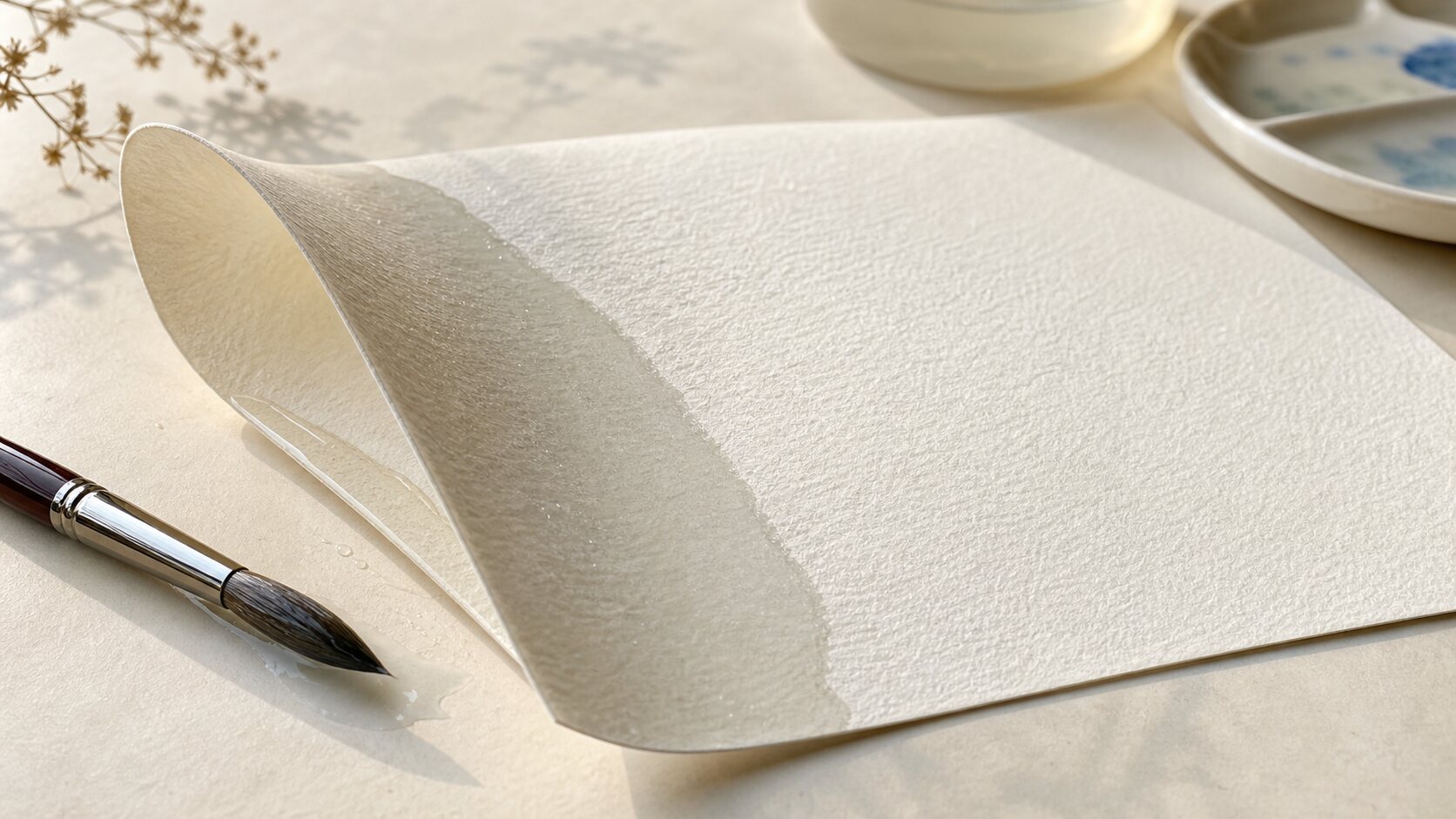
Paper curls when only one face gets wet because cellulose fibers near that face absorb water and expand before the fibers on the dry face do. The two sides remain bonded but try to adopt different lengths, so the sheet lowers the mismatch by bending. During initial wetting, the more expanded wet layer generally occupies the outside of the curve, although the direction and magnitude can change as water spreads and later evaporates.
A sheet that looks continuous is actually a porous network of flattened, overlapping pulp fibers. Cellulose has many sites that interact with water, so moisture does more than fill the air spaces between fibers. Water is taken into the fiber wall, changing the fiber's dimensions. Those changes are transferred across contact zones where fibers are bonded to one another, allowing microscopic swelling to become a measurable change in the dimensions and thickness of the whole sheet.
The expansion is strongly directional. Cellulose chains and microfibrils are arranged mainly along a fiber's long axis, and most pulp fibers swell much more across their width and thickness than along their length. Papermaking adds another level of directionality because the flowing stock tends to align many fibers with the machine direction. Ordinary machine-made paper therefore often expands more in the cross-machine direction than in the machine direction as moisture changes. Fiber orientation also helps determine the axis around which a curling sheet prefers to bend.
A drop or a wet brush does not make the moisture content uniform through the paper at once. Layers near the contacted surface swell first, while the lower, drier layers resist the same extension. This creates a strain gradient through the thickness. Because the layers cannot slide freely apart, remaining flat would force both into an unfavorable compromise. Curving lets the longer layer travel around a larger radius and relieves part of that mechanical stress. The idea resembles a bimetallic strip heated on one side, but paper's moisture keeps diffusing and its fiber network is anisotropic, so its curvature evolves with time.
Real wet paper does not always form one neat cylindrical roll. If water arrives in patches or the edges are restrained, neighboring regions attempt different expansions and may buckle into multiple waves and peaks. Paper scientists and conservators often call this localized out-of-plane distortion cockling. Grammage, thickness, local fiber orientation, drop shape, gravity, and constraints such as a book binding or tape influence where a bend concentrates. A thin copier sheet and heavy watercolor paper can consequently respond very differently to the same nominal amount of water.
Drying is not simply a film played backward. As moisture diffuses through the sheet, the initial gradient may weaken and the early curl may relax. If the exposed face then dries and shrinks first, the curvature can change direction. Severe wetting can also let fiber contacts slip, release locked-in drying stresses, and reform bonds in a new geometry. A residual curl may remain after the average moisture content returns to its starting value. This is why research distinguishes a reversible response associated with changing moisture from irreversible curl influenced by stress relaxation and structural asymmetry.
The two faces may already differ before the accident. Formation on a paper machine can produce through-thickness differences in fiber orientation and fine-particle distribution between the wire side and the top side. A coating, ink, or adhesive on only one face changes both the rate of moisture entry and that face's expansion. Heat in printers and copiers can likewise create unequal moisture histories across the sheet. The same drop can therefore leave different shapes depending on which face it touches, the machine direction, and whether the paper has been printed or coated. There is no universal curl radius for all grades.
Researchers test the mechanism with more than visual observation. They cycle relative humidity while measuring strain in the machine and cross-machine directions, and use microscopy or digital image correlation to follow motion in fibers and networks. In one-sided wetting experiments, moisture distribution and curvature can be recorded together through time. Models supplied with fiber orientation, inter-fiber coupling, and a through-thickness moisture gradient are then compared with the measured bend. The agreement supports the roles of transverse fiber swelling and strain transfer through bonds, but numerical values still depend on pulp species, recycled content, fillers, formation, and drying history.
For ordinary materials, keeping both faces exposed to similar humidity and supporting the whole sheet evenly during controlled drying can reduce differential strain. Valuable documents and artwork should not be soaked or ironed as a casual remedy, because water and heat can move colorants, create tidelines, damage adhesives, and impose new distortions. The Library of Congress recommends a relatively dry, stable environment and supportive enclosures for paper collections. Curling is therefore not merely the extra weight of water: it is a visible surface created when one part of a microscopic fiber network changes length before another.
EDITORIAL RESPONSIBILITY
FactosBrain Editorial Desk
The FactosBrain Editorial Desk researched and reviewed this article under our editorial policy. We assess error reports under our corrections policy.