Most people hiding something valuable look for a better place to put it. At a Copenhagen laboratory in 1940, a chemist chose to change the object instead. He dissolved two gold Nobel Prize medals, leaving their recovery to chemistry rather than a key.
The medals belonged to German physicists Max von Laue and James Franck. They had entrusted them to Niels Bohr's institute to protect them from confiscation. Germany's occupation of Denmark in April 1940 made that refuge dangerous. The medals could now become evidence against their owners.
Each carried a name. If discovered, it would identify a German scientist who had sent gold abroad, an act that could bring severe consequences under Nazi rule. The concern extended beyond the loss of prestigious and valuable possessions.
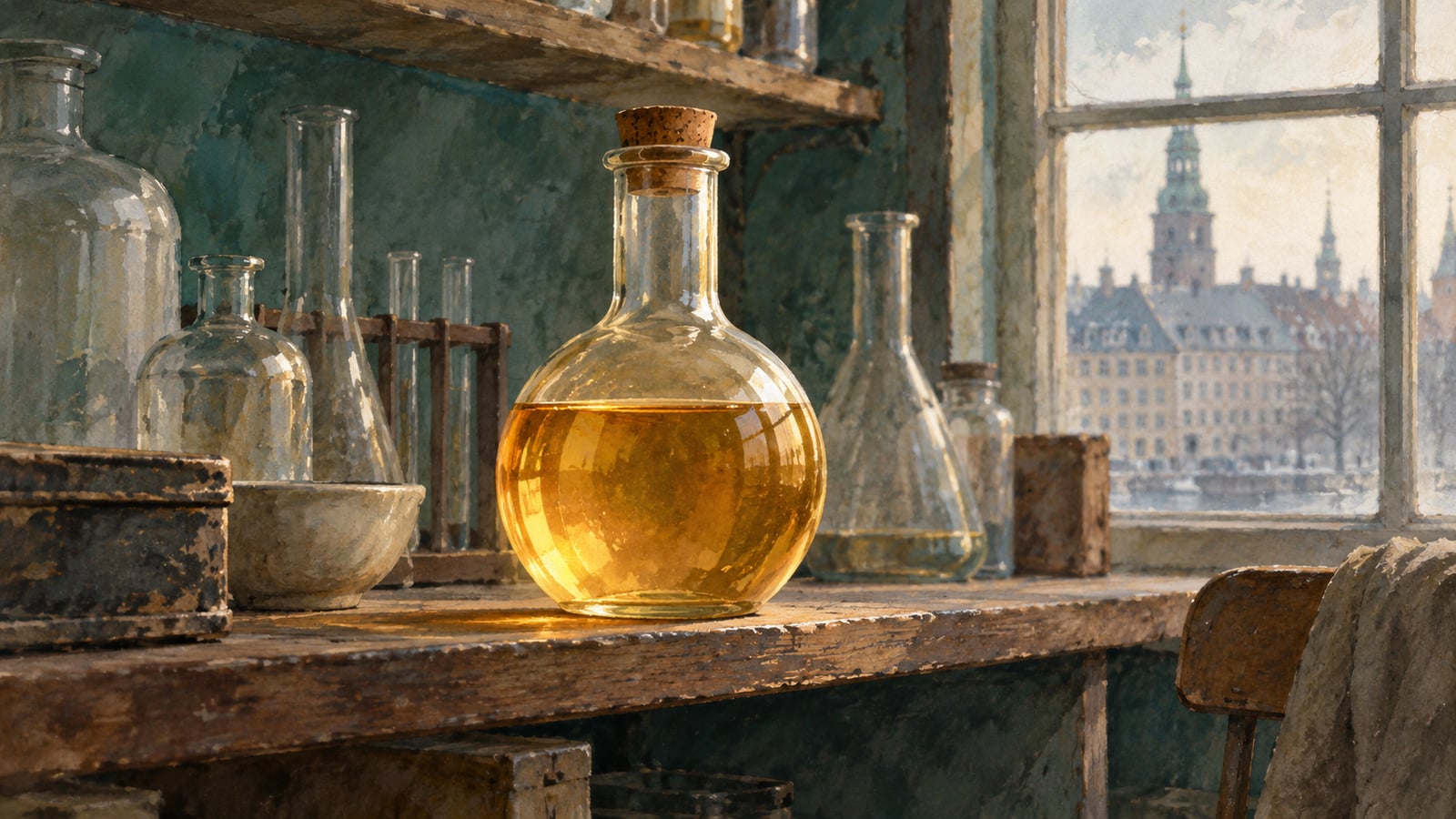
George de Hevesy, a chemist working at the institute, later described finding Bohr worried about Laue's medal on the morning of the invasion. He first suggested burial. Bohr objected that someone could dig it up. Hevesy then decided to dissolve the medals. Instead of choosing a hiding place, he would remove the recognizable form of the things being hidden.
Gold made that difficult. It is resistant to many chemical reactions; putting a medal in water does not make it disappear like a lump of salt. Hevesy used aqua regia, which can dissolve gold. He later recalled that the task was far from easy. Eventually, the medals became a solution in which neither their circular outlines nor their engraved names remained visible.
The gold itself had not ceased to exist. It was still present in the liquid, which is what made this more than an act of destruction. The recognizable objects were gone, while the material from which they had been made could potentially be recovered.
The solution survived the war. The gold was subsequently recovered and replacement medals were made. Nobel Foundation records describe Franck receiving his newly struck medal in Chicago in 1952. What had been deliberately deprived of its shape during the occupation could again be presented as an award.
Bohr's own medal is sometimes added to the story, but it followed a different route. He had already donated it to an auction supporting Finnish relief. The two medals dissolved at the institute belonged to Laue and Franck. Their colleague's laboratory had provided a peculiar kind of safekeeping: the medals survived by temporarily no longer looking like medals.
EDITORIAL RESPONSIBILITY
FactosBrain Editorial Desk
The FactosBrain Editorial Desk researched and reviewed this article under our editorial policy. We assess error reports under our corrections policy.