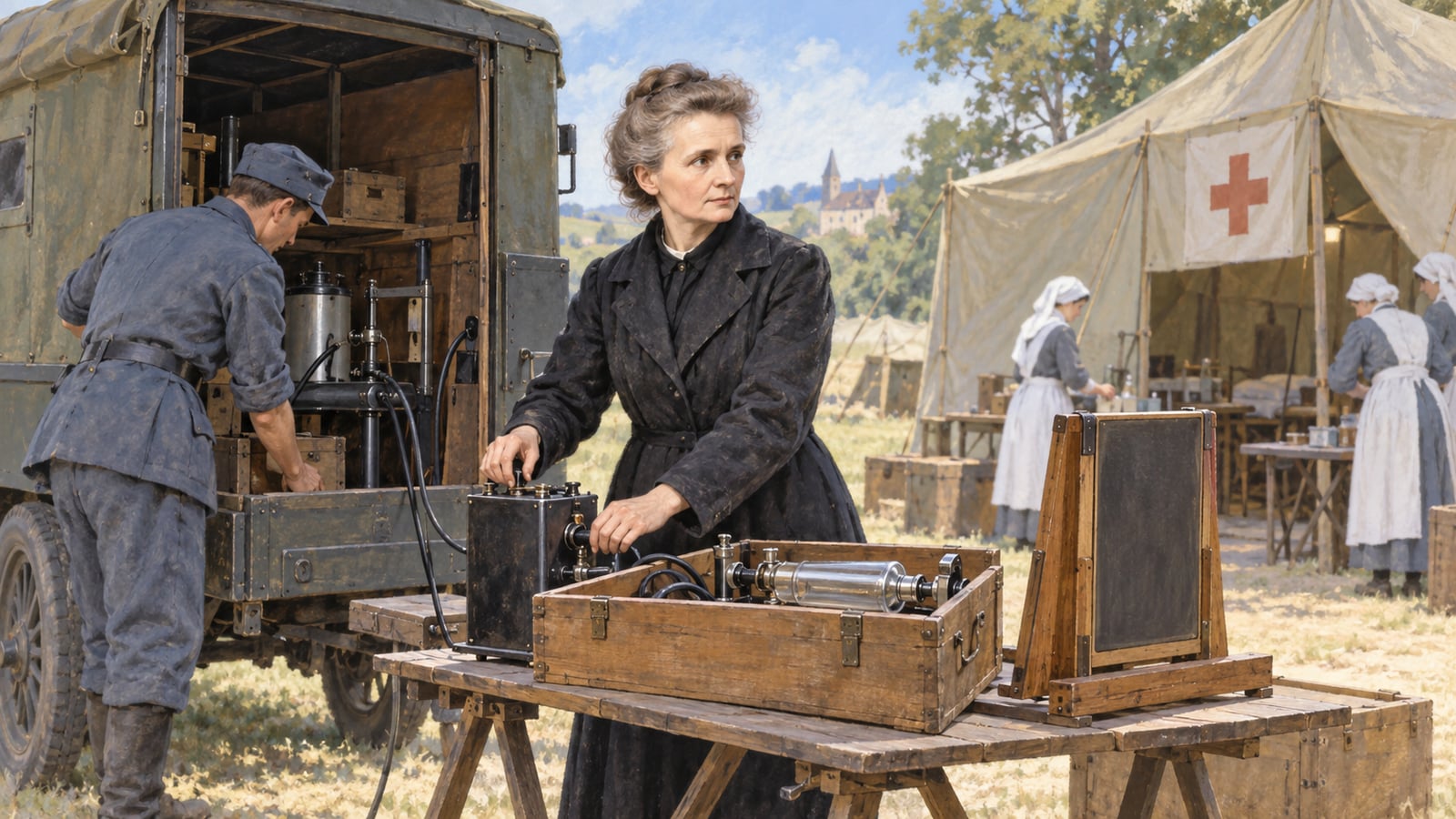
Reaching the hospital was only the beginning. The team still had to unload boxes, assemble equipment, darken windows, and obtain electricity. The radiology cars Marie Curie helped equip during the First World War did not simply carry a finished examination room. They carried what was needed to turn an available room into one.
France's wartime hospitals faced an influx of wounded people. Some occupied temporary premises, including schools, without electrical supplies. Doctors needed to locate bullets, shell fragments, and fractures, but X-ray equipment was not available everywhere. Sending an injured person to a distant facility was not always a workable answer.
Curie helped bring the equipment to the patients. She sought donations of money and cars, arranged adaptations, and prepared herself for the practical work. Her scientific reputation did not automatically teach her to operate a radiology service. She studied anatomy and X-ray technique, learned to drive, and acquired knowledge of motor mechanics. A car that could not move could not deliver its instruments.
Power had to travel with the equipment too. A vehicle might carry a generating unit, or use its own engine to drive a dynamo. In the latter arrangement, the engine kept working while the car stood outside the hospital. The challenge was not merely to transport an X-ray apparatus. It was to make the apparatus function wherever the team was needed.
Curie's postwar book describes the work in concrete terms. As the driver prepared the power supply, colleagues carried equipment indoors. They covered windows, assembled the examination table and supports, and checked the connections. At a familiar site, if nothing went wrong, preparation could take half an hour. Members of a good team had to do more than the task suggested by their job titles.
During examinations, observations were recorded for the medical staff. Afterward, the apparatus went back into its packing cases, ready for another assignment. Driving, installation, examination, and packing formed one continuous job. Curie's daughter Irène, seventeen in the year the war began, joined her mother in this radiological work.
Expanding the service required trained people as well as vehicles. Equipment could do little while sitting in a box with nobody able to use it. Curie helped organize instruction; her account states that roughly 150 women operators were trained from 1917 until the war ended. As permanent and semi-permanent facilities multiplied, experienced mobile teams also advised staff at newer stations.
Curie did not expect the cars to become useless once peace returned. They could serve places without fixed facilities, reach patients who could not be moved, or replace equipment temporarily out of action. The need that had sent the cars onto wartime roads would remain: sometimes the examination room had to come to the patient.
EDITORIAL RESPONSIBILITY
FactosBrain Editorial Desk
The FactosBrain Editorial Desk researched and reviewed this article under our editorial policy. We assess error reports under our corrections policy.