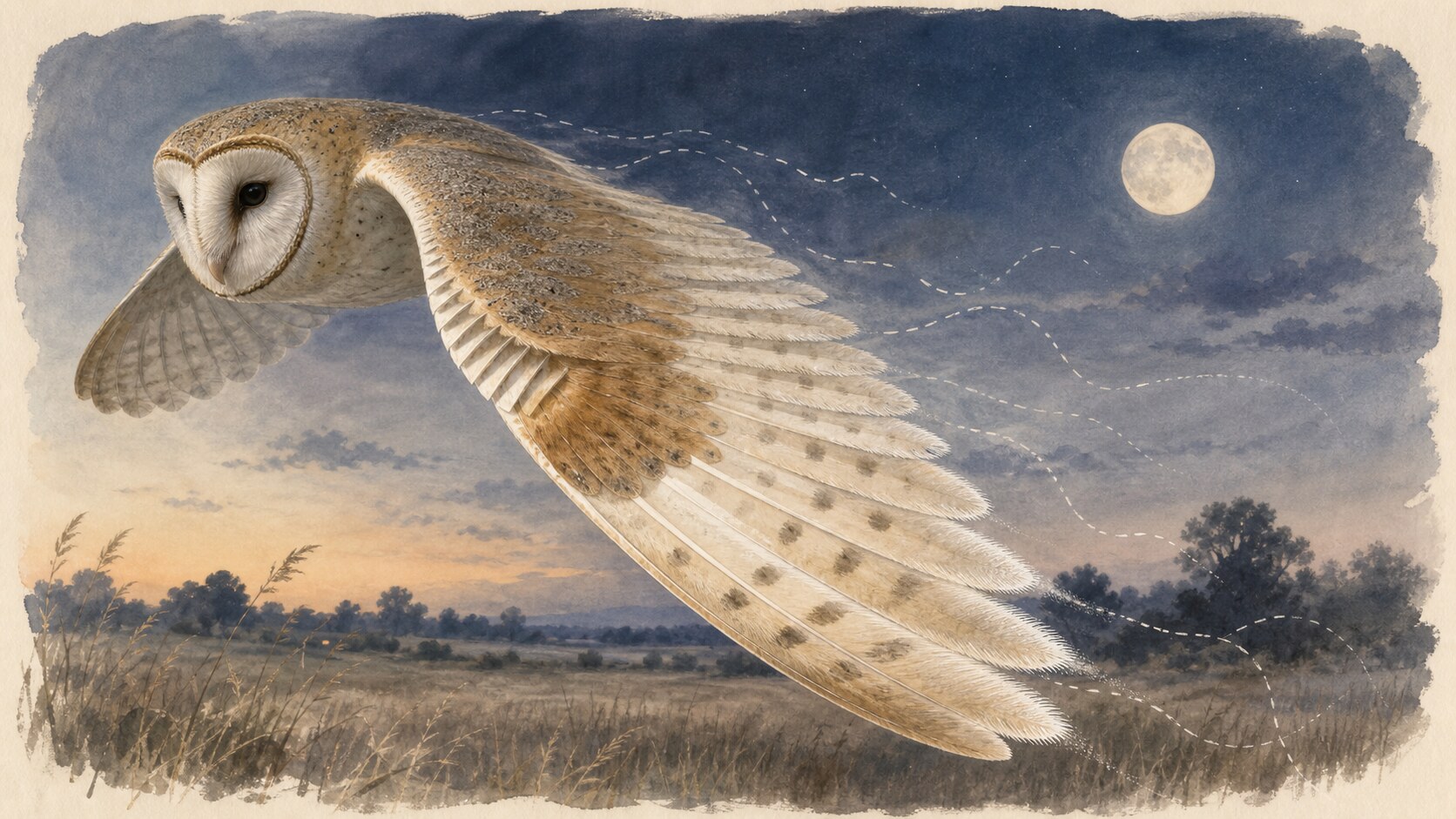
Owl flight is not perfectly silent, but it is remarkably quiet compared with that of many similarly sized birds. Broad wings support relatively slow flight, while separate microstructures at the front, rear and surface of the feathers reduce noise arising at different stages of airflow and feather contact.
Comb-like barbs project from large feathers along the leading edge. These serrations alter flow structures where the wing first meets air and modify how large pressure fluctuations develop. Their effect depends on speed, angle of attack, length and spacing, so the popular image of a comb merely “chopping air into smaller pieces” is too simple.
The trailing edge is not a hard, sharply cut line either. Fine feather branches separate into a flexible fringe that spreads the boundary where air leaves the wing. Distributing pressure fluctuations across that soft edge can reduce components of trailing-edge noise that would be stronger around a rigid boundary.
Velvet-like down and a porous upper surface also influence small near-surface flows and contact between feathers. Broad wings with low wing loading let an owl produce lift without moving extremely fast. Because aerodynamic sound generally rises steeply with speed, a slow approach is itself an important part of the quiet-flight system.
The features are not equally developed in every owl. A study of museum specimens from 147 species found that leading-edge comb size was associated with facial-disc size. Phylogenetic analyses including prey and hunting ecology supported two compatible benefits: avoiding detection by prey and reducing the owl's own wing noise so it can hear prey.
No structure suppresses every frequency under every flight condition. An isolated feather in a wind tunnel, a fixed wing model and a flapping living bird are different systems. Evidence supports several quieting roles, but whole-wing motion, speed, wear and moisture also shape real sound. One feature cannot fairly be named the sole cause of “silence.”
Engineers test related edges on fans, turbines and airfoils, yet copying a feather outline does not guarantee a useful machine. A noise-reducing geometry may trade against drag, efficiency, strength or durability and must be measured under its intended operating conditions. Owl flight is a coordinated biological solution that manages airflow at its beginning, its exit and the surface between them.
EDITORIAL RESPONSIBILITY
FactosBrain Editorial Desk
The FactosBrain Editorial Desk researched and reviewed this article under our editorial policy. We assess error reports under our corrections policy.