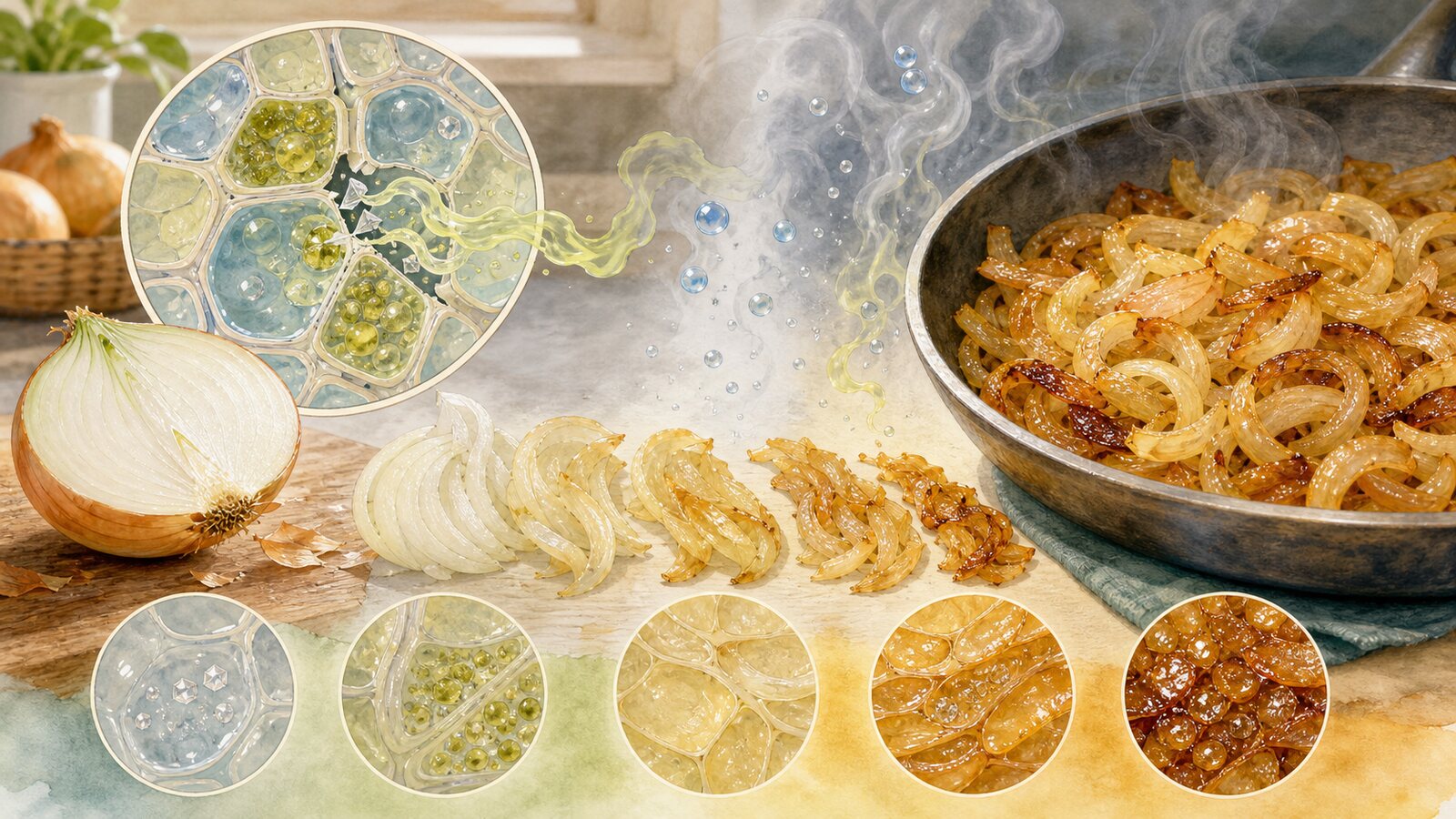
Tears from chopping an onion are a protective response, not an emotion. A knife breaks cellular compartments that normally keep enzymes away from sulfur-containing precursors. The resulting reaction chain produces a volatile irritant that reaches the eye and activates the tear glands.
Onions use sulfur taken up from soil to make cysteine-sulfoxide compounds. In intact cells, those precursors and the enzyme alliinase occupy separate compartments, so they cannot react freely. A blade or an animal bite ruptures the barriers and starts the first chemical step.
Alliinase breaks down a precursor to form a highly reactive sulfenic acid. Lachrymatory-factor synthase then helps convert it into the tear-producing compound syn-propanethial-S-oxide. The onion does not store a finished reservoir of “tear gas”; it assembles the irritant through several reactions immediately after tissue damage.
Because the compound is volatile, it moves away from the cut surface through air. When it reaches the moist eye, sensory nerves register irritation and the lacrimal glands release extra fluid to dilute and wash it away. Ordinary onion tears settle as exposure falls and that rinsing response completes its work.
Not every onion produces the same exposure. Cultivar and growing conditions can change the amounts of sulfur precursors and relevant enzymes, and sweet onions or green onion relatives may be less irritating in some cases. A label cannot guarantee a tear-free experience, however; the amount cut and the cutting method also matter.
The most direct way to reduce tears is to reduce what reaches the face. An extractor fan or airflow toward an open window carries material away, while chilling can slow enzyme reactions and evaporation. Experiments also suggest that cutting slowly with a sharp blade can reduce the mist expelled from pressurized cells, but no technique prevents every reaction in every onion.
Normal irritation is different from dangerous poisoning, yet rubbing the eyes can transfer more onion residue from the hands. Persistent pain or altered vision should not automatically be blamed on cooking; rinse thoroughly with clean water and seek appropriate help if symptoms do not resolve. Onion tears link plant-cell damage, enzyme chemistry and the eye's cleaning system within seconds.
EDITORIAL RESPONSIBILITY
FactosBrain Editorial Desk
The FactosBrain Editorial Desk researched and reviewed this article under our editorial policy. We assess error reports under our corrections policy.