Look a little closer
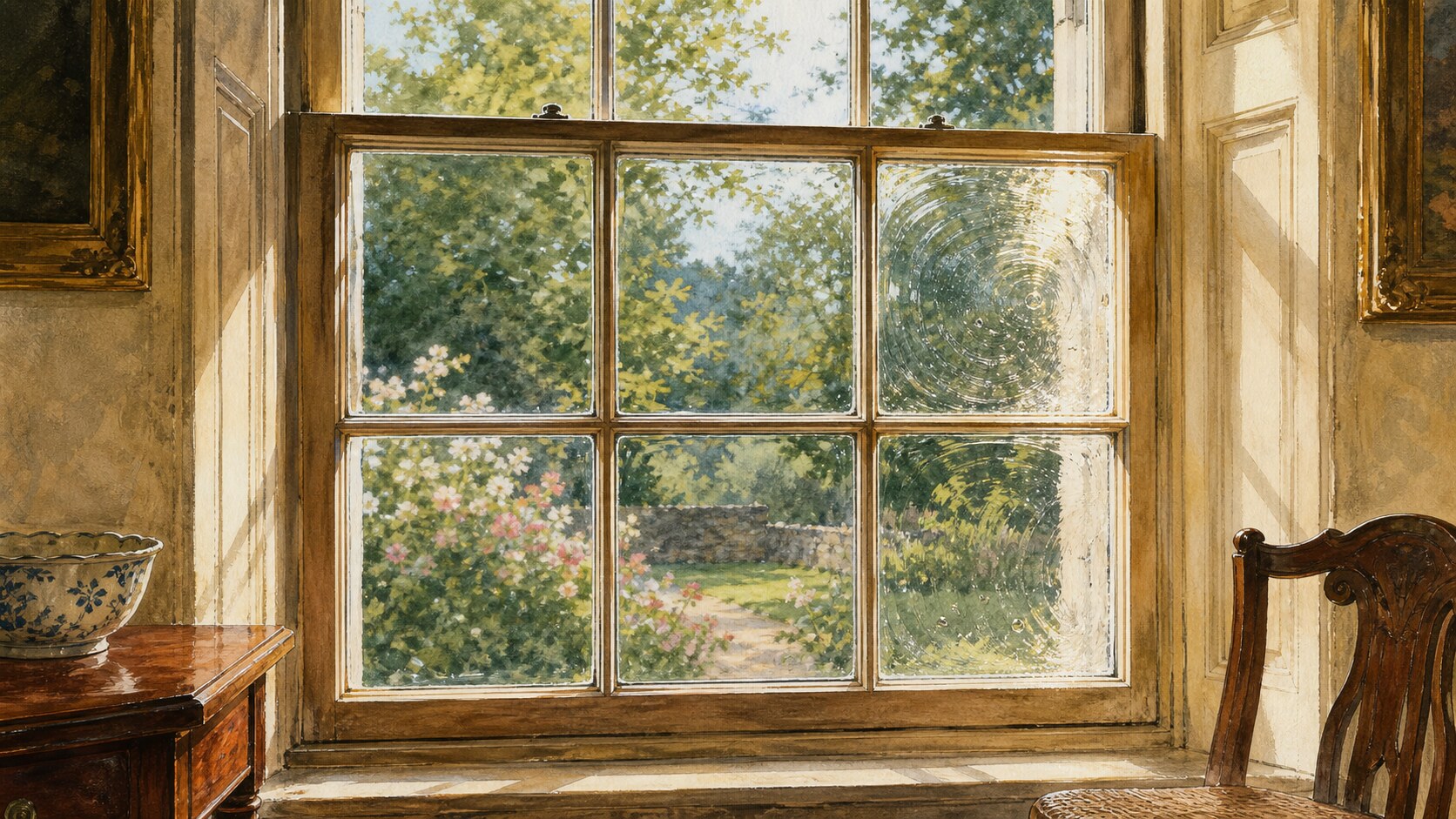
Old window glass looks wavy and varies in thickness mainly because of how hot glass was formed into sheets, not because a once-flat pane slowly flowed downward for centuries. At room temperature, window glass behaves as an amorphous solid and does not sag by a visible amount over the lifespan of a building. Reflections shimmer and scenery bends because the two faces of a handmade pane are not perfectly flat or parallel, so light changes direction by slightly different amounts across the glass.
The claim that glass is an extremely slow liquid sounds plausible for two reasons. Glass lacks the long-range atomic order of a crystal, and molten glass gradually stiffens across a range of temperatures rather than freezing at one sharp point. Neither fact makes a room-temperature pane a flowing liquid. As glass cools, its viscosity rises enormously and the time required for its structure to rearrange becomes correspondingly long. The Corning Museum of Glass attributes thickness variation in historic windows to sheet-making methods and notes that glass objects far older than medieval windows show no gravitational flow.
One important historic method produced crown glass. A craftsperson blew a hot mass into a hollow form, opened it, and spun it rapidly while it was attached to a rod. Centrifugal force spread the softened material into a broad disk. The outer region became relatively thin, while a thick bull's-eye remained near the point where the rod had been attached. Window panes cut from different parts of that disk could inherit radiating ripples, tiny bubbles, curved tool marks, and uneven thickness. Concentric patterns in surviving glass can therefore be a frozen record of a rotating hot disk.
Cylinder glass was made by blowing an elongated glass cylinder, removing its ends, cutting it lengthwise, and reheating it until it could be opened and flattened. Turning a curved wall into a sheet did not produce the geometrical precision of a modern factory line. Gentle waves and long directional striations could remain. Historic-building guidance from Scotland describes crown and cylinder glass as common in eighteenth- and nineteenth-century windows and links their distinctive reflections to spinning and cylinder-flattening. Panes from different workshops or repair periods can consequently distort a view in different directions even within one building.
Optics makes those manufacturing marks visible. A ray changes direction when it crosses from air into glass and again when it leaves. If the two glass surfaces are flat and parallel, those changes are orderly. If either surface tilts or curves across the pane, the outgoing ray shifts, making a straight branch or window bar appear displaced. Reflected light follows the same small slopes, giving handmade glass a lively surface when an observer moves. Conservators can read bubbles, ripples, thickness, and reflection as material evidence rather than treating every irregularity as damage.
Some historic panes really are thicker along their lower edges, but that observation cannot establish slow flow on its own. A sheet manufactured with a wedge-shaped cross-section will have one thick edge before it enters a frame, and an installer may choose to place the heavier edge downward. Other old pieces can have their thickest region at a side or at the top. A valid flow claim would need a consistent, measurable change through time after manufacturing differences and installation choices were accounted for. Finding age and bottom thickness together does not supply that missing causal evidence.
A stained-glass window that bulges outward presents a different issue. Its many pieces are held by lead or other metal cames, soldered joints, putty, and a supporting frame. The U.S. National Park Service warns conservators about windows that sag out of plane or develop failing joints because the assembly and its supports can deform or deteriorate. In such a case, the structure holding the pieces has moved; it is not evidence that each pane's atoms have drained downward. Glass, metal network, frame, moisture, and loading must be examined separately.
Modern panes are flatter because manufacturing changed. The float process sends molten glass across a bath of liquid tin, allowing industry to make long sheets with highly parallel faces and controlled thickness. Earlier crown and cylinder processes inevitably preserved more variation. Replacing historic panes with uniform glass may improve specified thermal or safety performance in a redesigned window, but it can also remove the moving reflections and manufacturing evidence that contribute to an old building's character. Preservation guidance therefore treats surviving handmade glass as historic fabric, not merely as an obsolete transparent filler.
Historic window glass is useful for explaining the unusual solid called glass, but its waviness is not a time-lapse image of a solid becoming liquid. The material flowed readily while a maker blew, spun, reheated, or flattened it. Cooling then preserved the resulting geometry. When a garden seems to ripple through an old sash, we are not watching centuries of downward motion. We are seeing light pass through a three-dimensional trace of a vanished manufacturing process.
EDITORIAL RESPONSIBILITY
FactosBrain Editorial Desk
The FactosBrain Editorial Desk researched and reviewed this article under our editorial policy. We assess error reports under our corrections policy.