Look a little closer
Old paper often turns yellow and brittle because cellulose and the materials around it slowly change under the influence of acids, oxygen, light, heat, and moisture. Oxidation creates light-absorbing structures that shift the page toward yellow or brown, while acid-catalyzed hydrolysis and oxidation cut long cellulose chains until the fiber network loses flexibility and strength. Discoloration and embrittlement often share the same aging conditions, but they are related symptoms rather than one identical process.
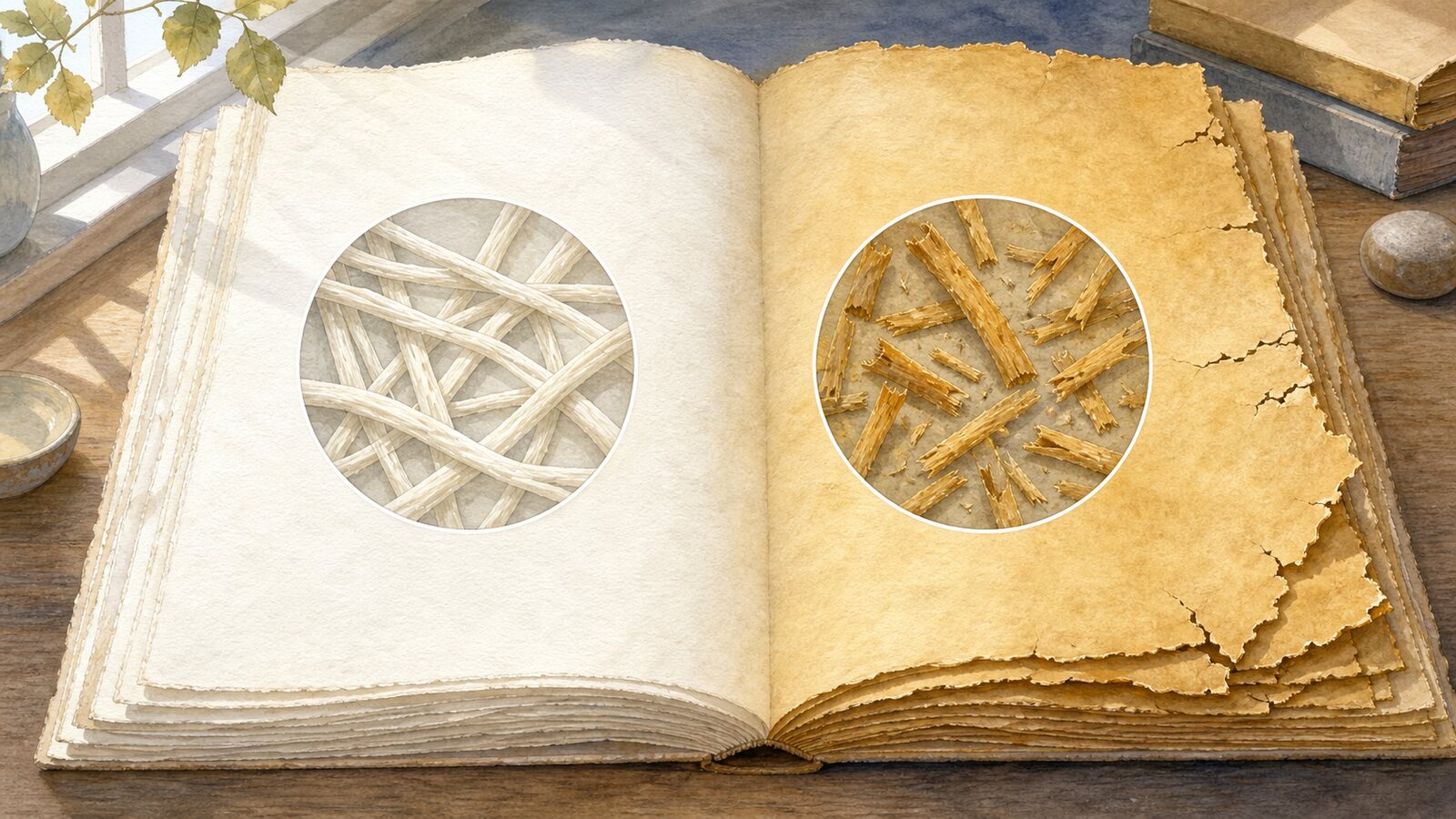
A sheet of paper is a thin felted network of plant fibers. Its main structural polymer, cellulose, consists of glucose units linked into long chains. Long chains and intact fibers distribute the stress of folding or pulling, helping a page remain strong and supple. Lignin, sizing agents, fillers, dyes, bleaching residues, and traces of metal introduced by the raw material or manufacturing process can all change how that network ages.
Acid-catalyzed hydrolysis is one of the principal routes to lost strength. Acids may come from the original pulp and manufacturing additives, polluted air, poor-quality folders, or the paper's own degradation products. When moisture is present, hydrogen ions help break bonds along cellulose chains. Shortened polymers can no longer support the fiber structure as effectively, so a page loses fold endurance, cracks at stressed edges, and eventually fragments under handling that a newer sheet would tolerate.
Yellowing signals a change in how molecules interact with light. Oxidation of cellulose, lignin, and related material can produce or enlarge chromophores, molecular arrangements that selectively absorb part of the visible spectrum. When more blue and violet light is absorbed, the reflected light reaching the eye is biased toward yellow and brown. Illumination can speed photo-oxidation, but darkness does not stop every reaction; heat, oxygen, residual chemicals, and acids can continue altering paper in storage.
Mechanical wood-pulp paper is especially vulnerable. From the mid-nineteenth century onward it made newspapers and inexpensive books far cheaper, but grinding wood into pulp produces relatively short fibers and leaves much of the lignin in place. Lignin is sensitive to light and oxidation and can contribute to discoloration and acidic degradation. A newspaper from the twentieth century may therefore be browner and more fragile than a much older sheet made from long cotton or linen rag fibers and stored under favorable conditions.
Manufacturing history adds another major difference. Alum-rosin sizing was widely used to reduce ink bleeding in wood-pulp paper, and it left many older papers acidic. Moisture then helped drive reactions that cut cellulose more quickly. In contrast, chemically purified pulp with much of its lignin removed, long cotton fibers, neutral or alkaline processing, and an alkaline reserve can produce paper that lasts far longer. Since the late twentieth century, permanent papers have often included alkaline buffers that neutralize acids as they form.
Temperature and relative humidity act like controls on the reaction rate. Warm conditions generally accelerate chemical change, while elevated humidity supplies water for hydrolysis and raises the risks of mold and physical distortion. Sulfur and nitrogen oxides from polluted air, as well as acidic boards and enclosures, can add damage from outside; this helps explain pages that are browner and more brittle at exposed edges. Sealing paper without considering its condition is not a universal cure, because acidic degradation products trapped inside an enclosure can also promote further aging.
Color alone cannot reveal a page's remaining strength precisely. One set of reactions may form conspicuous chromophores without causing the same amount of chain scission, while another sheet can lose substantial molecular length before its appearance seems dramatic. Surface dirt, yellowed adhesive, and localized brown spots from metal contamination are also different from uniform chemical yellowing. If an important document is already fragile, repeatedly bending a corner to test it can cause the very loss one hopes to assess; a conservator can evaluate it without such improvised stress.
Paper carries a more exact history in its materials and environment than in its calendar age. Oxidation changes the structures that absorb light, and acids plus moisture progressively shorten the cellulose that gives a sheet mechanical integrity. Cool, stable conditions, reduced light and pollutants, and acid-free buffered enclosures can slow those changes, but they cannot reconnect chains already broken. A yellow brittle page is therefore not merely white paper covered with the dust of time; it is a visible and tangible record of molecular transformations within the sheet itself.
EDITORIAL RESPONSIBILITY
FactosBrain Editorial Desk
The FactosBrain Editorial Desk researched and reviewed this article under our editorial policy. We assess error reports under our corrections policy.