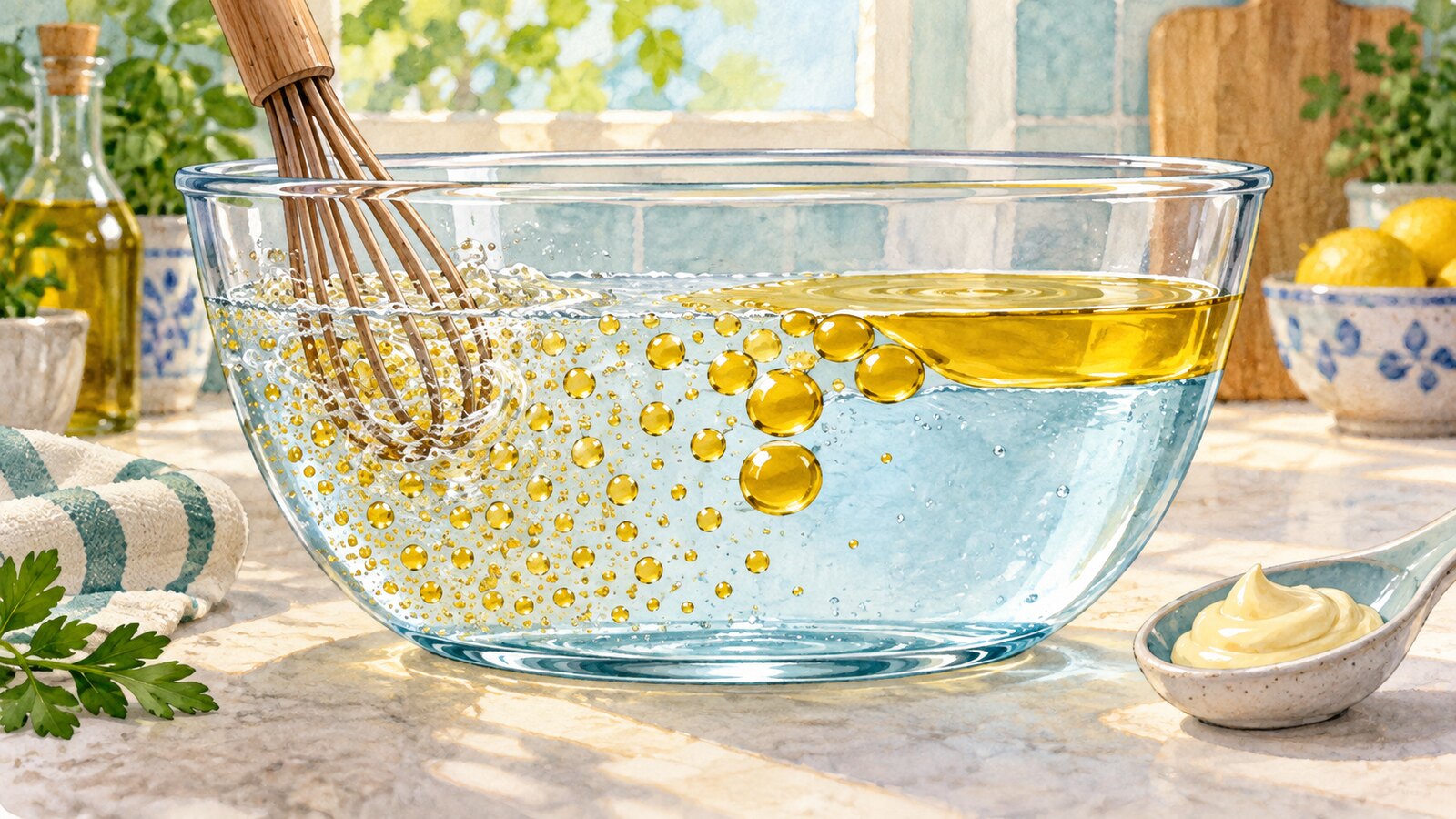
Oil and water may look mixed for a moment after vigorous stirring, but they separate because a state with less oil-water interface is more stable than one containing countless exposed droplets. Stirring can break oil into tiny drops and scatter them through water; without an emulsifier or another stabilizing ingredient, those drops collide, merge, and eventually rebuild a distinct layer.
The explanation begins with the molecules. A water molecule is polar: its oxygen side carries a slight negative charge and its hydrogen side carries slight positive charges. This uneven charge distribution lets neighboring water molecules form strong attractions called hydrogen bonds. Most of an edible-oil molecule, by contrast, consists of long hydrocarbon regions that are effectively nonpolar. Attractions between water and those regions are not favorable enough to replace the network of interactions that water molecules make with one another, so the two liquids have very low mutual solubility rather than blending uniformly at the molecular scale.
Saying that oil simply repels water can therefore be misleading. There is no special push that throws every oil molecule away. The important cost comes from the way water must rearrange around a nonpolar surface and give up some favorable contacts with other water molecules. When nonpolar material gathers into larger regions, less of its surface touches water. That reduces the energetic cost of the interface. This tendency of nonpolar substances to cluster in water is part of what chemists call the hydrophobic effect, and it explains why separated regions are favored even before density determines which one sits on top.
What, then, is the cloudy mixture produced by shaking salad dressing? Mechanical work tears the oil layer into many small droplets and disperses them through the watery phase, creating a temporary emulsion. Dividing a fixed amount of oil into thousands of small spheres produces far more total surface than keeping it in one large region, so energy must be supplied to make that new interface. The droplets also scatter visible light in many directions, which can make a previously clear mixture look pale or opaque. That visual change does not mean the oil has dissolved; the oil remains in discrete droplets with boundaries around them.
Once the shaking stops, the droplets move with currents, gravity, and random thermal motion. When two approach, the thin film of water between them can drain away. If that separating film ruptures, the droplets join in a process called coalescence. A single larger sphere has less surface area than several small spheres holding the same volume, so every successful merger reduces the total oil-water interface. At the same time, most cooking oils are less dense than water. Their droplets rise in a process called creaming, crowd together near the top, and gain more opportunities to merge until a visible upper oil layer returns. Coalescence and creaming are distinct processes, but they cooperate in an ordinary jar of dressing.
Mayonnaise illustrates how a third ingredient can slow this return. Emulsifier molecules have one region that interacts well with water and another that interacts well with oil. Components in egg yolk, including phospholipids, can settle at a droplet's surface with their different regions facing the appropriate liquid. This changes the interfacial properties and creates physical or electrical barriers that make close droplets less likely to merge. Vigorous mixing supplies the work needed to create small droplets, while enough emulsifier must reach and protect the newly created surface. Proteins and fine particles can also help stabilize food emulsions through somewhat different interfacial mechanisms.
An emulsion is usually kinetically stable, not permanently mixed in the thermodynamic sense. Its lifetime depends on droplet size and distribution, the type and amount of emulsifier, viscosity, temperature, acidity, salt concentration, and how the mixture was processed. Smaller drops may rise more slowly, while a thicker continuous phase can reduce how quickly drops travel and collide. Even a well-made mayonnaise can break if its protective interfaces are disrupted. Conversely, a plain vinaigrette can be restored temporarily by shaking because mechanical energy recreates the droplet population, although it does not remove the underlying drive toward separation.
The familiar two layers therefore cannot be explained by buoyancy alone. Density explains why ordinary oil ends up above water, but molecular interactions explain why oil and water remain separate phases and why stirred droplets tend to reunite. The phrase ‘do not mix’ is also an approximation: their mutual solubility is very low, not mathematically zero. Stirring briefly creates a large amount of interface, an emulsifier can protect that interface for a useful time, and an unprotected mixture reduces it again by gathering into the smallest practical contact area—two broad layers.
EDITORIAL RESPONSIBILITY
FactosBrain Editorial Desk
The FactosBrain Editorial Desk researched and reviewed this article under our editorial policy. We assess error reports under our corrections policy.