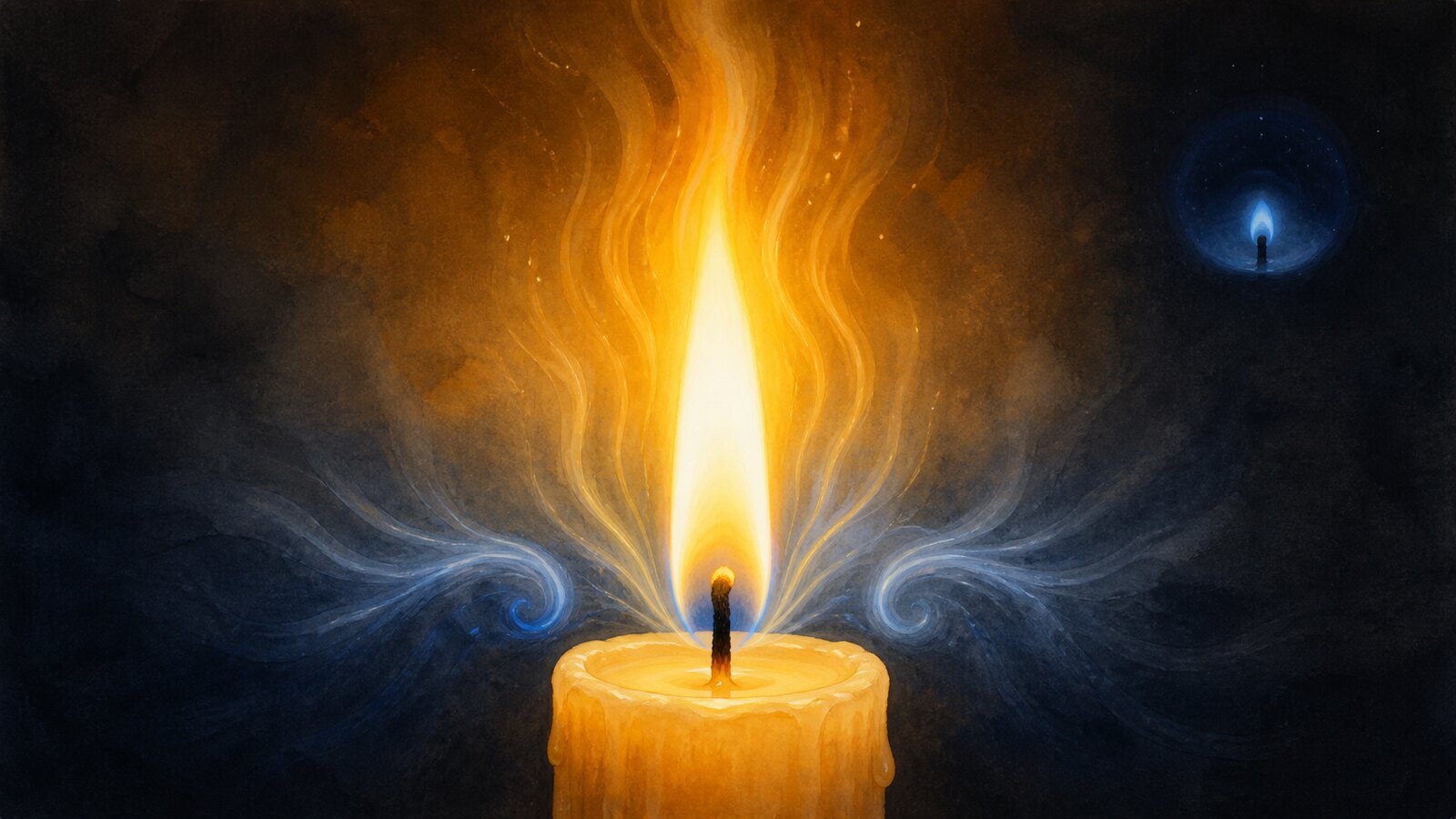
A candle flame stretches upward mainly because combustion heats gases until they are less dense than the cooler surrounding air. In Earth's gravity, buoyancy carries that hot mixture upward while fresh oxygen-bearing air enters from below and the sides. The resulting convection elongates the reaction zone and transports glowing soot toward a pointed tip. Flame does not possess a preference for 'up,' and the wick's orientation alone does not create the familiar shape.
A solid candle does not leap directly into flame. Heat melts wax around the wick, and capillary action draws that liquid through narrow spaces between the wick fibers. Near the hot tip, the wax vaporizes into gaseous fuel. Most combustion occurs in a thin region where wax vapor meets oxygen from the surrounding air. Energy released there melts and vaporizes more wax, sustaining a cycle in which the wick mainly serves as a fuel-delivery structure.
Carbon dioxide, water vapor, and other gases produced by the reaction expand as they become hot. At similar pressure, the heated mixture is generally less dense than nearby cool air, so gravity creates a buoyant upward flow. Cooler, denser air replaces the rising products and supplies more oxygen. This circulation aligns the movement of fuel, heat, reaction products, and particles in a common direction, pulling the visible flame into its elongated terrestrial form.
Tilting a candle sideways offers a simple clue. The wick can point horizontally while the tip of the flame turns upward, because the buoyant gases still rise relative to Earth's gravity. An imposed draft can overpower that natural convection and bend the flame sideways or extinguish it. Upward is therefore the default only in fairly still air when buoyancy dominates the flow, not an absolute rule that survives every surrounding condition.
The yellow glow is also connected with that moving gas. Close to the wick, wax vapor is abundant and oxygen is limited, so incomplete combustion can produce tiny carbon-rich soot particles. Heated to incandescence, those particles emit bright light while being carried upward and then burn in regions with more oxygen. The luminous yellow volume is not identical to the entire chemical reaction boundary. Blue reaction zones can remain visible near the base and outer edge.
Microgravity provides a powerful comparison. When gravity-driven buoyant convection becomes very weak, hot products do not rush in one preferred direction and fuel and oxygen meet mainly by slower diffusion. NASA candle demonstrations show a long yellow terrestrial flame becoming smaller, rounder, dimmer, and blue in microgravity. Removing the directional circulation lets the reaction zone form more symmetrically around the wick, revealing which part of the familiar shape came from gravity.
That round flame is not evidence that a spacecraft contains no oxygen. Controlled experiments provide oxygen, but the natural flow that rapidly delivers it and removes hot combustion products is greatly reduced. Molecular diffusion and any artificial ventilation become more important. Burning rate, temperature, soot formation, and extinction behavior can consequently differ from those on Earth. Fans aboard a real spacecraft can impose a new direction and prevent a flame from remaining perfectly spherical.
Flame length is not set by candle diameter alone. The amount of wax vapor delivered by the wick, ambient oxygen, airflow, and wax composition all influence burning rate and soot production. If a long wick supplies fuel faster than oxygen can reach it, the flame can grow and become sootier; a weak fuel supply produces a smaller flame. The same upward buoyant direction can therefore contain visibly different balances of fuel and oxygen.
A flickering flame is likewise a moving reaction zone rather than a solid object dancing above the wick. The boundary between rising hot gas and incoming cool air develops vortices and responds to even weak room currents. Oxygen and wax-vapor concentrations change from moment to moment, shifting both the chemical reaction and the position of luminous soot. Restricting air with a glass enclosure alters the shape and brightness because it changes that supply-and-exhaust flow.
The pointed tip of a candle flame is ultimately a visible map of heat and mass moving under gravity. Melted wax climbs the wick, vaporizes, reacts with oxygen, and produces hot gases; buoyancy lifts those gases and draws in replacement air. The rounded flames observed in microgravity isolate the missing step and show that convection, rather than the geometry of the candle, gives an ordinary flame its upward stretch.
EDITORIAL RESPONSIBILITY
FactosBrain Editorial Desk
The FactosBrain Editorial Desk researched and reviewed this article under our editorial policy. We assess error reports under our corrections policy.