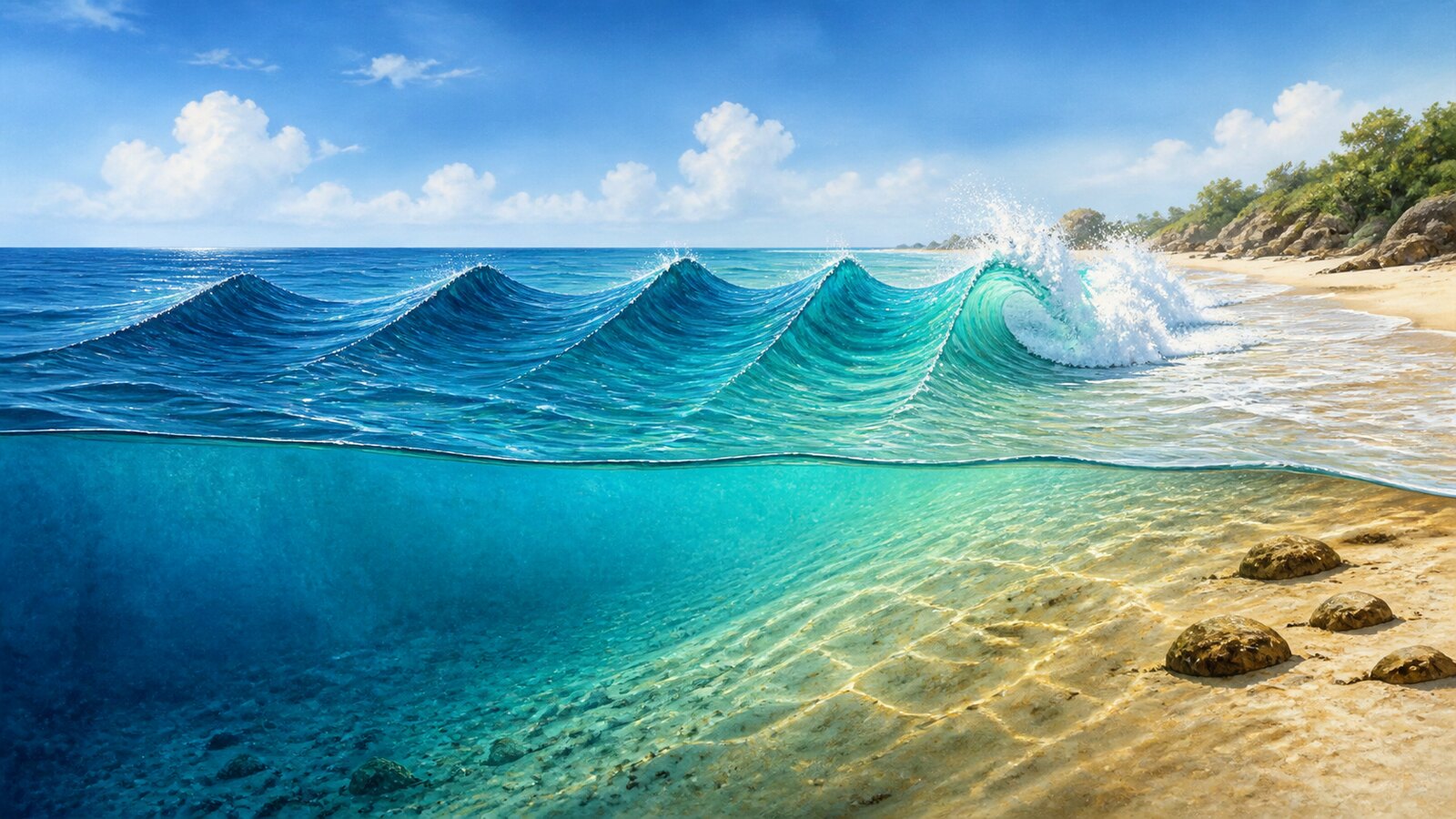
Ocean waves break near shore because decreasing depth alters the water motion beneath them. The lower part of a wave begins interacting with the seafloor and the wave slows, while its wavelength shortens and its height and steepness can increase. Eventually the crest can no longer be supported by the slower water below. It pitches or spills forward, converting organized wave energy into foam, turbulence, sound, and nearshore currents.
A swell crossing the open sea can look as though an entire mass of water is traveling toward land. In an ordinary wind wave, however, energy is the main thing transmitted over long distance. Individual water particles move in paths that are approximately circular or elliptical as a crest and trough pass. A floating buoy rises, moves slightly forward, falls, and moves back toward a similar position. There can be a modest net drift, but the bulk water does not race across the ocean at the wave's speed.
In deep water, that orbital motion weakens rapidly with depth and barely affects the seabed. A common boundary for deep-water behavior is a depth greater than about half the wavelength. As the wave enters shallower water, its subsurface orbits reach the bottom and become flattened. Friction, pressure changes, and the constrained motion near the bed can no longer be ignored. The same incoming wave must adjust to a new environment before it reaches dry land.
Wave speed in shallow water depends strongly on depth, so the advancing wave slows as the bottom rises. Crests behind it continue to arrive with energy, while the horizontal distance between crests—the wavelength—contracts. Changes in particle motion and energy transport can also make the wave grow taller through a process called shoaling. Slower speed, shorter wavelength, and greater height combine to increase steepness, usually expressed as height relative to wavelength.
A wave cannot preserve an arbitrarily steep shape. Under simplified shallow-water conditions, breakers often form when wave height approaches roughly 0.78 times the local water depth, although slope, period, and interactions with other waves shift that value. Near the limit, water around the crest moves forward faster than the lower supporting part and the front face becomes unstable. Gravity then pulls the crest down as a spilling sheet or a curling plunge. That collapse is the visible breaker.
The style of breaking depends on the incoming wave and the beach profile. Over a gently sloping sandy bottom, foam may spill gradually down the face for some distance. A steeper slope and suitable wave steepness can produce a plunging breaker whose crest curls over an air-filled space before crashing. At a very steep shore, water may surge upward with little distinct curl. These are useful types, not rigid boxes into which every real wave must fit.
Depth also changes direction when a wave approaches at an angle. The section of a crest that enters shallow water first slows first, while the section still in deeper water keeps moving faster. The crest rotates toward alignment with the depth contours in a process called wave refraction. Sandbars, channels, reefs, and headlands can focus or spread energy, so breaker height and location vary along one beach even under the same offshore swell.
Breaking does not make energy simply cease to exist. It transforms coherent wave motion into turbulent mixing, bubbles, sound, heat, and moving water in the surf zone. Obliquely arriving breakers and returning water help drive longshore and rip-current circulation. Turbulence also lifts sand from the bed so currents can transport it. The breaker zone is therefore where wave physics becomes the daily reshaping of a beach.
Very long waves do not necessarily make the familiar curling shape. A tsunami has a wavelength vastly longer than an ordinary wind wave and can cross deep ocean as a low, fast disturbance. Near land it often arrives more like a rapid rise and powerful flood than a line of surfing breakers. A tsunami can break under some conditions, but assuming it must resemble a short wind wave hides its real behavior. Wavelength relative to depth determines which transformation dominates.
A line of white surf marks the point where ocean energy has been reshaped beyond a wave's stability limit. The seabed modifies lower-water motion and slows the wave; its wavelength contracts, its crest grows steeper, and the unsupported top falls forward. The precise place and form of that collapse depend not only on wave height and period but also on beach slope and underwater topography.
EDITORIAL RESPONSIBILITY
FactosBrain Editorial Desk
The FactosBrain Editorial Desk researched and reviewed this article under our editorial policy. We assess error reports under our corrections policy.