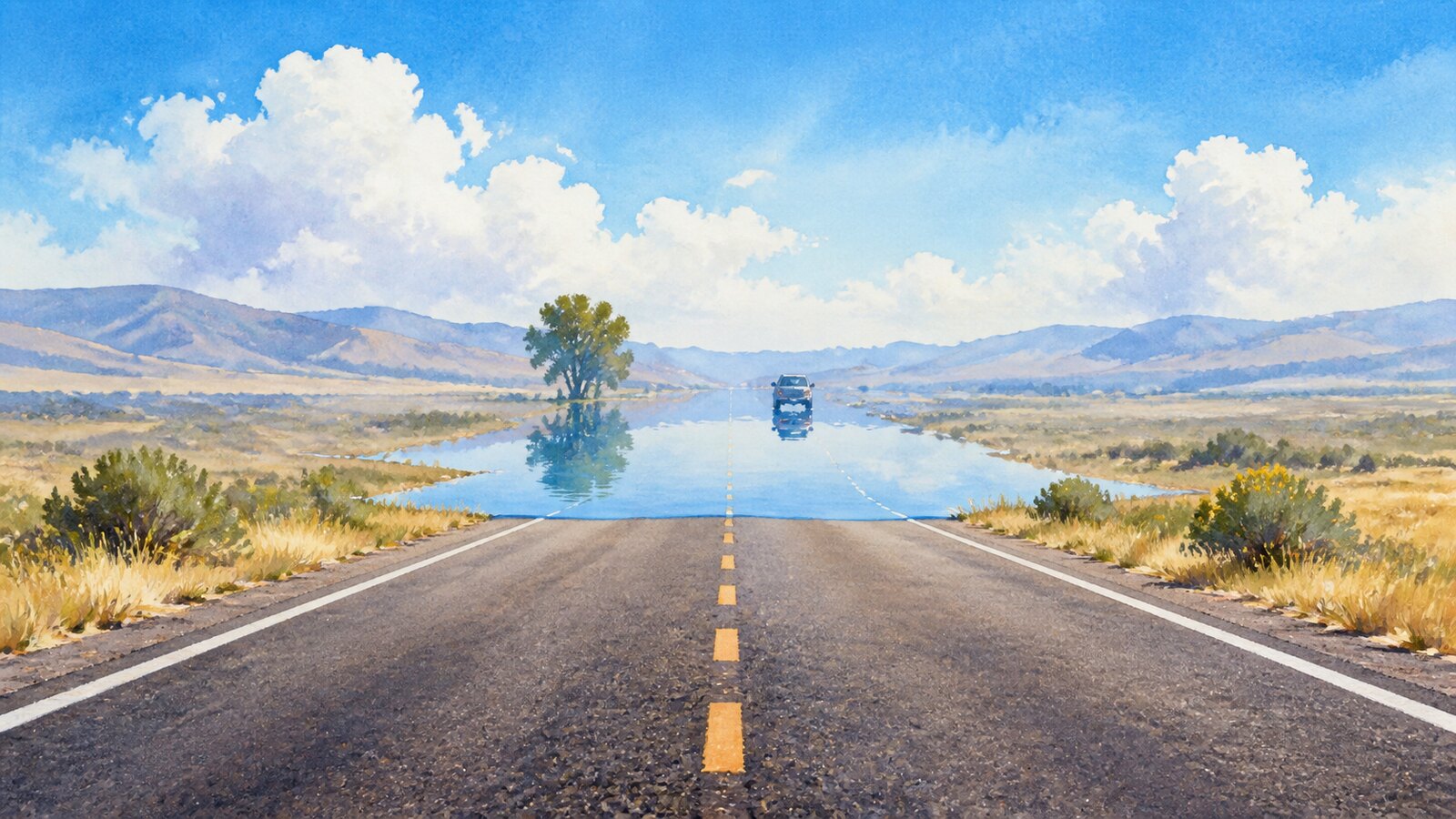
A hot road looks wet in the distance because layers of air at different temperatures bend light from the sky and faraway objects. Air immediately above sun-heated pavement is hotter and usually has a lower refractive index than the cooler air above it. A descending ray can curve upward into your eyes, and the visual system traces it backward as though it came from below the road. The resulting virtual image resembles sky reflected in a puddle.
The process begins because pavement and the air above it do not share one temperature. Dark asphalt absorbs sunlight efficiently and heats a thin layer of nearby air. That air expands and becomes less dense, while air a little higher remains cooler and denser. There is rarely one crisp boundary between the two. Temperature, density, and refractive index usually change gradually with height, forming a steep optical gradient close to the surface.
Light changes direction when it travels obliquely through regions with different refractive indices. Over the road, the refractive index commonly decreases toward the hot surface, so a ray arriving from above bends progressively upward as it crosses many thin layers. It is not making one sharp reflection from a mirror. Its path curves through the air. At a sufficiently shallow angle, the ray turns before reaching the pavement and rises into an observer's eye.
Vision normally estimates position by assuming that light has traveled along a nearly straight line. Extend the upward-curving ray backward in that way and its apparent origin lies below the road surface. Blue sky can become a pale blue or silvery patch, while light from a distant car or tree may form a blurred, inverted image underneath the object. That arrangement resembles the familiar reflection produced by still water, which is why the brain interprets the patch as a puddle.
The effect is sometimes reduced to total internal reflection at one boundary, but the atmosphere contains no smooth sheet like a pane of glass. Air can be drawn as many horizontal layers for convenience, yet the refractive change between neighboring layers is tiny and the accumulated bending produces a curve. Only when the temperature gradient is strong enough and the viewing angle shallow enough does that path turn toward the observer. This continuous-gradient picture explains the image without treating the pavement as the surface that reflected it.
This is an inferior mirage, named because its virtual image appears below the real scene. Water has not evaporated and left an optical residue, and the asphalt has not suddenly become mirrorlike. The pavement's dark surface matters because it can produce a strong temperature gradient and provide contrast for a bright sky image. The apparently watery light itself, however, reaches the viewer after refraction through air rather than reflection from the road.
The image often shimmers because the air layers are not perfectly still. Hot parcels rise, cooler parcels move in, and turbulence changes the refractive-index pattern from moment to moment. Rays from the same distant feature then follow slightly different paths, making its apparent position and brightness dance. The same heat shimmer interferes with precise surveying close to bare ground, where a scale or target can seem to move even though the equipment is stationary.
Road mirages are especially conspicuous from a low viewpoint along a long, shallow line of sight. The ray must spend enough distance near the heated surface for small bends to accumulate. When a driver or walker approaches the apparent water, it retreats or disappears because the viewing geometry has changed. There is no object at the supposed location to reach; the image is produced jointly by the observer's position and the atmosphere's temperature structure.
Not every mirage appears beneath an object. Over a cold sea or ice surface, cool dense air can lie below warmer air in a temperature inversion. The opposite refractive structure can make distant ships or coastlines appear raised, producing a superior mirage. More complicated stacks of temperature layers can stretch and repeat images in a Fata Morgana. The optical principle remains refraction, but the direction in which air density changes with height controls where the displaced images appear.
The false puddle is therefore an image inside a temperature-shaped optical path, not a substance sitting on the asphalt. Sunlight heats the road, the road creates a strong gradient in the air, the gradient curves light upward, and the eye mislocates that curved ray along a straight backward path. Once the pavement cools or wind mixes away the temperature contrast, the path no longer exists and the apparent water vanishes with it.
EDITORIAL RESPONSIBILITY
FactosBrain Editorial Desk
The FactosBrain Editorial Desk researched and reviewed this article under our editorial policy. We assess error reports under our corrections policy.