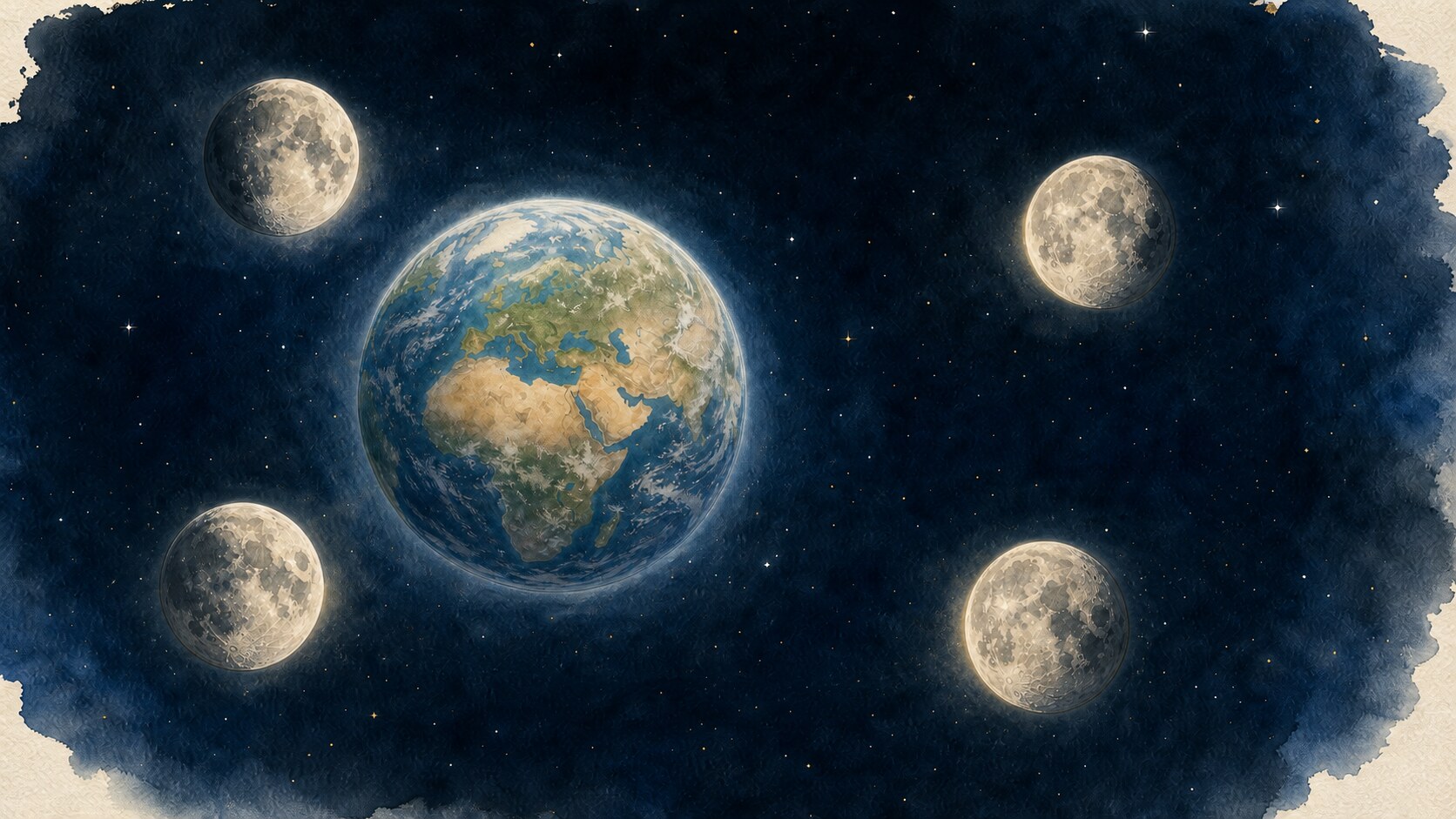
The Moon really does rotate even though Earth sees nearly the same side night after night. It turns once on its axis in the same direction and in the same time that it completes one orbit of Earth. Both motions take about 27.3 days relative to the distant stars, so one lunar hemisphere keeps facing us.
This arrangement is synchronous rotation, a form of tidal locking. Imagine walking once around a person in the center of a room while keeping your face toward them. If you kept your body pointed in one fixed direction, they would see your side and then your back. To face them for the entire circuit, you must rotate once as you go around.
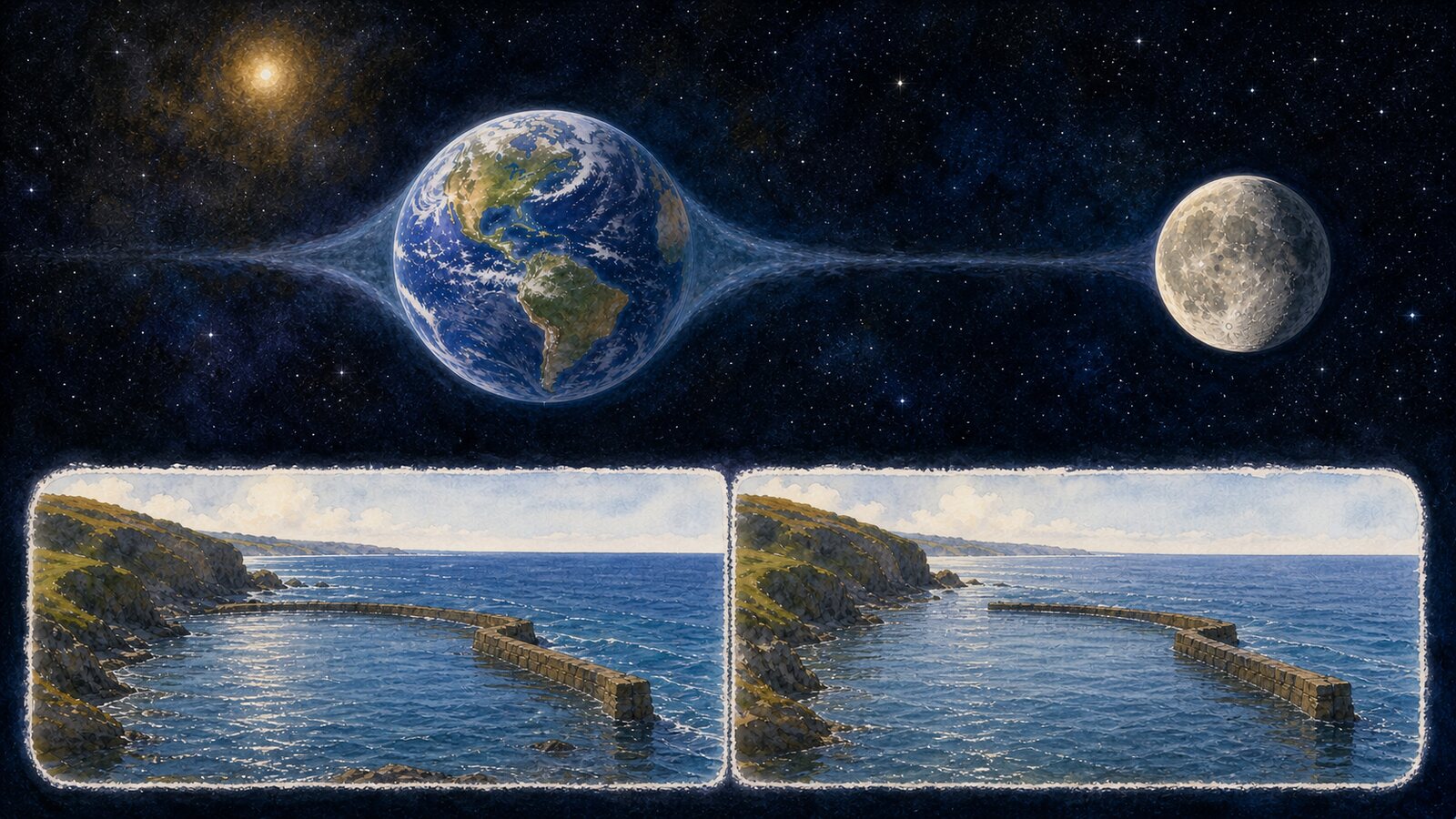
The Moon probably did not begin in its present state. It is thought to have spun faster when it was young. Earth's gravity pulls slightly more strongly on the Moon's near side than its far side, raising a small tidal distortion. When the spin and orbit were out of step, that bulge did not point directly at Earth, so gravity exerted a torque that changed the rotation.
Repeated flexing inside the Moon dissipated some mechanical energy as heat, slowing the spin over a very long time. Once one rotation matched one orbit, the tidal distortion could remain much more closely aligned with Earth. Tidal locking therefore does not mean that the Moon stopped turning. It means that gravity synchronized its rotation with its orbital motion.
We do not see exactly the same half every day. The Moon moves faster when closer to Earth and slower when farther away in its elliptical orbit, while its rotation is steadier. Its tilted axis and orbit add another change in perspective. Together these apparent east-west and north-south wobbles, called libration, let observers on Earth see about 59 percent of the lunar surface over time.
The 27.3-day rotation and orbital period is also different from the roughly 29.5 days between one new moon and the next. While the Moon circles Earth, Earth itself moves along its orbit of the Sun. The Moon must travel for a little more than two additional days to return to the same Sun-Earth alignment. The familiar face and the changing phases are related motions, but they do not use the same monthly clock.
The lunar far side is not a permanently dark side. It receives sunlight and experiences night, with daylight and darkness each lasting roughly two Earth weeks. We cannot normally see it from the ground not because light avoids it, but because gravity spent immense time matching the Moon's spin to its path around Earth.
EDITORIAL RESPONSIBILITY
FactosBrain Editorial Desk
The FactosBrain Editorial Desk researched and reviewed this article under our editorial policy. We assess error reports under our corrections policy.