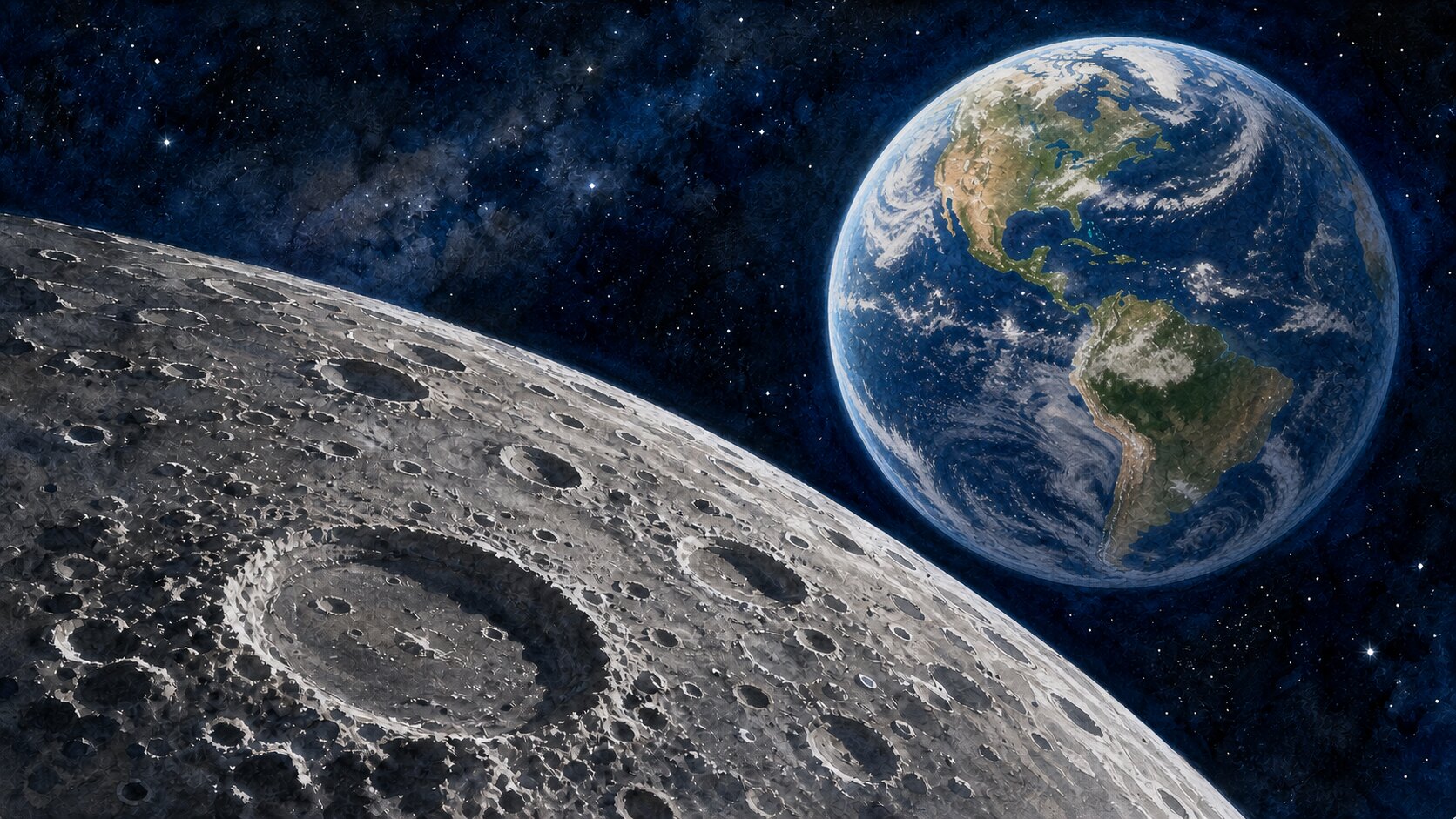
The Moon looks exceptionally cratered mainly because it has few ways to erase an impact scar, not because it has necessarily been struck far more often than Earth. Both bodies endured impacts from asteroids and cometary debris throughout solar-system history. Their surfaces differ most dramatically in how they preserve that record.
When a large space rock hits at very high speed, it does not simply press a neat hole into the ground. The released energy compresses, melts or vaporizes rock and blasts material outward, forming a roughly circular cavity, a raised rim and a surrounding blanket of ejecta. Many round features on the Moon are landscapes made by these impact explosions.
On Earth, rain, rivers, waves and wind erode rock while sediments fill low ground. Vegetation alters the surface, volcanism covers old terrain, and plate tectonics eventually carries much oceanic crust back into the planet. Over geologic time, even a large crater can be worn down, buried or deformed until it becomes difficult to recognize.
The Moon has only an extremely thin exosphere rather than weather-producing air, and it has no flowing surface water. It also lacks Earth's global system of plate tectonics that continually recycles old crust. With almost no rain, rivers or shifting plates to remove the evidence, an impact structure can remain recognizable for billions of years.
The lunar surface is not perfectly frozen in time. Micrometeorites and later impacts gradually break down and mix older terrain, and new craters can overlap old ones. Ancient basaltic lava also flooded and covered portions of earlier landscapes to form the dark lunar maria. Better preservation means much slower change than on Earth, not a complete absence of change.
Earth's atmosphere does destroy many small incoming objects, but the difference in large crater abundance cannot be explained by air alone. Large impactors can cross the atmosphere and strike the ground. The more important loss happens during the millions or billions of years after impact, as erosion, burial, volcanism and plate tectonics modify or remove the crater.
This long-lived record lets scientists use crater abundance and overlapping relationships to estimate the relative ages of surfaces. The densely cratered lunar highlands are generally older, while many dark lava plains are younger. The Moon's face is therefore more than a battered landscape: it is a geological archive of early solar-system impacts whose equivalent record has mostly vanished from Earth.
EDITORIAL RESPONSIBILITY
FactosBrain Editorial Desk
The FactosBrain Editorial Desk researched and reviewed this article under our editorial policy. We assess error reports under our corrections policy.