Look a little closer
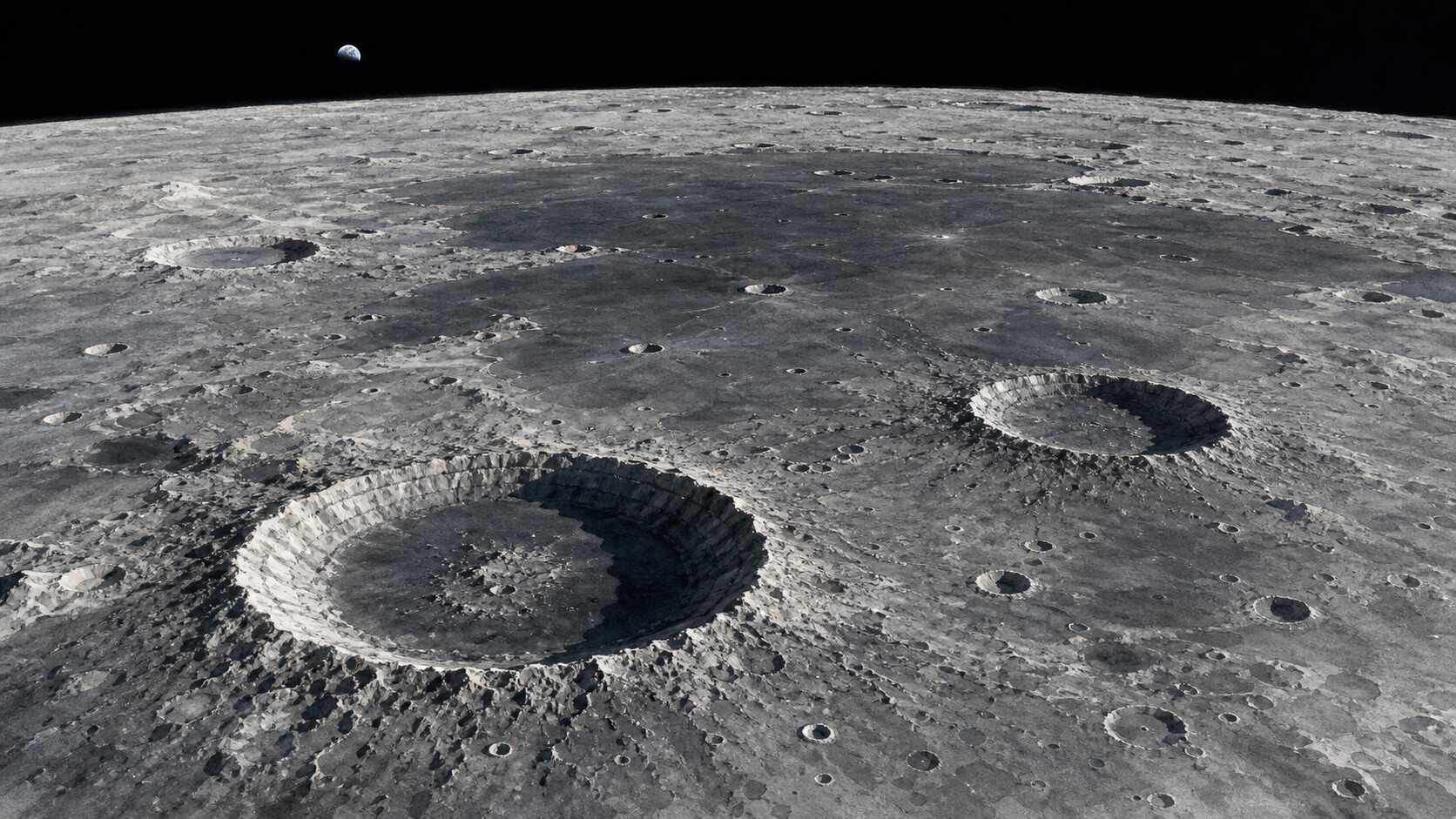
The Moon is covered with circles ranging from tiny pits to enormous basins. Most are not volcanic vents. They are impact craters, formed when asteroids, meteoroids, or comet fragments strike the lunar surface at tremendous speed. The collision excavates and melts rock, launches material outward, and leaves a depression surrounded by a raised rim. In larger impacts, collapse and rebound after the first excavation can produce terraces and a central peak.
A crater can be nearly circular even when the incoming object was not traveling straight down. At high impact speeds, energy is released so quickly that the excavation behaves somewhat like an explosion spreading outward from the impact point. Except at very shallow angles, the result is often round. Very large transient holes are unstable: their walls slump inward and material from depth can rebound upward, changing the simple bowl shape into a more complex structure.
The main reason lunar craters are so conspicuous is not simply that the Moon has been hit more often. It has very little that erases the evidence. There is no rain, river, wind, vegetation, or substantial atmosphere on the Moon. On Earth, water and wind wear down landforms, sediment fills depressions, and living things alter surfaces. On the Moon, a mark made long ago can remain recognizable for billions of years.
Earth has also been struck many times over its history. Our thicker atmosphere destroys many smaller incoming objects, while erosion, oceans, sedimentation, volcanism, and plate tectonics alter or bury the craters that do form. Plate tectonics continually recycles much of Earth's old crust. The Moon has lacked comparable surface recycling for billions of years, so it preserves old impacts that Earth often does not.
The dark lunar maria, often called seas, are linked to this history. Some very large impacts created basins that were later filled by basaltic lava rising from inside the Moon. Their dark, smooth floors sit within ancient impact structures. Within a region, the number and overlap of smaller craters can help scientists estimate relative surface age: a landscape exposed for longer has generally had more opportunities to collect impacts.
Lunar craters do still change. Later small impacts slowly churn and mix the upper surface, a process known as impact gardening. Solar wind and extreme temperature cycles also affect exposed material. But these processes are slow compared with Earth's weather and geology. A relatively young crater may show bright rays of ejected material, while an older one often has a softer rim and more overprinted small craters.
The Moon's many circles are therefore a time record of the solar system, not merely a pattern on a gray surface. They preserve evidence of past bombardment and reveal how long different parts of the lunar crust have been exposed. The lack of a substantial atmosphere makes the Moon a harsh place for visitors, but for planetary scientists it leaves an unusually durable archive of ancient events.
EDITORIAL RESPONSIBILITY
FactosBrain Editorial Desk
The FactosBrain Editorial Desk researched and reviewed this article under our editorial policy. We assess error reports under our corrections policy.