Look a little closer
Medieval scribes sometimes erased writing from parchment and used the sheets again because animal-skin parchment was laborious, valuable, and durable. A manuscript written over an erased text is called a palimpsest. Reuse was often practical recycling, not automatic evidence that authorities set out to suppress every work now found underneath.
Making parchment required soaking sheep, goat, or calf skin in lime, removing hair, stretching the skin under tension, and repeatedly scraping and finishing both surfaces as it dried. Before paper became widely available through local production and trade, preparing enough leaves for a substantial book consumed considerable labor and material. Good parchment was also tough: it tolerated folding, handling, and sometimes a second round of surface preparation.
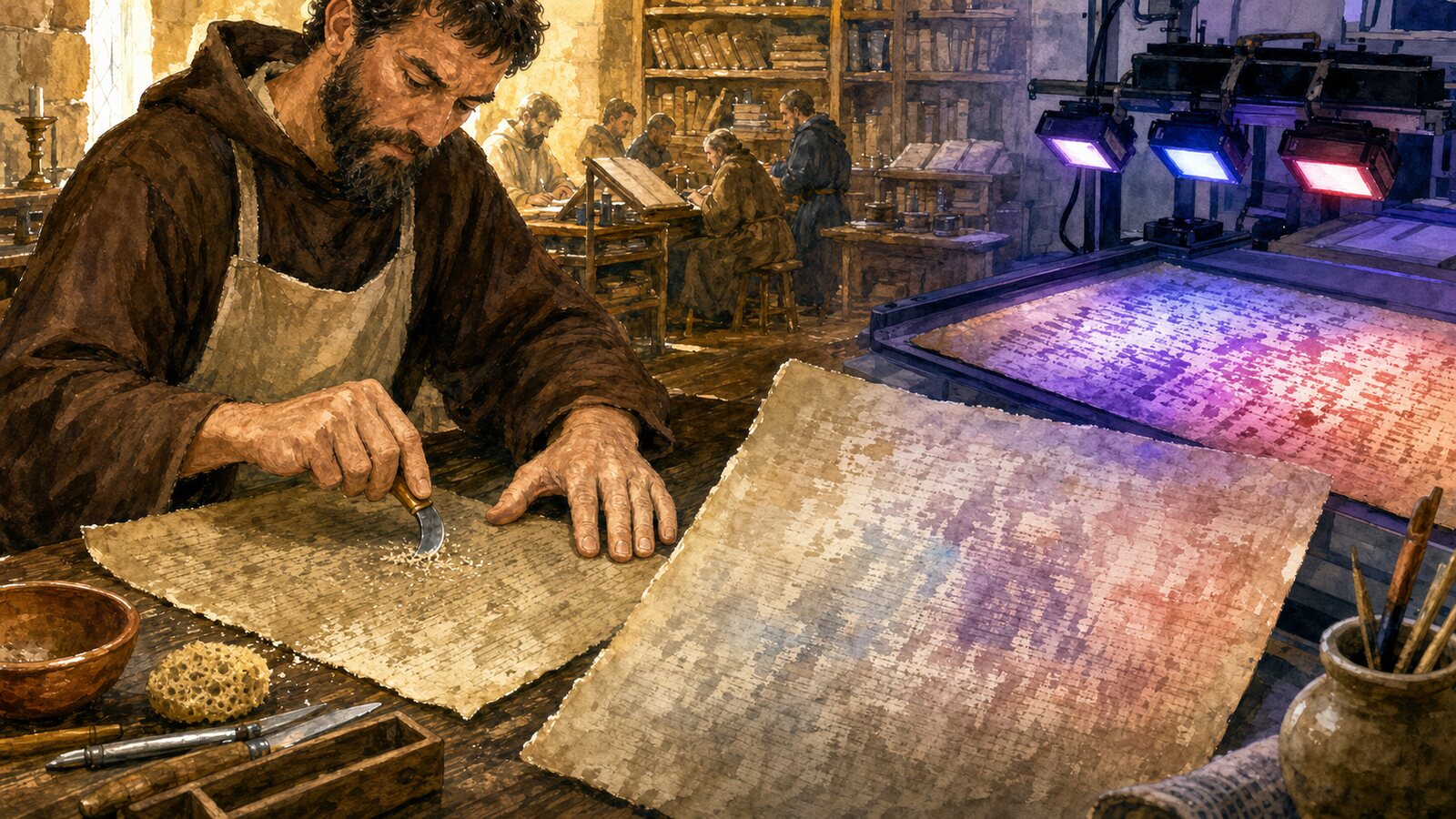
To recycle a manuscript, workers could take its binding apart into leaves or folded bifolia. A scribe or parchmenter scraped away ink and a thin surface layer with a blade, sometimes using liquids and abrasives to reduce the remaining stain. Leaves might be trimmed, rotated, and folded into a different format. New ruling and writing then turned the altered skin into a book with a different language, script, purpose, and reading direction.
The choice of undertext varied by place and period. A book might be reused because few local readers still understood its language, its legal or liturgical content seemed obsolete, duplicate copies existed, or the volume was damaged and incomplete. A disfavored or prohibited text could also be vulnerable. Treating every palimpsest as a coordinated campaign to destroy pagan classics, however, replaces a diverse material history with a single dramatic motive.
Erasure rarely removed every trace because ink did not simply rest like dry dust on top. Some of its components penetrated or interacted with the parchment's collagen fibers, while scraping changed the thickness and texture of those fibers. Residue that resembles a vague stain under ordinary illumination can absorb, reflect, or fluoresce differently from the surrounding skin at another wavelength. The physical act of erasure therefore left clues as well as gaps.
Modern investigators do not uncover the lost text with one magical photograph. They capture the same leaf under ultraviolet, visible, and infrared illumination, then compare or mathematically combine the images to increase differences among parchment, upper writing, and underwriting. A processed view can suppress one ink while emphasizing another. Where iron-bearing pigment survives, X-ray fluorescence can sometimes map the element's distribution even beneath paint or visually confusing layers.
The Archimedes Palimpsest provides the best-known example. A tenth-century Greek copy of mathematical works was dismantled in the thirteenth century along with leaves from other books. Its writing was erased, its sheets were cut, rotated, and refolded, and the material became an Eastern Orthodox prayer book. Consequently, mathematical undertext runs in a different direction beneath the prayers. The reused volume preserved works by Archimedes and traces of several other ancient texts.
Recovering that evidence required more than shining brighter light on the pages. Conservators first had to stabilize mold damage, fragile leaves, later glue, and forged paintings before separating and positioning the sheets safely. Imaging teams photographed many wavelength bands and tested different ways of separating their signals. X-ray methods helped with especially obscured areas, while scholars compared incomplete strokes with Greek grammar, context, and surviving textual traditions.
Multispectral imaging is powerful but does not make every erased letter certain without touching the object. Upper and lower texts may respond similarly, aggressive scraping may have removed crucial strokes, and stains, wrinkles, or repairs can imitate marks. Processing can also exaggerate noise into shapes that look meaningful. Reliable readings therefore depend on preserved raw images, documented methods, multiple renderings, and cautious paleographic judgment rather than a single enhanced picture.
A palimpsest is consequently more than a tale of one age's ignorance erasing another age's wisdom. It is a layered record of a book culture in which writing material had enough value to live twice. Medieval recycling obscured earlier works, yet the resilience of parchment also carried their residues into the present. When researchers separate the responses of ink and scraped collagen wavelength by wavelength, one page becomes visible as both a repurposed object and the meeting place of two reading worlds.
EDITORIAL RESPONSIBILITY
FactosBrain Editorial Desk
The FactosBrain Editorial Desk researched and reviewed this article under our editorial policy. We assess error reports under our corrections policy.