Look a little closer
Some late medieval and early modern European cathedral, monastic, and collegiate libraries chained books so that valuable volumes could remain available for shared reading without easily leaving the building. The chain was not a punishment for the reader or a seal placed on forbidden knowledge. It was a compromise between security and access: a book could reach a nearby lectern and open normally, but it could not be carried out. The practice was never universal, yet English cathedral and Oxford college records preserve unusually clear examples.
Before printing supplied large numbers of identical copies, a substantial volume embodied parchment or paper, scribal and sometimes artistic labor, correction, and binding. Works of theology, law, and medicine were essential to an institution while remaining portable enough to disappear. Balliol College describes medieval books as negotiable capital that could even be pledged as security for a loan. Keeping them in a locked chest protected the assets, but it also obstructed the quick, repeated consultation that teaching, worship, and scholarship required.
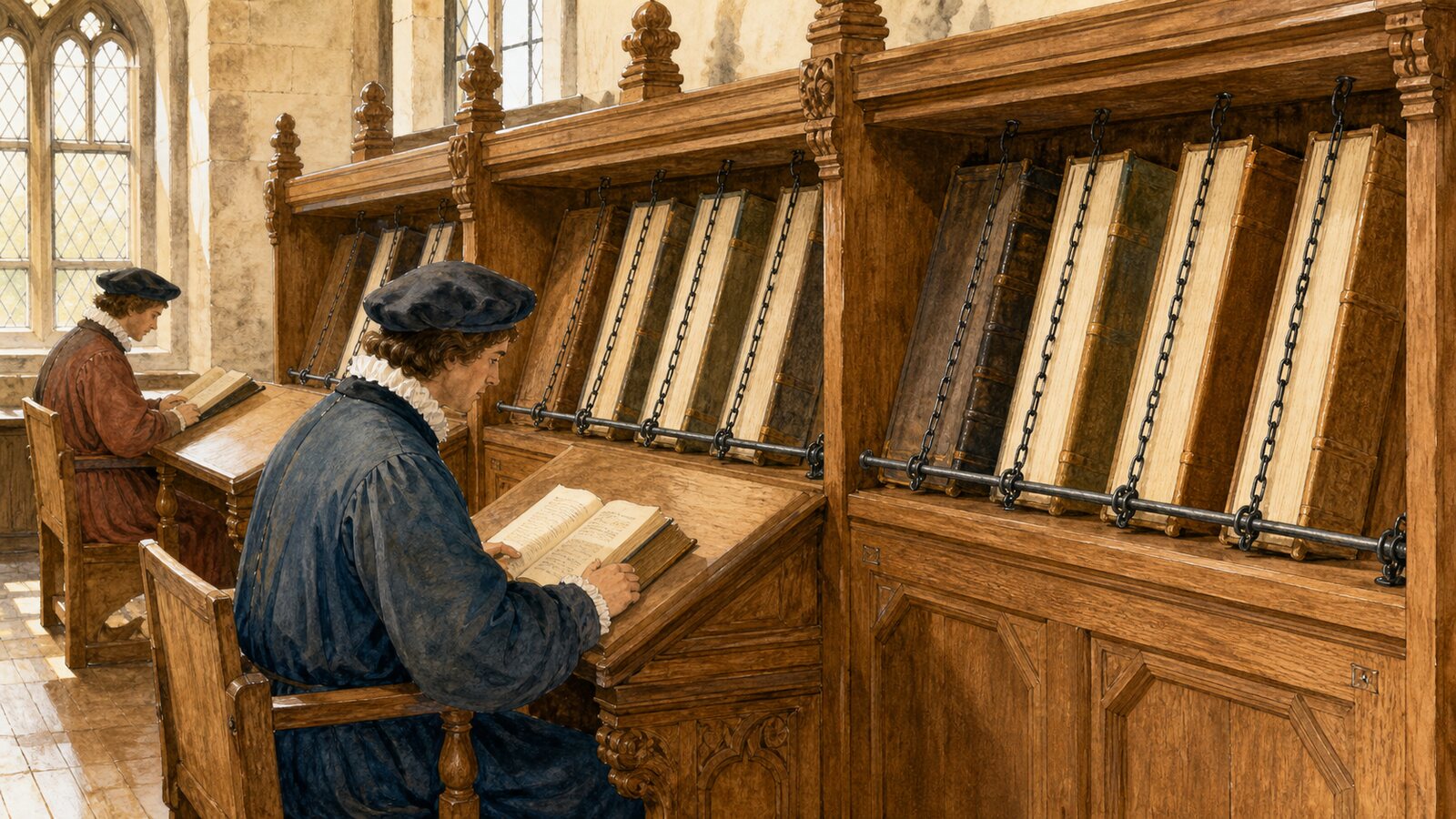
The chained library resolved that conflict through furniture. In the surviving system at Hereford Cathedral, one end of a short chain was fixed near the upper edge of a book's front cover. A ring at the other end ran along a horizontal iron rod beneath the shelf, and the rod was locked in place. The chain was long enough to lift the volume onto its attached desk or lectern and turn its pages, but too short to cross the room or reach a door. Unlocking the rod, rather than cutting each chain, allowed authorized rearrangement.
This mechanism explains the startling sight of books shelved with their fore-edges, not their spines, facing the reader. If a front-cover chain were attached to a conventionally shelved volume, turning that volume into reading position could wrap the chain around it or tangle it with its neighbors. Facing the page edges outward let a reader lift the book directly onto the adjacent sloping desk. Titles might be marked on a cover or fore-edge instead of a spine, so the arrangement that looks backward to a modern visitor was practical for the hardware.
Early rooms made book, shelf, window, and desk a single reading system. Balliol had a room for chained books by about 1385 and later used sloping lecterns set between windows. Oriel College records a chained library in 1409 and the construction of a new library in 1449. A scholar worked in available daylight and brought a needed text only as far as its rod permitted. Later stall arrangements placed upright shelves above or beside desks, increasing capacity while preserving the same promise: the text was open to consultation, but the physical copy stayed in its assigned bay.
Chaining did not mean that no book could ever be borrowed. Oriel's history shows that chained reference collections and lending collections could coexist, with loans controlled by deposits, pledges, or institutional rules. A decision to chain a volume could reflect not only its price but also how frequently it was needed and whether the community had to guarantee that at least one copy remained on site. The system was one layer of collection management, not a declaration that every reader was a thief.
Printing did not make the chains fall away overnight. It eventually increased the supply of texts and pushed down the cost of many copies, but large scholarly works and donated collections remained valuable, while furniture and administrative habits changed slowly. Hereford's intact arrangement is principally seventeenth-century and continued in use until 1841. Balliol ordered purpose-made chains in 1677, recorded further chaining work in the late 1760s, and did not sell the obsolete iron as scrap until the 1790s. A technology associated with the Middle Ages survived deep into the print era.
There was no single blueprint copied across every European library. Books could lie on lecterns or stand in stalls; the attachment point, chain length, cataloguing practice, and lending policy varied by place and period. Hereford is extraordinarily valuable because its fittings remain together, but its present room should not be mistaken for an average view of all medieval libraries. Historians reconstruct local practice by combining surviving furniture with staple marks on bindings, institutional accounts, gifts, regulations, and lists of books.
A chained book can look like an emblem of knowledge imprisoned, yet the arrangement often made scarce information more usable. It offered more access than a locked chest and more continuity than unrestricted lending when an institution owned only one crucial copy. As print collections expanded and supervision, catalogues, and loan systems changed, that particular compromise became less necessary. The outward-facing pages, cover staples, and measured lengths of iron show that early libraries designed not only possession but also the conditions under which a community could read.
EDITORIAL RESPONSIBILITY
FactosBrain Editorial Desk
The FactosBrain Editorial Desk researched and reviewed this article under our editorial policy. We assess error reports under our corrections policy.