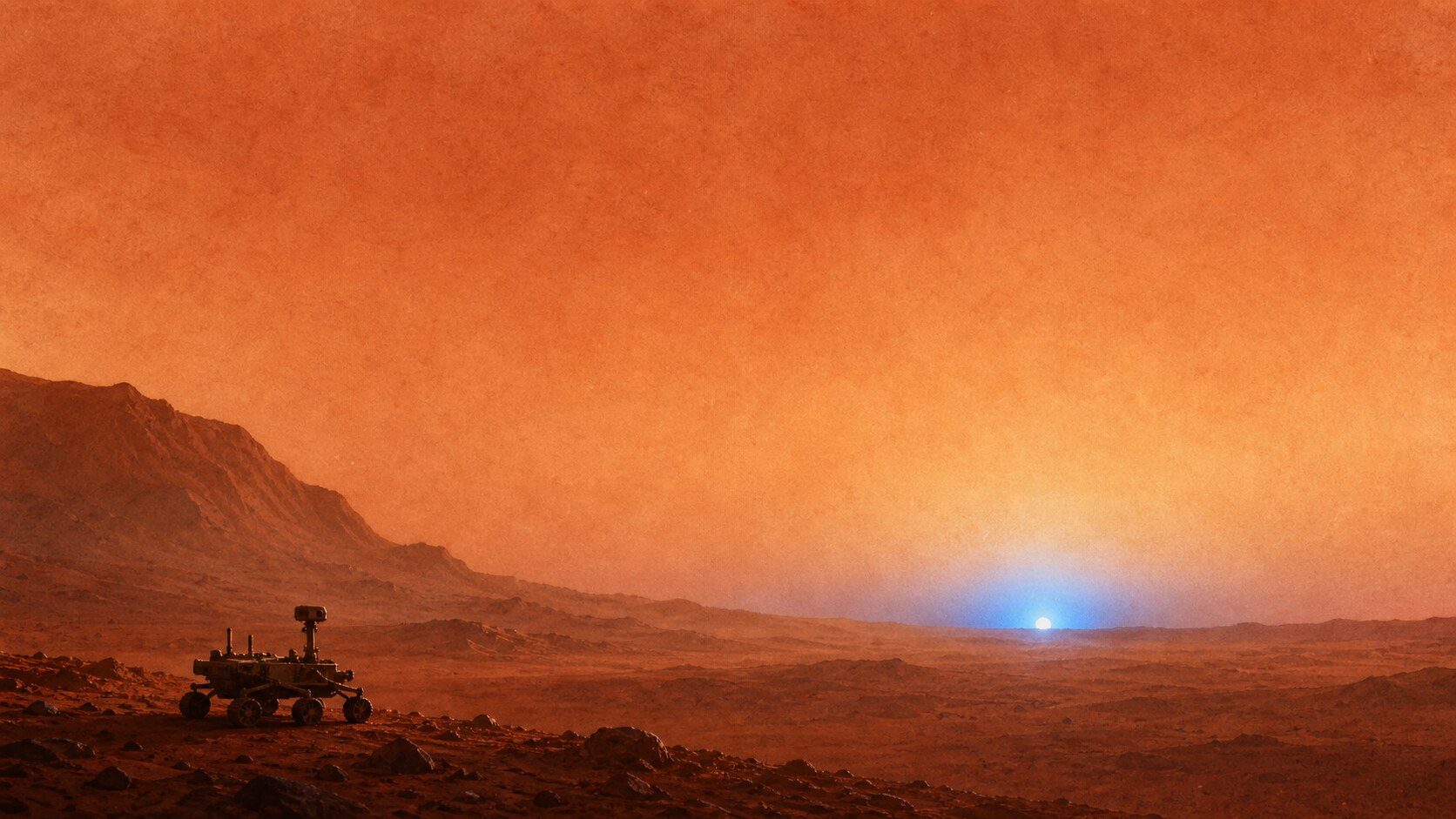
Calling a Martian sunset “blue” does not mean the whole sky turns the clear blue of daytime on Earth. On Mars, a blue or blue-grey glow becomes prominent close to the setting Sun while the wider dusty sky remains reddish. Curiosity and other Mars missions have photographed this contrast from the surface.
On Earth, molecules in the atmosphere scatter short blue wavelengths strongly in many directions, making a clear daytime sky look blue. Near sunset, sunlight crosses a longer path through the atmosphere and much of that blue light is scattered out of the direct line of sight, leaving warmer colours around the Sun. Mars has a far thinner atmosphere, and suspended mineral dust has a much larger role in setting the colour.
Martian dust spreads much of the yellow and red component across a broad area, contributing to the planet’s muted reddish daytime sky. At the same time, the particles scatter blue light preferentially near the forward direction—the direction in which sunlight is already travelling toward the observer. The blue component therefore stays more concentrated in the small part of the sky close to the solar disk.
The contrast strengthens at sunset. As the Sun drops toward the horizon, its light travels through more dusty atmosphere than it does at midday. More scattering separates the broadly distributed red and yellow light from the blue light concentrated near the Sun’s direction. The result is a distinct cool halo embedded in a much warmer sky.
This does not mean that physics runs backwards on Mars. Scattering depends on particle size and composition, wavelength and viewing angle. Earth’s clear sky is dominated by Rayleigh scattering from molecules much smaller than visible wavelengths. Mars’s dusty sky is strongly influenced by larger particles whose directional scattering produces a different pattern.
Rover photographs also need to be interpreted with their processing in mind. NASA’s Curiosity sunset sequence from Gale crater was colour-calibrated and white-balanced to remove camera artifacts. Its Mastcam records colour similarly to human vision but is slightly less sensitive to blue. Dust abundance, particle properties, season and the chosen image processing can all change the exact shade in a published view.
A blue Martian sunset is therefore not the red planet temporarily acquiring an Earth-like sky. It is the same sunlight redistributed by a different population of atmospheric particles. The small blue region around the Sun, set inside a red dusty background, provides a visible demonstration of how particle properties and the length of the light path shape a planet’s sky.
EDITORIAL RESPONSIBILITY
FactosBrain Editorial Desk
The FactosBrain Editorial Desk researched and reviewed this article under our editorial policy. We assess error reports under our corrections policy.