Look a little closer
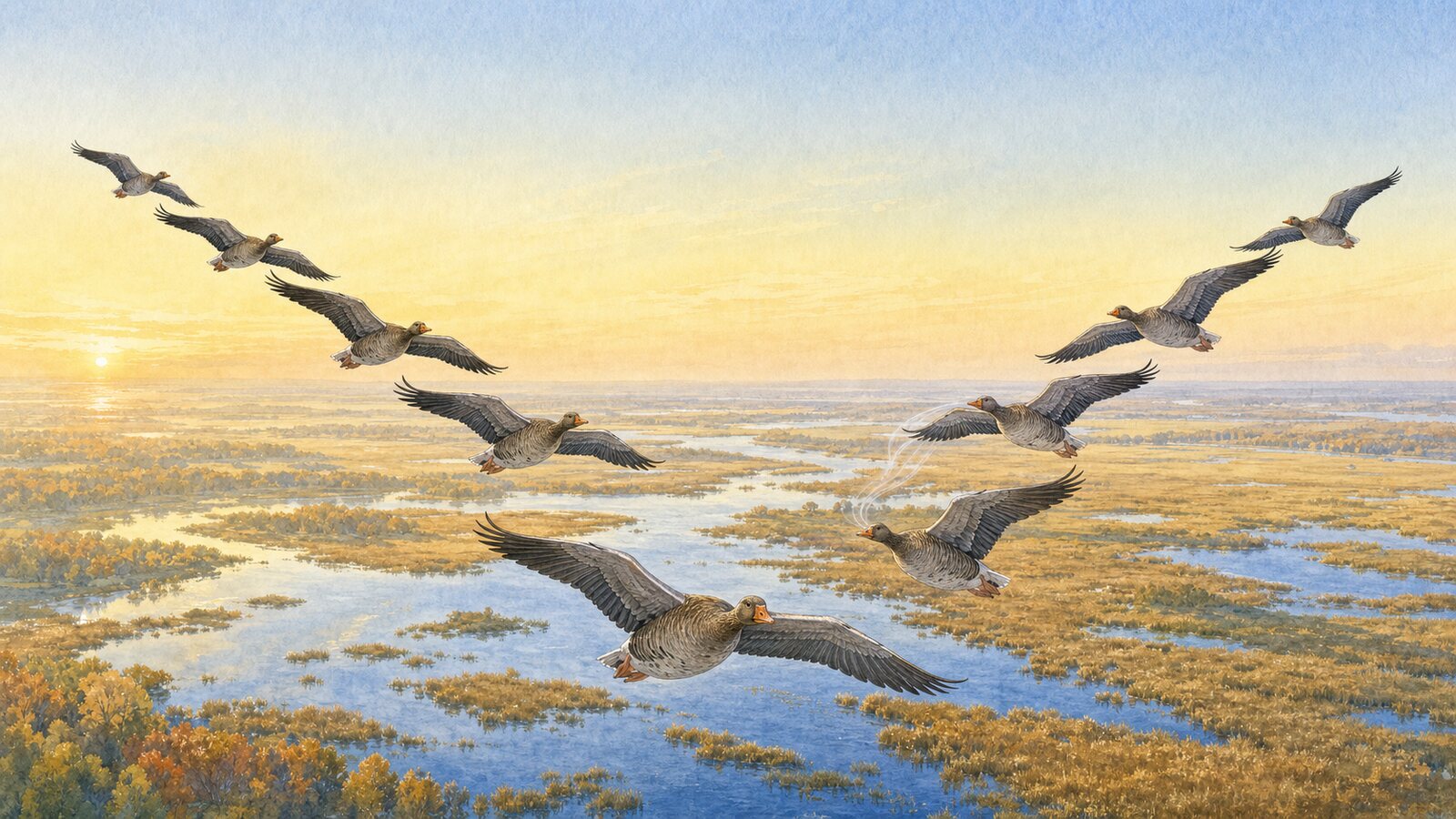
Some large migrants, including geese, pelicans, and ibises, fly in a V chiefly because a follower can use rising air just outside the wingtips of the bird ahead. It flies behind and to one side rather than directly in line, and may even time its wingbeats to the moving wake. This is not simply a bicycle-style draft in which the leader blocks a headwind; it is a three-dimensional use of lift-producing vortices.
A wing generates lift by turning air downward. Because a real wing has tips, higher-pressure air beneath it curls around each tip toward the lower-pressure region above, leaving a rotating vortex behind. Between the two trailing vortices, the average flow moves downward. Just outside each vortex, part of the circulation moves upward. A bird directly behind its neighbor risks entering turbulent downwash, whereas one offset behind a wingtip can place part of its own wing in useful upwash.
Upwash helps support the follower's weight, reducing some of the lift and induced power that it must produce for itself. Induced drag is the aerodynamic cost associated with creating lift and deflecting air downward. The effect is sensitive to position: too far inward puts the follower in descending air, and too far outward lets the useful circulation fade. When each bird chooses an offset position behind the one before it, those pairwise choices naturally extend into two diagonal arms—a V.
The wake is not a fixed ramp suspended in the sky. It rises, falls, and changes strength through each flap of the leading bird's wings. A 2014 study equipped northern bald ibises with devices that recorded their positions and wing motion during formation flight. The birds occupied locations predicted to contain upwash and adjusted the phase of their flapping according to their front-to-back spacing. They timed wingtip paths to exploit the rising portion of the wake and altered that relationship when positioned near less favorable flow.
Physiological measurements provide a second kind of evidence. In a 2001 experiment, great white pelicans trained to follow a light aircraft flew alone and in V formations while researchers recorded heart rate and wingbeat frequency. In formation, the pelicans flapped less frequently, spent longer gliding, and showed lower heart-rate-based estimates of energy expenditure. The result moved the idea beyond an elegant aerodynamic model: large free-flying birds could measurably reduce effort in a neighbor's wake.
Not every place in the V offers the same benefit. The leading bird has no predecessor's upwash to exploit, and the assistance available to each follower changes with lateral separation, distance behind, flap timing, wind, and turbulence. Wild flocks do change leaders and rearrange themselves, but that observation does not prove that every species follows a fair rotation schedule. A natural formation is dynamic, often lopsided, and rarely the ruler-straight diagram shown in a textbook.
Visibility and communication may add value. An offset bird can keep neighbors and the route ahead in view, avoid collisions, and detect a change in direction. Yet evidence for aerodynamic savings does not make every honk or position change an energy-management signal. Migration also requires navigation, predator awareness, and social coordination. The importance of those functions varies among species and situations, and several advantages can coexist without one explaining every detail of the flock.
Nor do all migrating birds use a V. Large birds with long wings often pay a substantial induced-power cost and can maintain the spacing needed to use one another's wakes. Small birds may travel in dense clusters, loose flocks, lines, or alone. In tightly maneuvering pigeon flocks, sensor studies have found increased flapping costs associated with banking and proximity to other birds. Group flight is therefore not automatically efficient; the energetic outcome depends on both the formation and the task.
A V is best understood as the visible result of many birds repeatedly finding favorable moving air. Each wing leaves both downwash and upwash. Followers shift outward into the rising part and coordinate their flapping with a wake that oscillates in time. When that alignment works, the wings and cardiovascular system can pay less for a long journey. The letter shape does not create energy by itself; it repeatedly places birds where energy already imparted to the air can be shared.
EDITORIAL RESPONSIBILITY
FactosBrain Editorial Desk
The FactosBrain Editorial Desk researched and reviewed this article under our editorial policy. We assess error reports under our corrections policy.