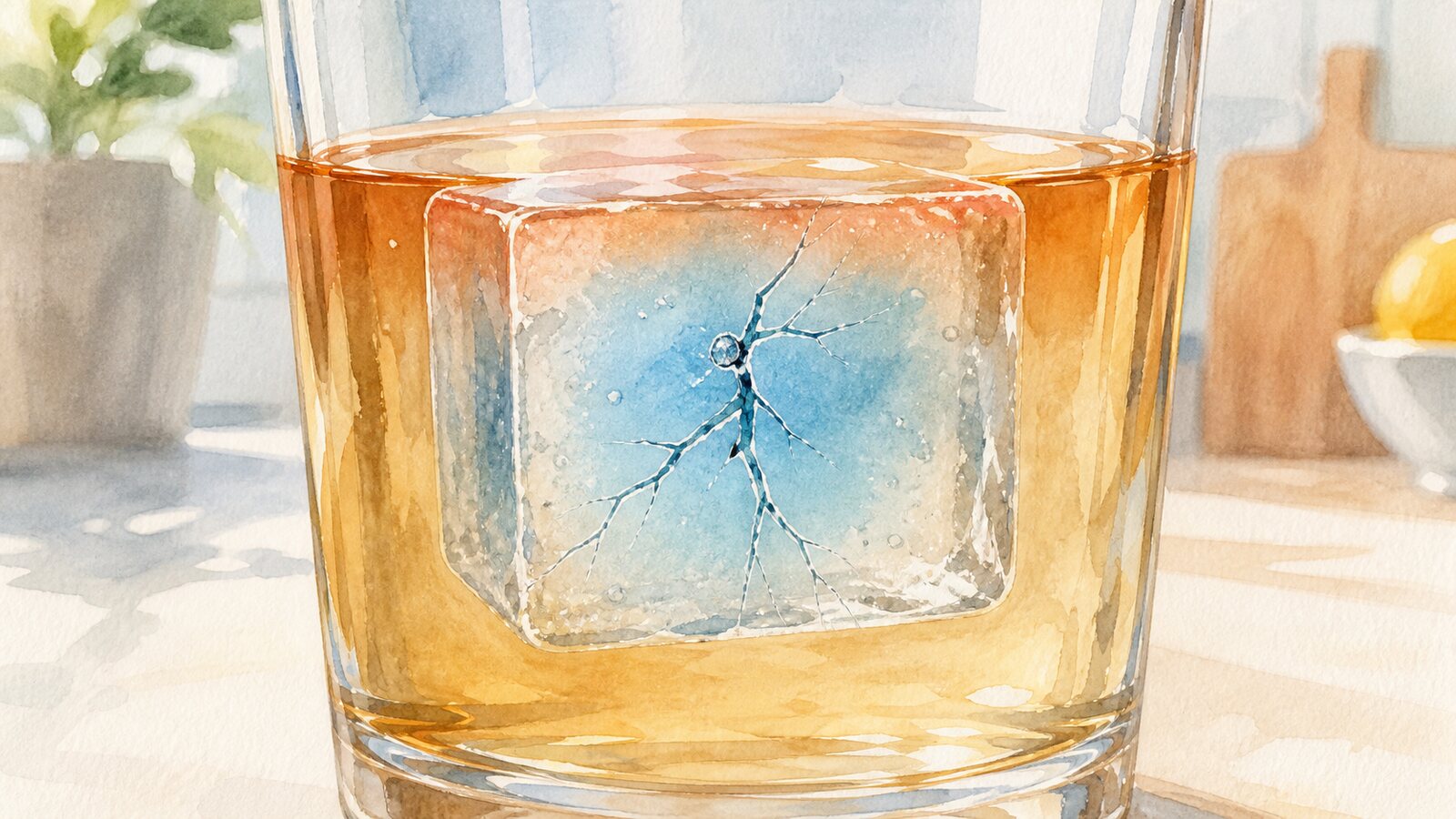
Look a little closer
A freezer-cold ice cube often cracks in a drink because its outside warms much faster than its center, creating thermal stress. The outer layer tries to expand as its temperature rises while the cold core remains close to its original size. Because those regions are bonded into one brittle solid, their incompatible deformation concentrates stress at a flaw until a crack races through the ice.
Kitchen ice begins well below its melting point. A domestic freezer is commonly set near −18°C, whereas even a chilled drink may be many degrees warmer and a room-temperature drink warmer still. Liquid transfers heat over the cube's exposed surface, but heat needs time to conduct into the interior. For the first moments after immersion, one apparently uniform cube therefore contains a steep temperature gradient: a rapidly warming shell around a colder core.
Solid ice expands slightly as it warms. This should not be confused with the famous expansion that occurs when liquid water freezes. No phase change is required for the initial stress; ordinary thermal expansion within the solid is enough. A detached warm layer could change size freely, but the shell is attached to cold material that has not yet undergone the same thermal strain. Each region constrains the other, producing a pattern of compression and tension inside the cube.
Ice can deform slowly under some loads, yet it behaves as a brittle material when stressed quickly. Real cubes are also far from flawless crystals. Air bubbles trapped during freezing, boundaries between differently oriented ice grains, dissolved impurities, and tiny cracks caused by uneven cooling all disturb the structure. Stress intensifies around these weak points, so two cubes from the same tray can behave differently: one melts quietly while the next splits with a sharp report.
Once a crack begins, elastic energy stored in the stressed ice helps create new fracture surfaces. Stress becomes especially concentrated at the narrow crack tip, allowing the line to accelerate and branch. The sudden movement vibrates the cube, liquid, and glass, producing the familiar click or pop. A loud crack does not necessarily mean that the cube has separated into pieces; a fracture can cross much of the interior while unbroken bridges still hold it together until melting blurs the boundary.
Controlled experiments support the thermal-shock explanation. L. W. Gold reported cracks produced by thermal shock in ice plates in Nature in 1961. Later experiments cooled macroscopic ice spheres and plates, then rapidly warmed part of a surface by contacting it with water. Cracking depended strongly on the initial temperature, the fraction of the surface warmed, and specimen geometry. Those dependencies are what a thermoelastic fracture model predicts, rather than what would be expected from the mechanical splash of water alone.
A warmer drink can create a larger temperature difference, but hotter does not translate into a simple guaranteed number of cracks. Rapid surface melting can round corners and remove material that would otherwise carry stress. Cube size, grain structure, transparency, bubbles, freezing rate, liquid motion, and prior knocks all change the outcome. The experimental threshold for one carefully prepared ice sphere should therefore not be treated as a universal cracking temperature for every cube in every glass.
The event is also different from frost wedging. In a rock crack, liquid water can freeze, expand, and push the walls apart over a much longer cycle. An ice cube placed in a drink is moving in the opposite thermodynamic direction: it is warming and eventually melting. Dropping the cube may add an impact that triggers an existing weakness, but a cube lowered gently into warmer liquid can still crack after a delay, showing that impact is not required.
The brief pop from a glass is thus evidence that heat has not reached the whole cube at once. Energy enters at the surface, unequal thermal expansion is restrained by the cold center, and the resulting stress finds the easiest route through a bubble, grain boundary, or microscopic crack. Letting ice warm closer to 0°C before immersion, or placing it in liquid close to freezing, reduces the sudden gradient and usually reduces the chance of fracture. One white line in a cube records both the pace of heat conduction and the brittleness of crystalline ice.
EDITORIAL RESPONSIBILITY
FactosBrain Editorial Desk
The FactosBrain Editorial Desk researched and reviewed this article under our editorial policy. We assess error reports under our corrections policy.