Look a little closer
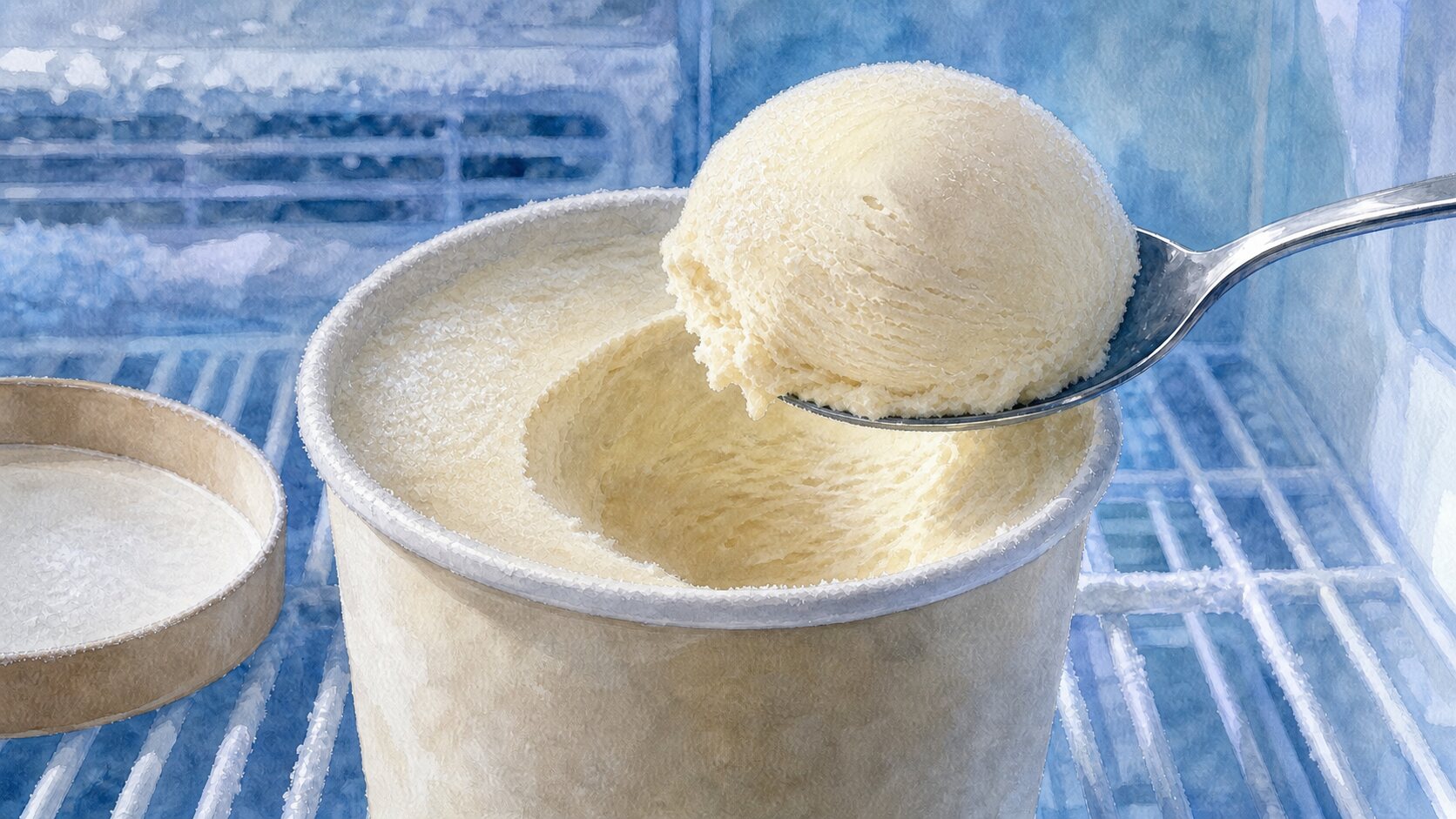
Ice cream becomes coarse in the freezer mainly because its original population of tiny ice crystals does not remain fixed. Small temperature rises melt part of that ice, and the mobile water later joins surviving crystals when the product cools again. Repeated recrystallization reduces the number of crystals while increasing their average size. Structures that were initially too small for the tongue to resolve eventually feel icy and grainy instead of creamy.
Ice cream is not simply frozen milk. It is a multiphase frozen foam containing ice crystals, air cells, partly clustered fat droplets, and a concentrated unfrozen solution of sugars, proteins, salts, and stabilizers. Sugar and other dissolved substances depress the freezing point, so not all water is solid even at domestic freezer temperatures. That liquid matrix is essential to scoopability and flavor release, but it also provides a route through which water can move when temperature changes.
During manufacturing, a cold scraped-surface freezer chills and agitates the mix, producing many crystal nuclei while incorporating air. For the same total amount of ice, a large population of small crystals feels smoother than a few large ones because individual particles are harder to detect. The semifrozen product is then hardened rapidly at a lower temperature to stabilize that microstructure. Slow initial freezing or delayed hardening gives existing crystals more time to grow and can create coarse texture before the container reaches a consumer.
When stored ice cream warms, smaller crystals and crystal edges partly melt, increasing the water in the unfrozen phase. During cooling, that water tends to join the surfaces of crystals that remain rather than nucleating an equally large population of new tiny ones. Highly curved small crystals are less stable and can disappear while larger ones grow, a process related to migratory recrystallization or Ostwald ripening. Neighboring crystals can also fuse. The pint does not have to become liquid: tomography experiments found that temperature oscillations of only about one kelvin could significantly accelerate coarsening.
Texture changes become obvious only after crystals grow into a range the mouth can distinguish. There is no universal sensory cutoff because recipes, measurements, and tasters differ, but ice crystals below roughly 50 to 60 micrometers are commonly associated with smoother ice cream. In a 52-week storage study, premium ice cream kept at −18°C developed larger crystals than samples held at −30°C or colder. Low, stable temperature thickens the unfrozen matrix and slows molecular movement, suppressing the rearrangement.
Ice is not the only structure that ages. At relatively warm or unstable freezer temperatures, air cells can merge and grow, while the fat-protein framework can weaken, changing density and melting behavior. A poorly sealed surface may also lose moisture and develop a pale dry layer or separate frost. This freezer-burn damage often accompanies internal coarsening, but the processes are not identical. Surface damage emphasizes sublimation, moisture loss, and redeposition; recrystallization describes a change in the size distribution of ice within the dessert.
Nor does every sandy sensation come from water ice. In dairy formulations with abundant lactose, freezing concentrates the remaining solution, and poorly soluble lactose can crystallize. Once those crystals grow large enough to detect, they produce a powdery or sandy defect somewhat different from the cold crunch of coarse ice. Manufacturers manage lactose content, sugar combinations, cooling, and viscosity; lactase can split lactose into the more soluble sugars glucose and galactose. Appearance alone may not reveal which type of crystal caused an old pint's roughness.
At home, the most useful protection is temperature stability. Keep the container toward the back of the freezer rather than in a frequently warming door, serve only what is needed, and return it promptly. A tight lid limits moisture exchange and surface damage. Instead of leaving a hard pint at room temperature for a long time, briefly temper it in the refrigerator or warm the scoop. Once large ice crystals have formed, merely making the freezer colder will slow further growth but will not divide them back into the original small population.
Creaminess therefore depends on more than fat content. It emerges from a controlled microstructure of ice, air, fat, and concentrated liquid. A freezer slows change; it does not stop water molecules and crystal boundaries from rearranging. That is why a pint can remain visibly frozen yet preserve a record of every trip home, open door, and softening cycle in its texture. The best defense is not just a low number on the thermostat, but keeping the original small crystals cold enough that water rarely gets the chance to migrate.
EDITORIAL RESPONSIBILITY
FactosBrain Editorial Desk
The FactosBrain Editorial Desk researched and reviewed this article under our editorial policy. We assess error reports under our corrections policy.